
Original briefings. Zero spin.
Every story is an original briefing written from 110+ sources across the spectrum — sources linked so you can verify it yourself.
 finance
Major Story (8/10)
Event date: August 27, 2026
finance
Major Story (8/10)
Event date: August 27, 2026
Washington's $27 Billion Stake in Private Companies Faces Lawsuits, Poll Backlash and Midterm Risk
A Quiet $27 Billion Shopping Spree
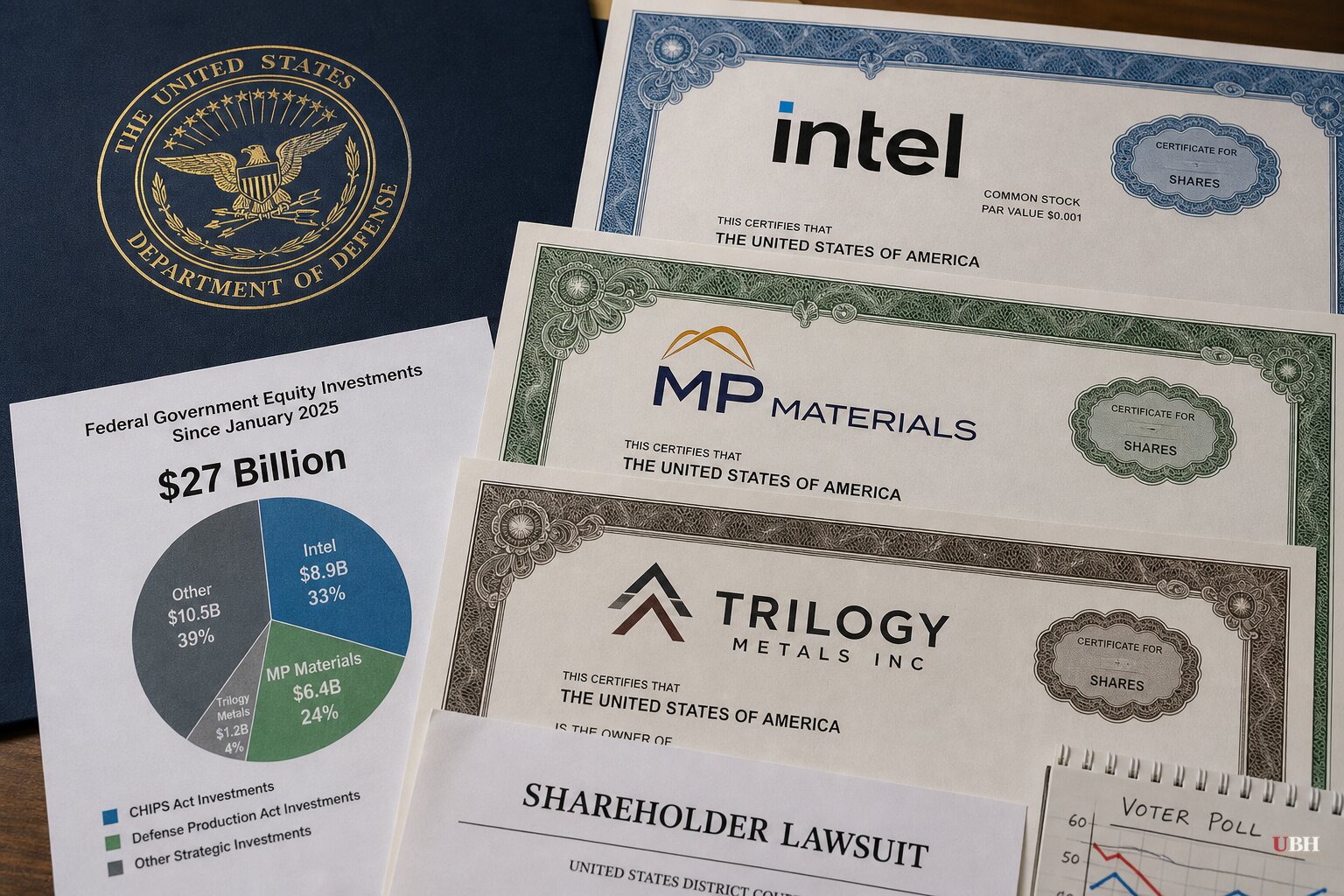
Since January 2025, the U.S. government has executed somewhere between 30 and 37 equity or quasi-equity deals, according to Crypto Briefing and Jefferies, whose tallies put the total value at roughly $27 billion and $27.6 billion respectively. The money flows through converted CHIPS Act grants, Defense Production Act authority, and restructured Energy Department loans.
The government now holds a 10% stake in Intel and a 15% stake in MP Materials, according to Crypto Briefing. Bloomberg reports Intel shares are up more than 300% in the year since reports first surfaced that Washington was negotiating a stake, MP Materials is up 87% since the Pentagon's $400 million equity investment last July, and Trilogy Metals is up 73% since an October deal that gave the U.S. a 10% stake alongside approval for an Alaska road project the company needed to reach its mining claims.
Jefferies breaks down who's actually doing these deals: the Commerce Department leads with 22 transactions under CHIPS Act authority, the Pentagon has taken on the most structurally complex deals in critical technology, the Development Finance Corporation is focused on overseas mineral platforms, Energy has restructured legacy loans with attached warrants, and Treasury holds a single governance-only 'golden share' in U.S. Steel. Semiconductors and critical minerals account for more than 80% of total deal value.
Not a Nationalization, According to the Fine Print
Outside the U.S. Steel golden share, these stakes are deliberately structured to be minority, non-controlling, and passive, according to Jefferies. Intel's terms explicitly bar the government from taking a board seat and require Washington to vote alongside the company's own board. That represents a meaningfully different structure than a state-owned enterprise. The administration's stated rationale—reducing foreign dependence in chips and rare earths deemed critical to national security—is the strongest case supporters make for the program.
Passive governance doesn't erase the underlying tension. A company negotiating a Pentagon contract while the Pentagon owns a chunk of its equity is navigating a conflict of interest with no clean fix, as Crypto Briefing puts it.
The Pushback Is Bipartisan
Rep. Pat Harrigan has warned of unintended consequences when the government takes equity in firms it also regulates and contracts with. Sen. Rick Scott has called government investment in private companies a measure of last resort, not a feature of industrial policy, according to Crypto Briefing. Both are Republicans criticizing a Republican administration's flagship industrial strategy.
Public opinion isn't warming to it either. A July 2026 CNBC poll found 49% of voters view government ownership stakes as inappropriate against just 19% who support them, Crypto Briefing reported. Among finance economists surveyed by Kent Clark, 67% said government equity stakes hurt corporate performance and 82% said they damage governance practices.
An Intel shareholder lawsuit is now testing whether the legal basis for the government's equity demands under CHIPS Act funding holds up in court. If plaintiffs win, Crypto Briefing notes, some of the administration's highest-profile deals could unwind.
Matt Gertken of BCA Research told Bloomberg the underlying legal framework simply hasn't been tested yet. "There is a sort of interventionist approach that is not fully litigated and mediated in the American system yet," he said. "So there's going to be ups and downs in that process." Bloomberg's reporting, republished by Moneycontrol, states plainly that a Democratic takeover of even one chamber in November's midterms raises the odds these positions face real legislative and judicial scrutiny, which could reverse much of the momentum driving the rally in these stocks.
Washington's Other Market Moves
The equity stakes aren't the only place the government is leaning on markets. Treasury Secretary Scott Bessent told CNBC on Aug. 20 that the Treasury's debt buyback program, already sized at $4 billion, could grow larger still, citing "very poor" liquidity conditions in 30-year bonds. The 30-year yield hit 5.31% that week, its highest since June 2007, while the 10-year climbed to a 14-month high of 4.77%, according to the Epoch Times.
Lawrence Gillum of LPL Financial called the move a "necessary normalization, not a crisis," noting similar repricing is happening in Japanese, German, French and British bonds. UBS strategists were more skeptical, writing the buybacks "discourage aggressive curve-steepening trades" but don't fix the deficits and price-sensitive investor shifts driving yields higher. Breitbart, meanwhile, pushed back on Wall Street Journal framing that cast Bessent and Fed Chairman Kevin Warsh as rivals, arguing debt management and monetary policy are simply different jobs and the two aren't actually at odds.
And States Are Seizing Stock From Individuals
A separate trend is squeezing ordinary shareholders rather than corporations. Fox News reports that more than half of U.S. states have shortened the window before a stock is declared abandoned from the historical seven years down to three, and shifted the legal standard from "lost" to merely "inactive," according to transfer agent Computershare, which calls the trend "unfortunate."
German citizen Jan Peters owned 1,029 pre-split Amazon shares while living in Munich. California treated his address as "Munich, CA 00000," declared the stock abandoned, and sold it for about $1.6 million. Peters has petitioned the Supreme Court, arguing the state seized and liquidated his property without proving he'd actually disappeared.
Whether the Supreme Court takes up Peters' case, whether the Intel shareholder lawsuit survives, and what happens to Washington's equity portfolio if Democrats flip a chamber in November are three separate open questions with three separate timelines, but all three test the same basic issue: how much authority government at any level should have over equity that isn't its own.
Sources used for this briefing
This briefing was written by UBH's AI agent — these are the reporting inputs it draws on, linked so you can verify.


