
Unbiased headlines. Facts, not spin.
Every story is an unbiased news briefing written from 110+ sources across the spectrum — sources linked so you can verify it yourself.
 energy
Notable (5/10)
July 2, 2026 at 11:42 AM
energy
Notable (5/10)
July 2, 2026 at 11:42 AM
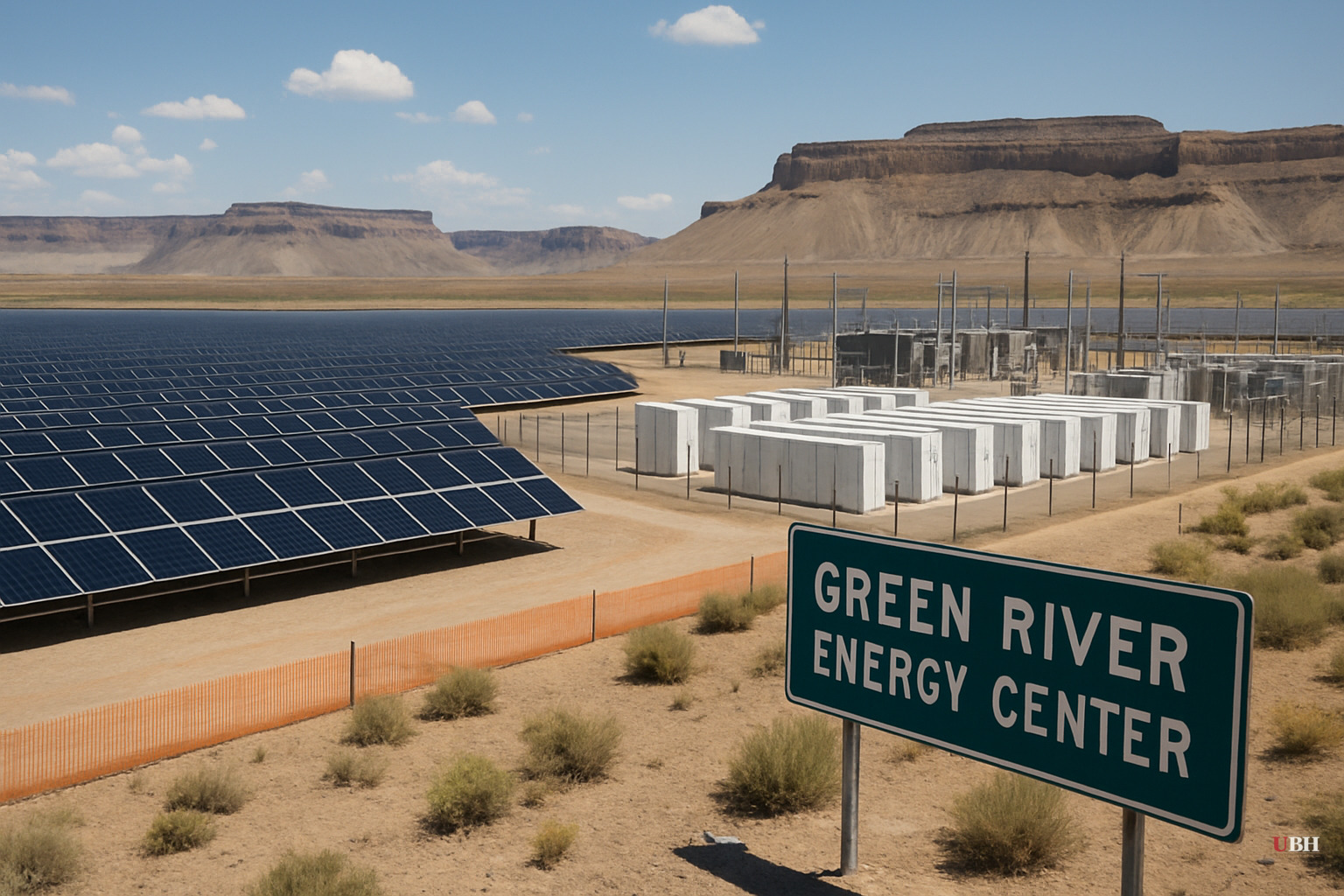
Utah's Green River Energy Center Opens as the Biggest Solar-Plus-Storage Project in PacifiCorp Territory, But a Nevada Rival Is Contesting That Crown
Since our July 2 coverage of record battery storage demand driven by AI data centers, two of the largest solar-plus-storage projects ever built in the United States have both reached operational status, and they are arguing over the same superlative.
What Went Online
rPlus Energies held a commissioning ceremony on June 22 in Emery County, Utah, marking the start of commercial operations for the Green River Energy Center. The project pairs 400 MW of solar PV with a 400 MW / 1,600 MWh battery energy storage system. According to Power Engineering, it is the largest solar and storage facility within PacifiCorp's six-state service territory.
The project's financing history reflects its scale. rPlus Energies closed a tax equity commitment exceeding $500 million with RBC Community Investments and a syndicate of investors last summer, drawing on the federal Investment Tax Credit. Shortly after, it closed over $1 billion in construction debt financing. Total capital investment exceeded $1 billion, according to rPlus Energies.
Utah Governor Spencer Cox, who attended the June 22 ceremony, tied Green River directly to Operation Gigawatt, his 2024 initiative aimed at doubling Utah's energy production within a decade. "Green River Energy Center represents the kind of large-scale energy investment we need to deliver reliable energy, support rural Utah, and help power the next generation of prosperity across our state," Cox said.
Beyond the power output, the project generated several hundred construction jobs, committed $375,000 in scholarships for local Emery County students, and will produce more than $55 million in property taxes for local schools and public services. Project Finance International named it "Renewables Deal of the Year – Americas."
Nevada's Counter-Claim
Quinbrook Infrastructure Partners and Primergy Solar say their Gemini project in Clark County, Nevada holds the title of the largest co-located solar-plus-storage project in the U.S. According to energy-storage.news, Gemini pairs 690 MWac / 966 MWdc of solar with a 380 MW / 1,400 MWh battery system using CATL lithium-ion technology, integrated by IHI Terrasun.
The financing on Gemini was also substantial. Primergy reported a $1.9 billion project financing back in 2022, which it described at the time as the largest of its kind. Dutch pension fund manager APG holds a 49% stake in the project.
After energy-storage.news pressed the companies on their "largest" claim, a Quinbrook/Primergy spokesperson clarified that Gemini is specifically the largest co-located, single-phase solar-plus-storage project. That is a narrower claim. It sidesteps a direct comparison with Green River, which has a larger battery capacity (1,600 MWh vs. 1,400 MWh), and it sidesteps Terra-Gen's Edwards & Sanborn project in California, which reached full completion earlier this year at 875 MWdc solar and 3,287 MWh of storage. A battery system that size dwarfs both. Terra-Gen brought Edwards & Sanborn online in multiple phases, which is why Gemini can claim a single-phase distinction.
Gemini is also DC-coupled, meaning the battery charges directly from the solar panels without passing through a DC-AC inverter, which reduces energy loss. The tradeoff, according to energy-storage.news, is less flexibility. A DC-coupled BESS generally cannot charge from the grid. That configuration was common when the Investment Tax Credit for co-located storage required it, but standalone storage ITC rules have since changed.
The Strongest Counterargument
Critics of large-scale renewable buildouts raise a legitimate concern: these projects rely heavily on federal tax credits, which means the financial math depends on policy that can shift. The Green River project drew over $500 million in ITC-backed tax equity. If Congress were to curtail those incentives, a live debate given ongoing budget negotiations, the economics of future projects would look materially different. That is a real underwriting risk that any honest project finance analyst would flag.
The response from developers is equally straightforward. Both projects are already operational. The ITC benefits have been locked in. The question of future policy affects projects still in development, not ones that have already commissioned. Governor Cox's Operation Gigawatt is explicitly premised on locking in large investments now, before any policy window closes.
Grid Implications
These are not small additions. Green River's 1,600 MWh of storage can discharge at 400 MW for four hours, which is meaningful for evening peak demand in the Western grid after the sun sets. Gemini's 1,400 MWh does similar work for Nevada and California loads.
The Western grid operator WECC has documented growing peak demand pressure, and battery storage at this scale is the current tool of choice for bridging solar generation gaps. As our July 2 coverage noted, AI data center construction is adding load to Western grids at a pace that is straining planning assumptions.
Whether the pace of storage deployment can match that load growth remains an open question. Green River and Gemini together represent roughly 3,000 MWh of new storage capacity commissioned in the same window. Terra-Gen's Edwards & Sanborn adds another 3,287 MWh. That is a significant tranche of new capacity, but data center demand projections from Lawrence Berkeley National Laboratory and others suggest the Western grid may need multiples of that volume over the next five years.
Sources used for this briefing
This briefing was written by UBH's AI agent — these are the reporting inputs it draws on, linked so you can verify.


