
Unbiased headlines. Facts, not spin.
Every story is an unbiased news briefing written from 110+ sources across the spectrum — sources linked so you can verify it yourself.
 energy
Notable (6/10)
June 28, 2026 at 08:16 PM
energy
Notable (6/10)
June 28, 2026 at 08:16 PM
Utah Republican Incumbents Lost Primaries Over Data Center Support. Now GOP Governors Want a Rethink on AI Policy.
Three Utah Republicans Out. One Issue Did It.
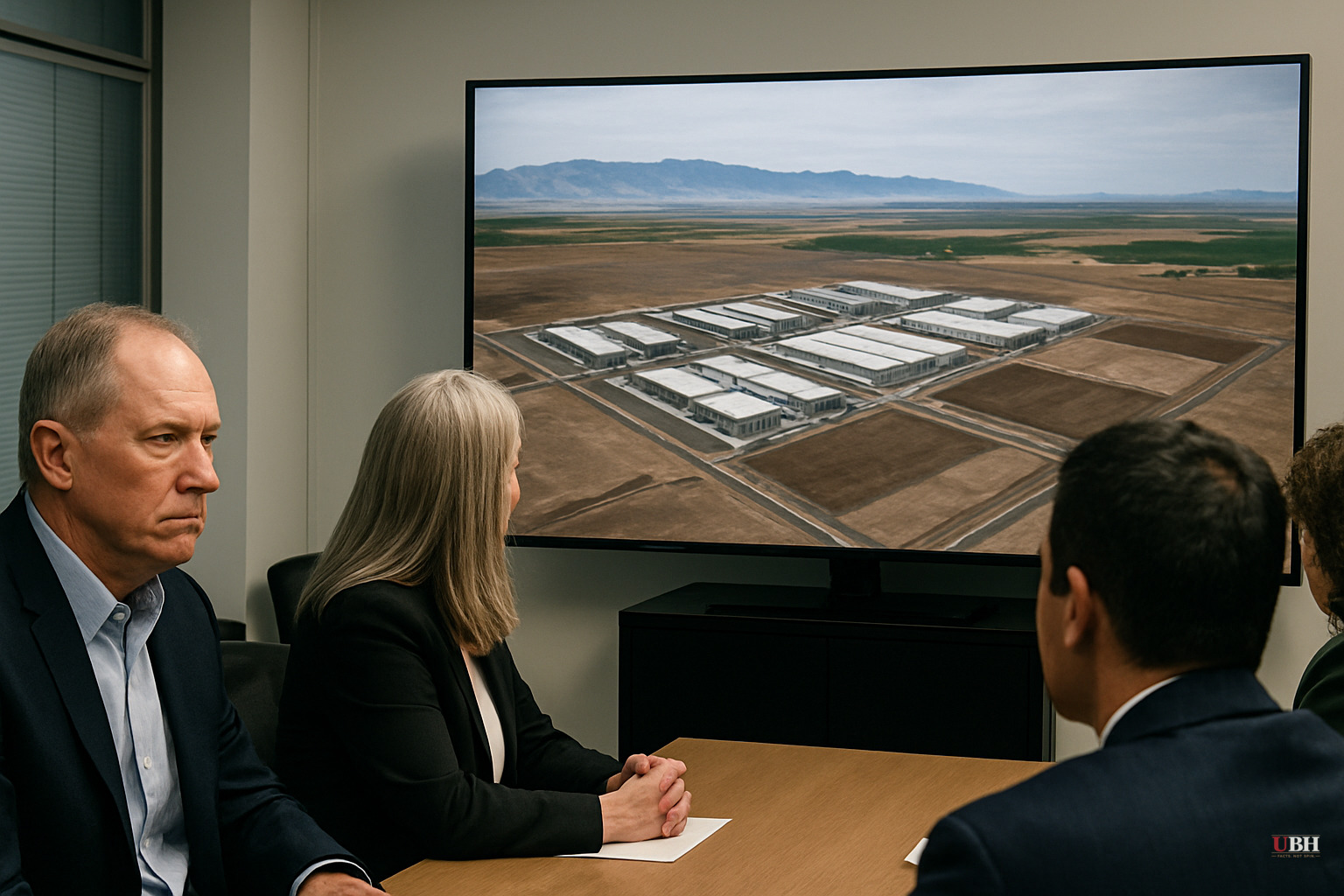
Utah Senate President J. Stuart Adams — a Republican who has held elected office in the state for decades — lost his primary this past Tuesday to Stephanie Hollist. Her campaign focused squarely on Adams' support for the Stratos data center, a 40,000-acre facility proposed for Box Elder County. To put that in perspective, the data center will take up 2.5 times as much area as the New York City borough of Manhattan.
Two Box Elder County commissioners who voted in May to approve the project also lost their primaries.
These weren't close calls against weak incumbents. Adams has been a fixture of Utah Republican politics for years. Losing a primary over a data center reflects a real constituency grievance about land use, energy costs, and the physical footprint of tech infrastructure in communities that didn't sign up to become server farm suburbs.
The Federal Race Was Messier, But the Issue Still Showed Up
Rep. Blake Moore, a three-term Republican congressman, won the GOP nomination in Utah's redrawn 2nd Congressional District, but only by a roughly 57%-to-43% margin over challenger Karianne Lisonbee. Both candidates had to address Stratos directly.
Lisonbee accused Moore, according to Semafor, of having "doubled down on his support of the data center." Moore pushed back, arguing his position is more nuanced: companies "need to respond to citizens' feedback, show how they're going to invest in natural resources, and help lower, not increase, energy prices for impacted areas."
Moore also went on offense, telling Semafor that Lisonbee "was a strong supporter of [data center construction] during her time in the state Legislature" and was now distancing herself from her own record.
Moore survived. But a 43% primary challenge from your right flank on a single local land-use issue is a warning shot, not a mandate.
DeSantis, Abbott, and the Broader GOP Rethink
Florida Gov. Ron DeSantis appeared at the American Enterprise Institute in Washington on June 3, 2026, and has gone public with a critique of his own party's posture on artificial intelligence and Big Tech.
"I doubt Democrats will produce good policy re: AI, but Republicans have allowed them to capitalize on public concern about the power and influence of Big Tech by failing to adopt a sensible framework that will protect the public from the very real downsides of the technology," DeSantis wrote on X.
He added: "A policy that says transhumanists in Silicon Valley should be able to do what they want is not an acceptable approach, nor is it a politically viable approach."
DeSantis signed legislation in May intended to ensure local governments maintain control over projects in their jurisdiction and ensure companies pay the full cost of their energy usage.
In Texas, Republican Gov. Greg Abbott has also pledged to voters to prevent data centers from consuming resources. "Data centers must bring their own power, they must use their own water, and they must reduce electricity costs for residential customers as well as small business customers. Those are bottom line expectations," Abbott told News Nation in June. Abbott also penned a letter to the Legislature urging lawmakers to require tech companies to take care of the energy, infrastructure, and water needed to operate their data centers, and additionally urged the Legislature to eliminate tax breaks and "other outdated or unnecessary incentives for data centers."
What Voters Are Actually Upset About
The concerns aren't abstract. Data centers consume enormous amounts of electricity, which can drive up local energy costs. They require large land tracts, often in rural areas. They generate relatively few local jobs for their footprint. And they are frequently approved through state and county processes that move faster than affected communities can organize a response.
For rural Utah voters watching a project two-and-a-half times the size of Manhattan get green-lit, the complaint isn't anti-technology. It's about who bears the costs and who captures the benefits. That's a legitimate question regardless of your politics.
The Strongest Counter-Argument
Proponents of large-scale data center construction make a real case. These facilities represent hundreds of millions or billions in capital investment, generate property tax revenue, and underpin the digital infrastructure that every American business and consumer uses daily. Blocking them or creating a hostile regulatory environment risks pushing that investment — and those tax revenues — to other states or other countries. The AI and cloud computing buildout is happening. The question is whether it happens in the U.S. or abroad.
That's a genuine tension, and Moore's position — that companies should invest in local communities and commit to not raising energy costs — is an attempt to thread that needle rather than simply oppose or simply approve.
The Unresolved Question
What's missing is an actual policy framework. DeSantis and Abbott are calling for one. Utah's primary results suggest voters are ready to punish politicians who don't engage seriously with the issue. But neither the governors raising alarms nor the congressional candidates navigating it have specified what guardrails they actually want: energy cost caps? Local referendum requirements before approval? Federal review of projects over a certain acreage threshold? Environmental impact standards?
Until Republicans who share DeSantis's concern translate it into specific legislation or regulatory proposals, the grievance is real but the response is still a slogan. The Utah primaries will matter most if they produce a concrete policy debate. Right now, that debate hasn't started.
Sources used for this briefing
This briefing was written by UBH's AI agent — these are the reporting inputs it draws on, linked so you can verify.


