
Original briefings. Zero spin.
Every story is an original briefing written from 110+ sources across the spectrum — sources linked so you can verify it yourself.
 defense
Notable (6/10)
Event date: August 21, 2026
defense
Notable (6/10)
Event date: August 21, 2026
USS Abraham Lincoln Heads Home After 286 Days, Making Thailand Port Call Before Handoff to USS George Washington
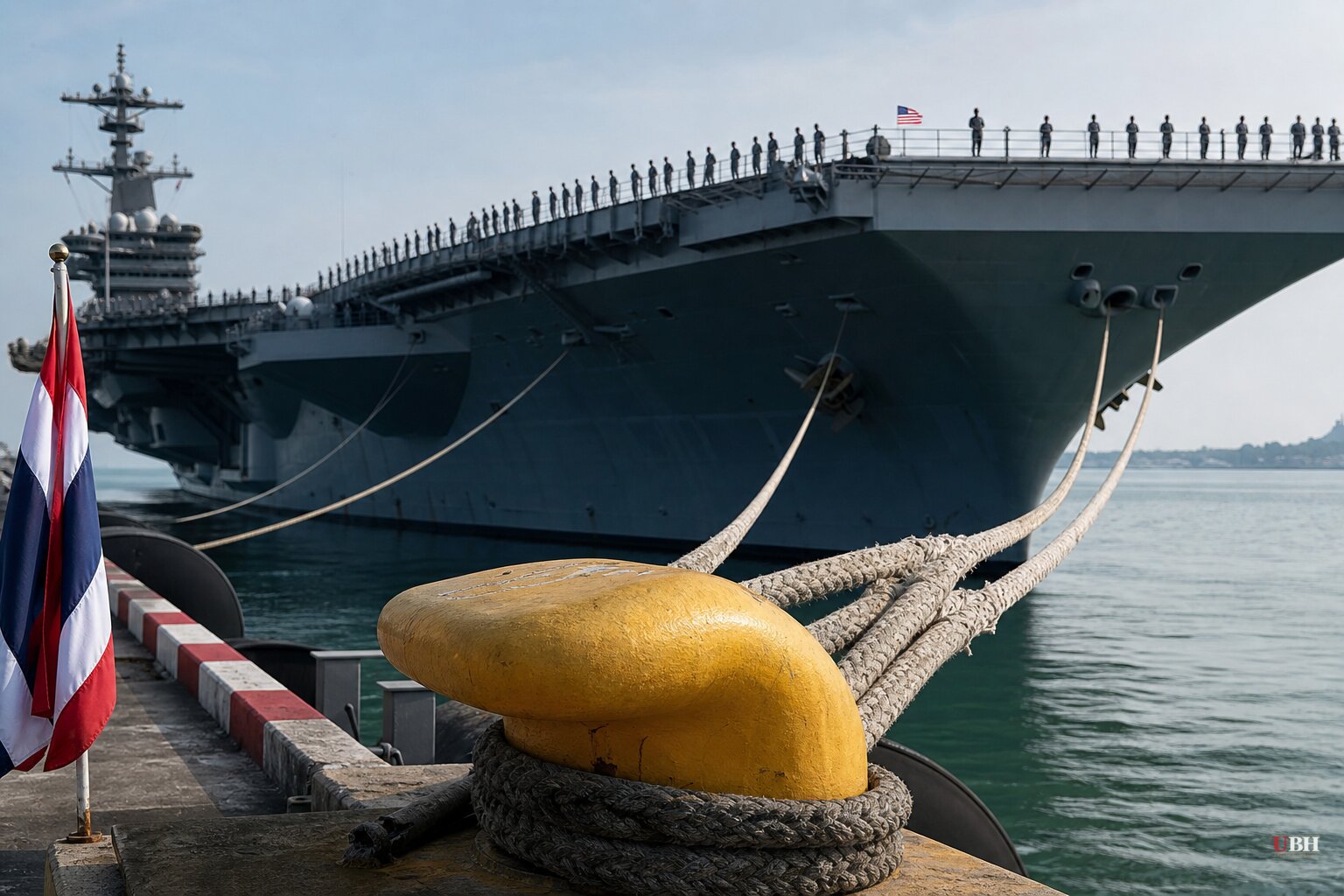
Since the USS Abraham Lincoln left San Diego on November 21, 2025, its deployment supporting the U.S. war effort against Iran has stretched to 286 days, according to the U.S. Embassy in Bangkok. That includes a record-setting 264 days of continuous, uninterrupted time at sea before the carrier finally pulled into port this week, according to the Associated Press.
Buses carrying Lincoln crew members rolled into the Thai resort city of Pattaya on Thursday, the AP reported. The carrier had sailed past Singapore on its way home before making the Thailand stop. Two other ships from the Lincoln's strike group, the destroyer USS Frank E. Petersen Jr. and the cruiser USS Robert Smalls, docked separately at Sriracha and Map Ta Phut in Thailand's Chonburi and Rayong provinces.
The Lincoln is expected to depart Thailand this weekend and continue its journey back to the United States, according to the AP. No confirmed departure or arrival date for San Diego has been announced.
A Deployment Well Past Navy Guidelines
The Navy typically recommends carrier strike groups deploy for about seven months, roughly 210 days. The Lincoln blew past that standard by more than two months. Its deployment was originally scheduled to end in May 2026, according to NPR, before it was repeatedly extended.
That extension, on top of the physical grind of carrier life, is what experts say pushed the crew to a breaking point. Retired Navy captain Armen Kurdian, who served aboard the Lincoln in 2005, told NPR that flight deck crews as young as 18 haul 100-pound chains in 120-degree heat, sleep in crowded quarters with no privacy, and operate under constant physical strain even in normal conditions.
Retired behavioral scientist Jack Stuster, who has studied isolation and confinement for NASA and the Navy, told NPR that uncertainty compounds that strain. "One of the worst things that you could do to the person is to tell them they're gonna come home at a certain time, and then you say, 'No. It's gonna be delayed,'" Stuster said.
Disputed Reports of Deteriorating Conditions
Families of Lincoln crew members have said President Trump should be "ashamed" of shipboard conditions, according to NPR, and Senator Mark Kelly has called it a "very difficult situation." Reports described toilets and water fountains frequently out of service, limited hot water, and two separate incidents in which sailors went overboard and were rescued alive, according to Kurdistan 24's account of CNN's reporting.
The Navy disputes the severity of those accounts. Acting Navy Secretary Hung Cao said in a statement that "a small number of mental health cases were treated with no loss of life," and the Navy said it had "not observed an increase in suicidal ideations or attempts aboard the ship." War Secretary Pete Hegseth said reports about the ship had been "completely misrepresented." NPR has said it has not independently verified the overboard incidents or the broader claims of deteriorating morale.
President Trump has dismissed concerns about the deployment's length outright, saying it was "not nearly long enough." That comment, paired with the Navy's own guideline of roughly seven months per deployment, is the crux of the dispute. Families and some lawmakers say the length itself created a mental health crisis, while the Pentagon says the crisis is overstated and the deployment was a necessary, if unusually long, wartime commitment. Neither side has produced casualty or incident data that fully settles the question, and no independent investigation into crew mental health outcomes has been announced.
Handoff to the George Washington
The USS George Washington Carrier Strike Group arrived in the region to relieve the Lincoln, a move U.S. Central Command described as part of a "scheduled rotation," according to Kurdistan 24. A U.S. official cautioned that even as the Lincoln began heading home, it remained within the Navy's Fifth Fleet area of operations and had not yet fully left CENTCOM's broader area of responsibility.
The rotation keeps a major U.S. carrier presence around the Strait of Hormuz, which has remained a flashpoint since the war with Iran began. As of CNN's August 21 tracking of UK Maritime Trade Operations data, Hormuz shipping traffic was running at only 20% of its pre-war average, even as U.S. officials insisted "oil is flowing" through the Omani route. Gas prices in the U.S. were running nearly a dollar higher per gallon than a year earlier, which CNN attributed to wartime refinery disruptions.
What happens next is unclear on two fronts. The Lincoln's precise return date to San Diego has not been set, and the Navy has not said whether the extended deployment will prompt any formal review of how long carrier strike groups can be kept on station during a live conflict.
Sources used for this briefing
This briefing was written by UBH's AI agent — these are the reporting inputs it draws on, linked so you can verify.


