
Original briefings. Zero spin.
Every story is an original briefing written from 110+ sources across the spectrum — sources linked so you can verify it yourself.
 defense
Notable (6/10)
September 6, 2026 at 01:58 PM
defense
Notable (6/10)
September 6, 2026 at 01:58 PM
USGS Raises Bay Area Earthquake Odds to 74.1% Through 2055, First Update Since 2014
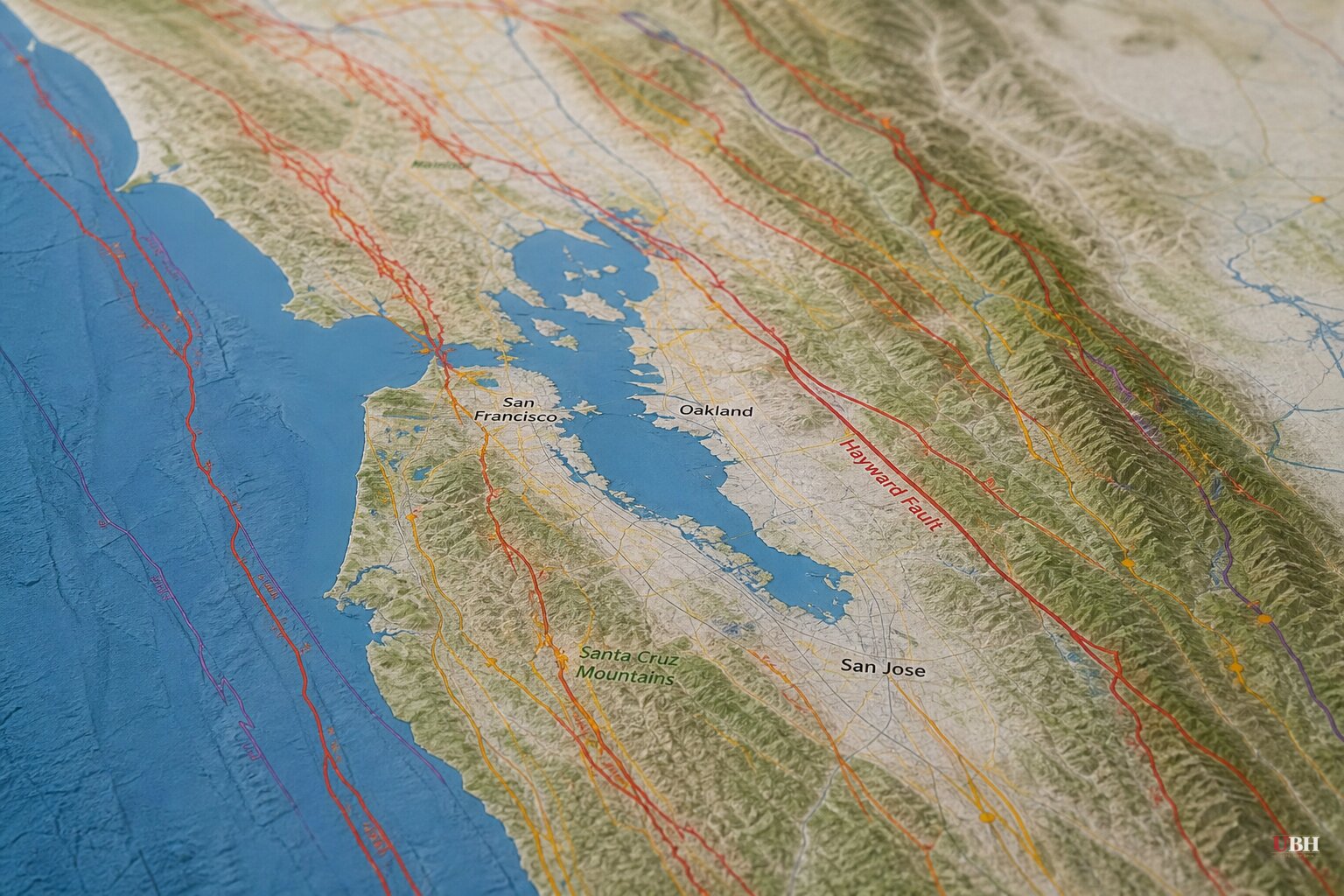
The U.S. Geological Survey has updated its 30-year earthquake forecast for the San Francisco Bay Area for the first time since 2014, and the odds went up, not down.
The new figure: a 74.1% chance of at least one magnitude 6.7 or stronger earthquake hitting the region by 2055, according to USGS data reported by the San Francisco Chronicle and confirmed by NBC Bay Area, the Daily Mail, and AOL. That's up from 72% in the previous assessment.
USGS research geophysicist Kevin Milner, who co-authored both the 2014 and 2026 studies, told NBC Bay Area the increase isn't a surprise. "It's reinforcing what we already know," Milner said. "That we have to be prepared for a major earthquake. It is going to happen in most of our lifetimes." Milner said the model, known as the third Uniform California Earthquake Rupture Forecast, was rerun with its starting point advanced to 2026, letting it account for the additional years faults have gone without rupturing.
Which faults, and by how much
The Hayward-Rodgers Creek fault system, running roughly from San Jose to San Pablo Bay, holds the highest individual probability among Bay Area faults at 34.3%, up from 33.1% in 2014, according to the Daily Mail and NBC Bay Area.
The biggest jump belongs to the San Andreas Fault, which climbed 3.6 percentage points, from 21.9% to 25.5%. USGS seismologist Dr. Lucy Jones told ABC7 San Francisco the San Andreas is capable of producing some of the state's largest earthquakes, but she cautioned against reading too much into timing. "It could go another hundred years, it could be tomorrow. It could be, you know, next minute," Jones said.
The Calaveras Fault rose to 26.8% from 25.6%.
USGS seismologist Ned Field, quoted by the San Francisco Chronicle, put it bluntly: "Things seem to be pretty locked and loaded. We'd be wise to be ready."
A small quake, and a long silence
The forecast update landed within days of a magnitude 3.5 earthquake that shook the Santa Rosa area on Thursday, September 3, centered near the Rodgers Creek Fault, according to Tech Times. Sonoma County officials confirmed no damage or injuries. Santa Rosa High School was briefly evacuated as a precaution and reopened within hours.
Paleoseismic research by Hecker et al., published in the Bulletin of the Seismological Society of America in 2005, dated the fault's most recent major rupture to between A.D. 1715 and 1776. Its preferred average recurrence interval is roughly 230 years. That means, as of 2026, somewhere between 250 and 311 years have passed since the last big one, which is longer than the fault's own historical average between ruptures.
A separate warning out of Southern California
A distinct academic study, reported by NTD, found that two Southern California fault systems near Cajon Pass have accumulated some of their highest modeled stress in 1,000 years, based on reconstructed earthquake records using displaced sediment and tree-ring data. Researcher Burkhard, quoted by NTD, stressed the finding is not a prediction: "This is not a prediction of when an earthquake will happen. What we can say is that the system is critically stressed." A rupture crossing Cajon Pass could affect Los Angeles, San Bernardino, Riverside, and the Coachella Valley, according to the university's own description of the study. This is a separate research effort from the USGS Bay Area forecast, not an update to it, and the two studies should not be read as confirming each other.
One factual mix-up worth flagging
The Daily Mail's writeup states "the last major earthquake to hit the Bay Area was in 1994, when a 6.7 earthquake centered in Northridge struck." That's a geographic error. The Northridge earthquake struck the San Fernando Valley in Los Angeles, not the Bay Area. NBC Bay Area and AOL both correctly reference the Bay Area's own last major event, the magnitude 6.9 Loma Prieta earthquake of 1989, which killed 63 people and caused roughly $6 billion in damage. The USGS has said a joint rupture of the Hayward and Rodgers Creek faults could release more than five times the energy of Loma Prieta, according to a 2017 USGS report cited by AOL.
Is anyone actually ready?
California's Office of Emergency Services told the Daily Signal the state has invested more than $125 million in earthquake early warning systems, along with seismic retrofit grants and expanded search-and-rescue staffing. "California is ready to respond when a major earthquake strikes," an OES spokesperson said.
Caltech seismologist Allen Husker offered a more measured view. "Definitely it's more prepared than it has been, and it's slowly getting more and more prepared over time," Husker told the Daily Signal, but he added that "earthquakes, depending upon how they occur and where they occur, will still probably cause significant damage."
Edward Ring of the California Policy Center pointed to aging water infrastructure as a specific vulnerability. More than 30% of Los Angeles's roughly 6,800 miles of distribution mainlines are over 80 years old, according to the city's 2025-26 Water Infrastructure Plan cited by the Daily Signal. Ruptured mains during a major quake can both flood streets and starve firefighters of water needed to stop quake-sparked fires, the same reason the 1906 San Francisco earthquake caused such extensive fire damage.
Victor Zayas, president of Earthquake Protection Systems, told NBC Bay Area that new critical buildings need higher standards than current code requires. "If we build any buildings, especially any new hospitals, we should be building them to not be damaged by earthquakes, not just not collapse," Zayas said.
The USGS numbers establish that the odds keep climbing the longer these faults stay quiet, and the agency's own scientists say the region should plan accordingly rather than wait for a warning that may never come.
Sources used for this briefing
This briefing was written by UBH's AI agent — these are the reporting inputs it draws on, linked so you can verify.


