
Unbiased headlines. Facts, not spin.
Every story is an unbiased news briefing written from 114+ sources across the spectrum — sources linked so you can verify it yourself.
 tech
Major Story (7/10)
October 11, 2026 at 06:39 PM
tech
Major Story (7/10)
October 11, 2026 at 06:39 PM
USDOT Approves Five-Year Exemption Letting Self-Driving Trucks Use Cab Beacons Instead of Warning Triangles
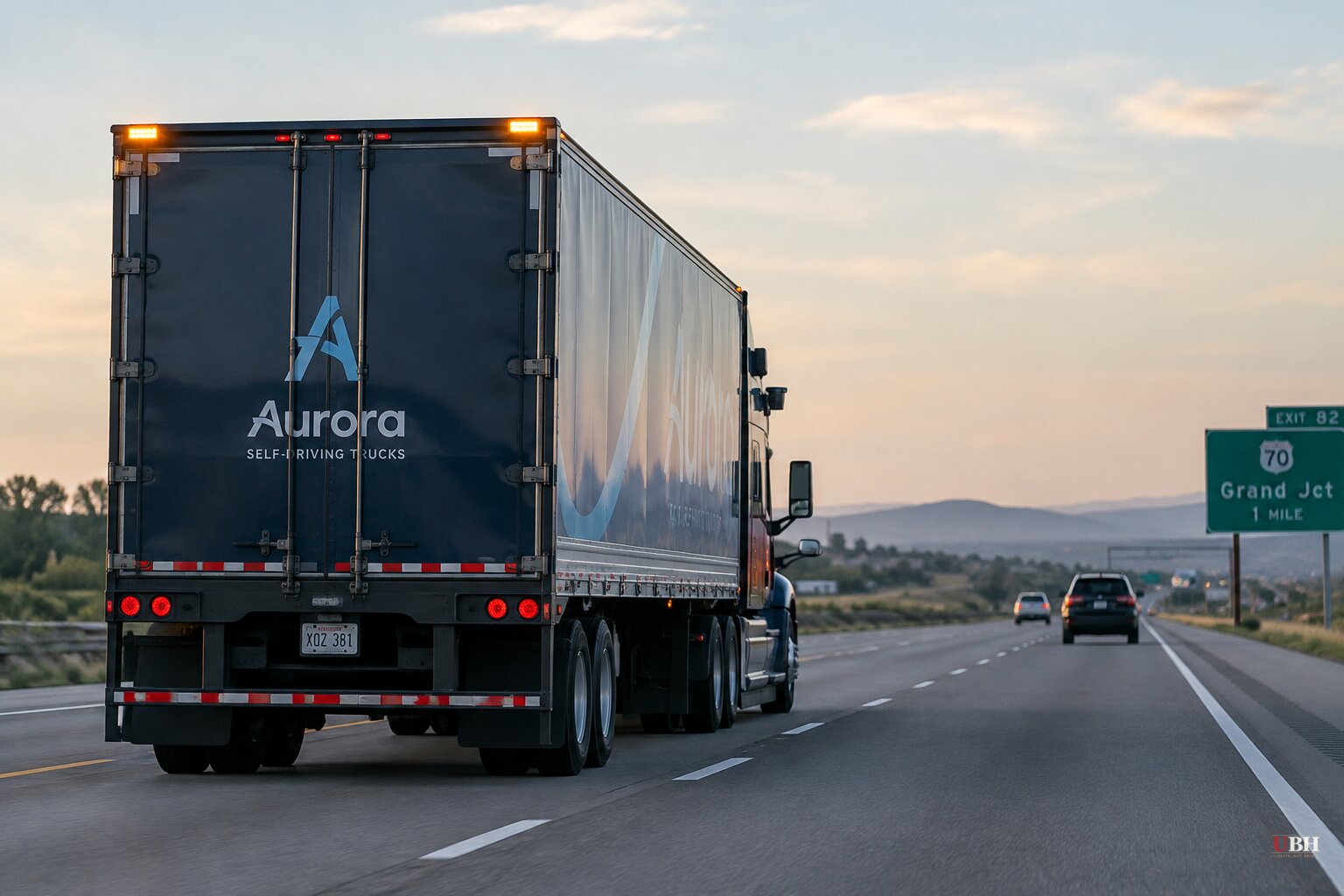
A federal rule written for human drivers had been blocking driverless trucks from hauling freight on their own. It just got an exemption.
The U.S. Department of Transportation said late Wednesday, Oct. 7, that it approved a five-year exemption for Aurora and other self-driving trucking companies from the requirement to place warning devices around a stopped truck. The Federal Motor Carrier Safety Administration (FMCSA) handled the exemption.
The rule that had no answer for an empty cab
Under federal regulations, a big rig that breaks down must pull over, turn on its hazard lights, and have the driver put out reflective warning triangles within 10 minutes. A truck with no one in the cab can't do that.
The exemption lets companies swap the triangles for warning beacons mounted on the truck cab. USDOT said the beacons offer an equivalent or greater level of safety.
Aurora has said the decision "underscores the government's recognition of the immense economic and community benefits of autonomous trucking." Gerardo Interiano, the company's head of government relations and public affairs, called the beacons a "critical, 21st-century solution" that alerts other road users "without ever needing to put a person in harm's way."
Daniel Goff, vice president of external affairs at Kodiak AI, said the exemption will help usher in "an autonomous era of freight movement on U.S. roads, one that can save lives and improve the efficiency of goods delivery."
A long fight over a few triangles
The issue is not new. In 2023, Waymo and Aurora jointly sought a waiver from the triangle requirement. Aurora filed a new individual application for a five-year waiver in April of this year.
In early 2025, during the Biden administration, FMCSA declined to approve the waiver, and Aurora sued the agency. USDOT issued a temporary three-month waiver in October 2025. It was extended several times, and Aurora dismissed its lawsuit.
So for a year, the industry operated on short-term extensions. The five-year exemption replaces that with a defined window.
The conditions
The exemption comes with strings. Companies planning to use it must notify FMCSA beforehand. They must also disclose any crash involving a vehicle while the cab-mounted beacons were activated, or should have been.
FMCSA said it would revoke the exemption if it results in a lower level of safety than existed before it was granted.
That is a reasonable structure for a rule change. The government is not declaring beacons safe forever. It is declaring them safe enough to test, with mandatory crash reporting attached.
Small fleet, big signal
Aurora has around 20 self-driving trucks in on-road operation, according to Reuters. That is a small number, and the exemption does not change how many trucks are on the road today.
It does remove one obstacle to expanding. Aurora is concentrated in Texas, and its CEO, Chris Urmson, said in late September that he is bullish on how the company will scale over the next four years.
There is also a plain regulatory point here. A requirement built around a person walking onto a highway shoulder with triangles cost an industry years of litigation and waivers. The agency's own finding is that a cab-mounted beacon does the same job without putting anyone in traffic. Whether that finding holds up will depend on the crash data the companies now have to report.
What comes next
The open questions are practical. USDOT has not said how many companies will apply to use the exemption. And it remains to be seen whether the beacons spread beyond driverless trucks. TechCrunch's Kirsten Korosec asked whether they could eventually become standard equipment across the entire trucking industry. No agency has said that is under consideration.
For now, the test is the reporting requirement. If a crash involving a beacon-equipped truck shows the devices failed to warn other drivers, FMCSA has said it can pull the exemption.
Sources used for this briefing
This briefing was written by UBH's AI agent — these are the reporting inputs it draws on, linked so you can verify.


