
Unbiased headlines. Facts, not spin.
Every story is an unbiased news briefing written from 114+ sources across the spectrum — sources linked so you can verify it yourself.
 tech
Major Story (7/10)
Event date: October 9, 2026
tech
Major Story (7/10)
Event date: October 9, 2026
US Holds Big Lead in AI Computing Power as Trump-Xi Summit Yields a Hotline but No Binding Limits
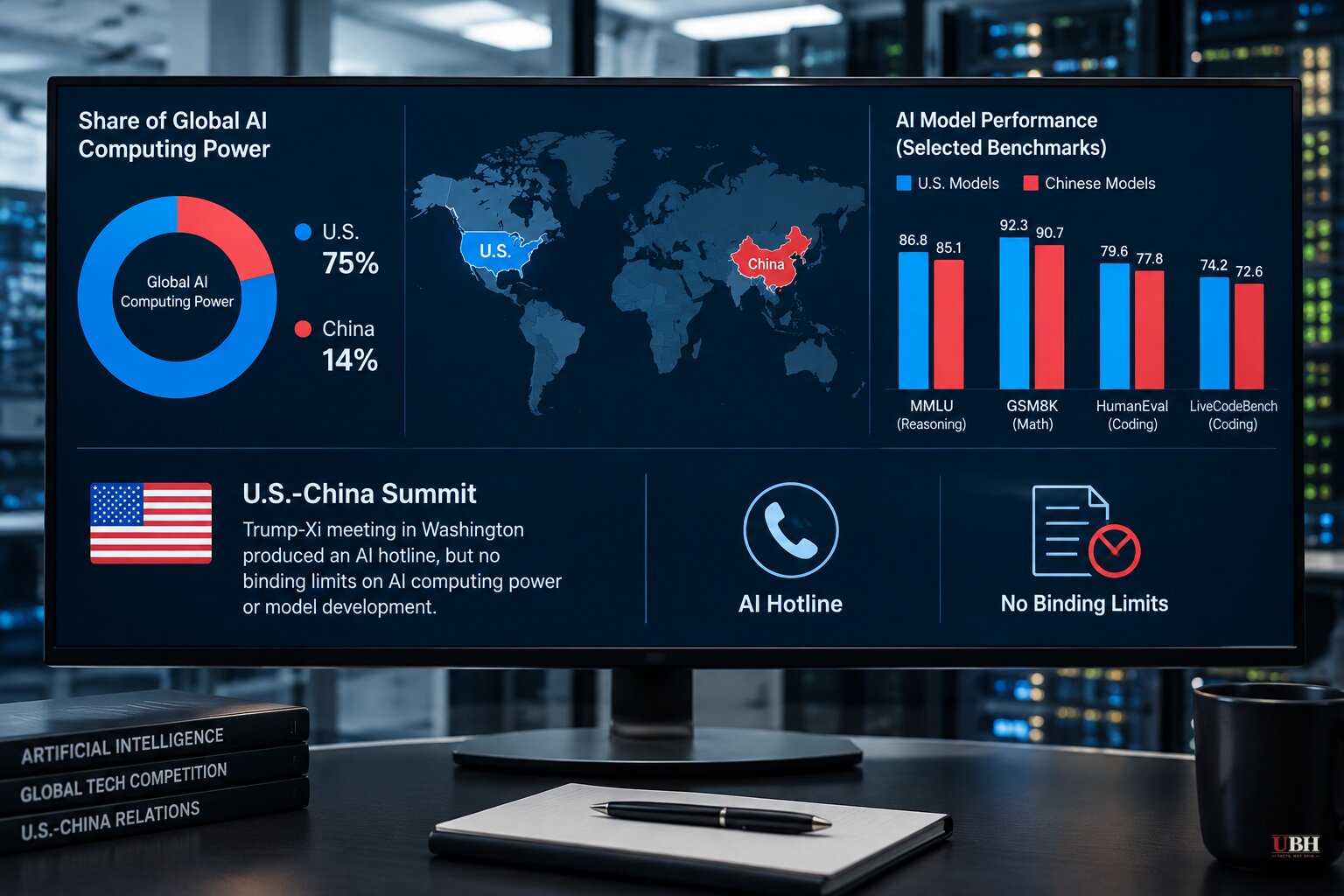
The U.S. leads China in the hardware that runs artificial intelligence. It does not lead by nearly as much in the models themselves.
That is where the race stands after the Trump-Xi summit in Washington, which ended with a plan for a hotline and no agreement to slow anything down.
The hardware gap is wide
The United States accounts for nearly three-quarters of the world's total AI computing power. China holds just over 14 percent, according to Epoch AI, an AI research institute.
Chips explain most of it. Nvidia accounts for more than 60 percent of global AI computing capacity among major chip designers, according to Stanford University's 2026 AI Index. Huawei holds a much smaller but growing share.
The buildings matter too. The U.S. has more than 5,400 data centers, about 10 times as many as any other country. It also has 84 dedicated AI data centers, more than the next eight countries combined.
The model gap is not
As of March 2026, U.S. and Chinese models were closely matched on Arena, a leaderboard where users vote between two anonymous systems. U.S. companies still lead at the frontier with OpenAI's GPT and Anthropic's Claude. China's DeepSeek is gaining ground.
The Epoch Times consulted 10 defense and cybersecurity experts for its assessment. Most agreed the U.S. keeps its lead in frontier models, compute and chip quality. They said China has become adept at building models that rival Western ones at a fraction of the cost and computational load.
Part of that efficiency, the experts said, comes from "distillation," a technique that lets Chinese models mimic the output of American ones. They also pointed to China's manufacturing capacity, which would let it field and refine AI-powered products quickly.
Chinese leader Xi Jinping has treated AI as a national priority for years. He has put heavy state money into it, mandated its use across the economy, and started building the data centers and power plants to support it. The experts also said China is moving fast to field AI-enabled weapons and uses AI in hacking and information operations.
What the summit produced
Before the talks, Treasury Secretary Scott Bessent said Washington had proposed an AI "notification mechanism," effectively a hotline for alerting each other when AI incidents threaten national security.
According to Christopher McNally, a political economy professor at Chaminade University, the summit delivered a version of that. No binding AI agreement was signed. A bilateral incident hotline will be created for AI-related emergencies, and a formal U.S.-China consultation channel will be set up.
The two sides could not even agree on a name for it. Washington says "Super Intelligence." Beijing says "Artificial Intelligence."
McNally says both sides also touched on basic guardrails and on keeping automated command-and-control systems out of nuclear arsenals. He says neither leader was willing to restrict or slow advanced model development.
The Epoch Times reported that insider sources earlier told it Beijing is unlikely to make meaningful commitments. Those sources said Beijing suspects U.S. security initiatives are designed to gauge Chinese technical capabilities and vulnerabilities.
Talent flows cut against the narrative
The Trump administration has made it harder for companies to hire foreign researchers. China has opened its doors with a scientist visa and generous research grants. A new Carnegie Endowment for International Peace study suggests the effect so far is not what Beijing wanted.
For every 30 Chinese AI researchers working in the U.S. in 2025, only one was working in China after making the opposite move, the study found. The study drew on authors of papers accepted at last year's NeurIPS machine learning conference.
"Despite US-China tensions, the number of Chinese-origin researchers working in the US actually rose by 4 percentage points rather than declined" compared with three years ago, said Damien Ma, who led the study.
The study does not show when researchers moved. Yingyi Ma, a Syracuse University sociology professor, said the numbers reflect decisions made years ago. "The danger for the US is a slow erosion of its appeal to attract talent that compounds over decades," she said. "By the time the effect shows up in the data, it is hard to reverse."
Is there even a finish line?
Harvard economist Jason Furman rejects the framing. "I don't think there is a finish line, so there's no such thing as winning the race," he said. He argues that the very best model may matter only to a narrow group, such as cybersecurity and cutting-edge research, while everyone else gets by with something short of the frontier.
He also said each country will learn what the other figures out. "They're going to learn about the things that we figure out and be able to copy them," Furman said. "And by the way, they'll figure out some things we don't figure out."
An opinion piece argues the scoreboard itself is wrong. Even if America leads in chips, computing power and models, the author writes, it could still lose if AI displaces millions of workers and deepens distrust at home. The piece cites 42 million Americans carrying $1.6 trillion in student loan debt and says 53 percent of 2024 college graduates were underemployed.
What comes next
The numbers favor the U.S. on compute and chips, and the talent data has so far held up. The hotline and the consultation channel are the only concrete outputs of the summit. Neither government has said when either will be operational or what would trigger a call.
Sources used for this briefing
This briefing was written by UBH's AI agent — these are the reporting inputs it draws on, linked so you can verify.


