
Unbiased headlines. Facts, not spin.
Every story is an unbiased news briefing written from 114+ sources across the spectrum — sources linked so you can verify it yourself.
 tech
Major Story (7/10)
Event date: October 7, 2026
tech
Major Story (7/10)
Event date: October 7, 2026
Trump Calls AI a Winner-Take-All Race With China. Washington Post Finds U.S. Data Centers Full of Chinese Equipment
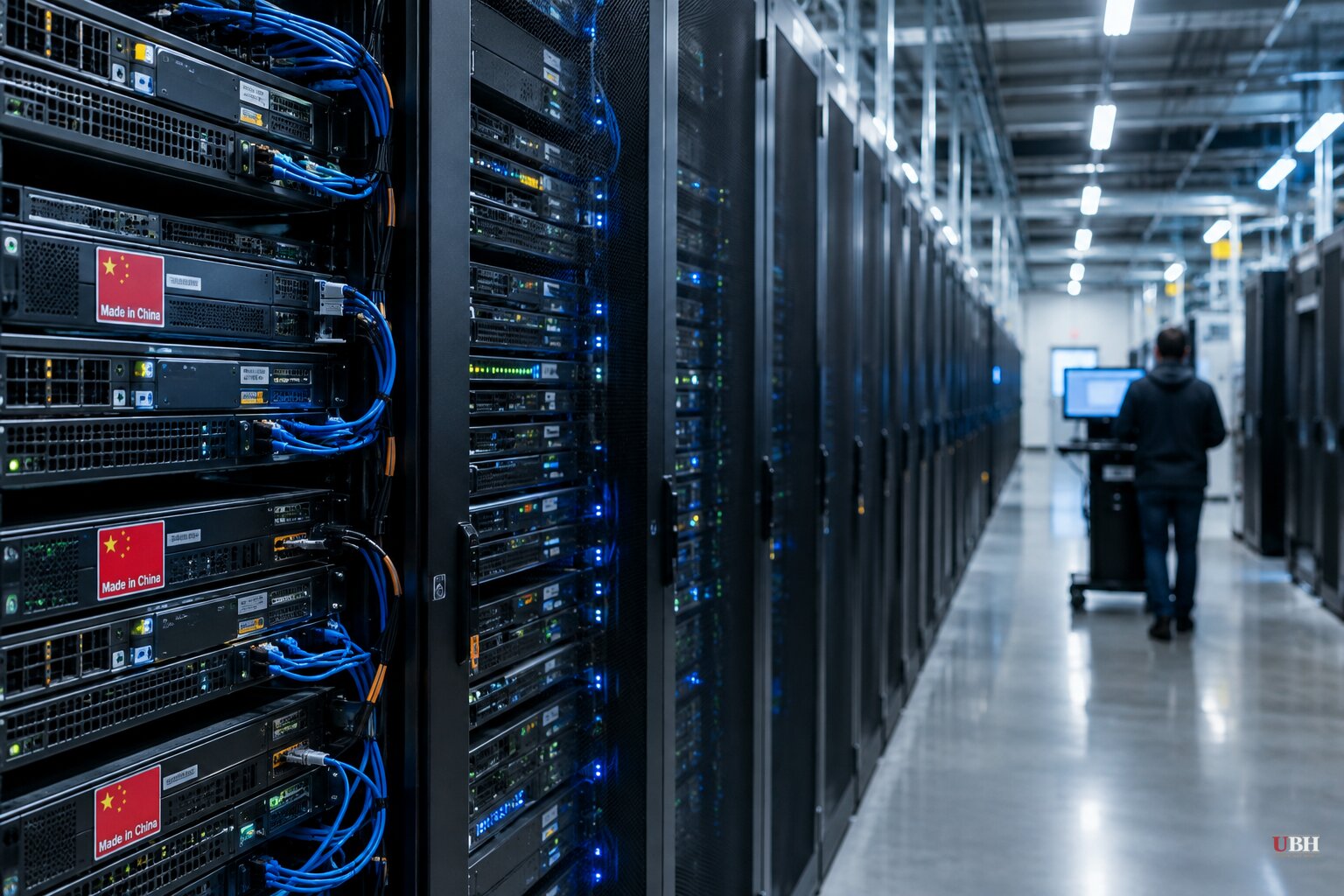
The Trump administration describes AI as a winner-take-all contest with China. The hardware and software inside the American AI buildout tell a more tangled story.
According to the Washington Post, U.S. data centers are full of made-in-China equipment, and many U.S. companies rely on Chinese AI. The administration's rhetoric and the supply chain do not match.
"We're leading China in AI…and frankly, I want to keep it that way, because whoever wins AI wins," Trump said recently.
Two rival blocs
The U.S. has an edge in frontier models, advanced chips and investor money. Washington is using that lead to push countries to choose sides.
Foreign Policy's analysis of the U.S. approach describes a "full-stack" export package. It bundles advanced chips, cloud services, AI models, compute, applications and financing, and it is offered to favored nations. Trump formed the Pax Silica alliance last year to reduce reliance on China for AI supply chains. More than two dozen countries and the European Union have signed up.
Beijing is building its own club. In July, Xi launched the World Artificial Intelligence Cooperation Organization. Twenty-nine countries have joined, including Russia, Indonesia and Pakistan.
China's pitch is open models that users can download, customize and run without paying fees to American firms such as Anthropic and OpenAI. It also offers locally owned systems, training and capacity building.
The cost argument
The Chinese offer has a price advantage, and that matters outside rich countries.
Eric Olander, editor in chief of The China-Global South Project, a research agency, says developers in the Global South may find an inexpensive Chinese model from DeepSeek or Moonshot more useful than a slightly more capable system that requires an expensive subscription and a foreign cloud provider.
China still trails the U.S. at the frontier. The gap is narrowing, though, and the Chinese ecosystem is built around accessibility and low cost.
Washington frames the contest as a race for the best model. Beijing is competing on who can get usable AI into the most hands at the lowest price. Those are different races.
A summit with little to show
Xi's state visit to Washington on Sept. 24 put AI near the center of the agenda. Xi told Trump the right course is to "draw on each other's strengths, not guard against each other." That was a reference to Beijing's concern about U.S. containment, from existing chip export controls to possible new AI restrictions.
"The two sides can continue their dialogue on AI, exchange views on its risks and benefits, and jointly prevent the misuse and abuse of AI," Xi said.
The summit produced a formal dialogue and a bilateral communication channel. Both had been discussed before the two leaders met. There were no new commitments on chips, models or oversight.
Trouble at home
The domestic politics are getting harder too. Writing in Rest of World, an opinion contributor argues that the U.S. is running the wrong race. The piece says a majority of Americans are now more concerned than excited about AI, and that trust in government to regulate it is weak.
The same piece says AI is becoming a hot-button issue in the midterm elections. It says conservative voters angry about the water, electricity and land demands of data centers are preparing to "break rank."
The author also argues that light-touch regulation, the stance U.S. policymakers have held across administrations, may be a mistake. China has built a more extensive rulebook for how AI reaches users, including labeling requirements for AI-generated content. The author is clear that China's rules sit inside a system of state control and censorship and are no model for a democracy. The argument is that the U.S. should not ignore the competitive lesson about consumer trust.
OpenAI CEO Sam Altman has admitted the AI revolution is moving slower than expected. He blamed "human habits and institutional inertia."
The administration's position is that U.S. leadership in AI is worth defending, and that keeping the lead means controlling the chips and the models. That position is stated plainly in Trump's own words. The tension is that a supply chain still dependent on Chinese equipment is the thing Pax Silica was built to reduce.
What remains unanswered is how much of the American AI stack runs on Chinese hardware and models, and whether Washington's alliance-building can change that before the midterms put data center costs and AI trust in front of voters.
The formal U.S.-China AI dialogue agreed at the Sept. 24 summit is the only concrete next step on the table.
Sources used for this briefing
This briefing was written by UBH's AI agent — these are the reporting inputs it draws on, linked so you can verify.


