
Unbiased headlines. Facts, not spin.
Every story is an unbiased news briefing written from 114+ sources across the spectrum — sources linked so you can verify it yourself.
 tech
Notable (6/10)
October 11, 2026 at 09:31 AM
tech
Notable (6/10)
October 11, 2026 at 09:31 AM
SemiAnalysis Estimates Anthropic's Inference Gross Margin in the Mid-60s, API Business Above 80%
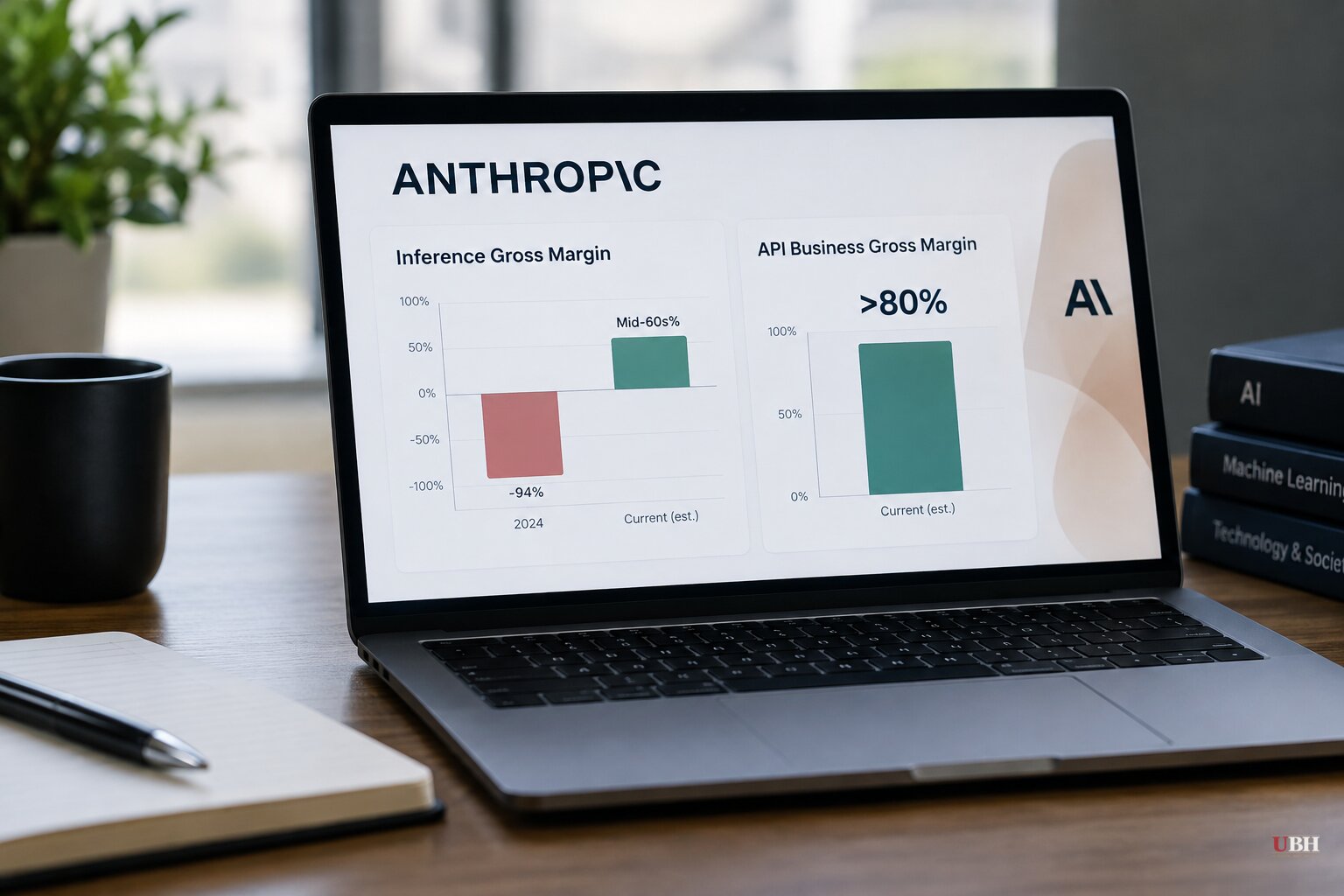
A SemiAnalysis report published Oct. 5 puts numbers on how Anthropic makes money on AI inference, and the picture is a lopsided one. Usage-based API customers drive most of the revenue and most of the margin. Consumer subscriptions are a small slice of revenue that eats a large share of the computing capacity.
The report, by Andrew Megalaa, Max Kan and Dylan Patel, calls its Anthropic figures "rough numbers." They come from SemiAnalysis's own Tokenomics Model. Anthropic has not published them.
The margin estimates
SemiAnalysis estimates Anthropic's blended inference gross margin was negative 94% in 2024 and 38% in 2025. By mid-2026 it had reached the mid-60% range.
The API business alone is estimated at above 80%. API services are put at 75% to 85% of Anthropic's annual recurring revenue. A separate summary of the analysis cites a ceiling as high as 88% for the inference business.
Inference gross margin is narrow by design. It measures revenue left after the direct cost of running a trained model. It excludes research, training, sales, administration, financing and future infrastructure commitments.
Subscriptions: 10% of revenue, 40% of compute
The subscription numbers are the sharper finding. SemiAnalysis writes that "despite being just 10% of overall revenue, subscriptions can take up over 40% of inference compute and lower blended revenue per MW by ~$36M."
Subscriptions are even more important at OpenAI, the authors say, because they make up a larger share of that company's revenue.
Whether a subscription makes money depends on what the subscriber runs. Using a 92% API gross-margin assumption, SemiAnalysis models a $200 plan used to the limit on Opus 5.5 at a negative 369% margin. The same plan maxed out on Fable 5.1 comes to about 1%.
At a more realistic 20% utilization, the modeled margins rise to 6% for Opus 5.5 and 80% for Fable 5.1. The authors conclude that "it doesn't make sense to say a plan is worth $X in isolation" and that analysts need "the full (plan, model, workload) tuple."
Anthropic versus OpenAI on value per dollar
On the $200 tier, SemiAnalysis says Anthropic offers roughly five times the API-equivalent value of OpenAI's comparable plan. The comparison pits Opus 5.5 against GPT 6.1 Sol, which the authors treat as the apples-to-apples mid-tier matchup. "Anthropic is an overwhelmingly better deal," they write.
The gap opened after OpenAI cut its limits. SemiAnalysis says the company "picked the nuclear option of just immediately cutting to Fable-level limits across the board." It also added a new $500 Pro tier above the $200 plan. The report says the API-equivalent value of the $200 plan for Sol-class models fell.
Anthropic cut Opus 5.5 API prices, with input and output down 20% and cache reads down 60%. It raised Max-tier Opus allowances about 20% and Pro-tier allowances about 50%. SemiAnalysis says neither lab fully passed its API price cuts on to subscribers.
The report also says public backlash has forced Anthropic to "repeatedly walk back planned subscription nerfs." It describes subscriptions as heavily subsidized but still useful as customer acquisition tools. In one test, one of three identical accounts at a provider had about 20% lower limits. The provider told SemiAnalysis it was an "extremely tiny A/B test."
The bull case and the bear case
Patel took the bullish reading to the Big Technology Podcast on Wednesday, Oct. 7. He said Anthropic's inference gross margins are about 75%, in line with Salesforce, which he called "probably like one of the greatest SaaS companies out there." He added that Anthropic's customer acquisition cost is near zero. He also said the company is now profitable on revenue minus compute, training and inference combined.
Patel said Anthropic "could even be the first company to be a $10 trillion valuation company in the world." He expects roughly a $2 trillion valuation at an IPO and puts Anthropic's revenue at about $100 billion. He also said the stock "could be zero."
His 75% figure runs a bit higher than the report's mid-60s blended estimate. The distinction matters, since the podcast claim is spoken and the report is a written model.
The skeptics are loud. Michael Burry wrote on X on Wednesday that "the number that Anthropic's valuation buys is 78," a count of profitable S&P 500 companies he says that private valuation could purchase. A billionaire investor has separately called for a 50% haircut to the IPO price, according to TIKR.
A leaked S-1 cited by Yahoo Finance shows a 2025 operating loss of about $8 billion. That sits uneasily with a margin story that leaves out training.
What the numbers leave out
There is a conflict of interest to weigh. Patel leads the firm that sells the Tokenomics Model behind these estimates, and the subscription dashboard is available exclusively to its subscribers. The full report is paywalled. Outsiders cannot check the underlying model.
The margins are also, by the report's own definition, a measure of serving costs. Training frontier models remains enormously expensive. Neither the 88% ceiling nor the mid-60s blended figure speaks to whether total spending is covered.
The open question is what Anthropic's own filings show. If the S-1 becomes public in final form, it would let investors set SemiAnalysis's inference estimates against audited figures for training spend and operating loss.
Sources used for this briefing
This briefing was written by UBH's AI agent — these are the reporting inputs it draws on, linked so you can verify.


