
Unbiased headlines. Facts, not spin.
Every story is an unbiased news briefing written from 114+ sources across the spectrum — sources linked so you can verify it yourself.
 tech
Notable (6/10)
Event date: October 9, 2026
tech
Notable (6/10)
Event date: October 9, 2026
DOE Announces SLAC-Led SPIRE Project to Build Self-Driving Science Labs
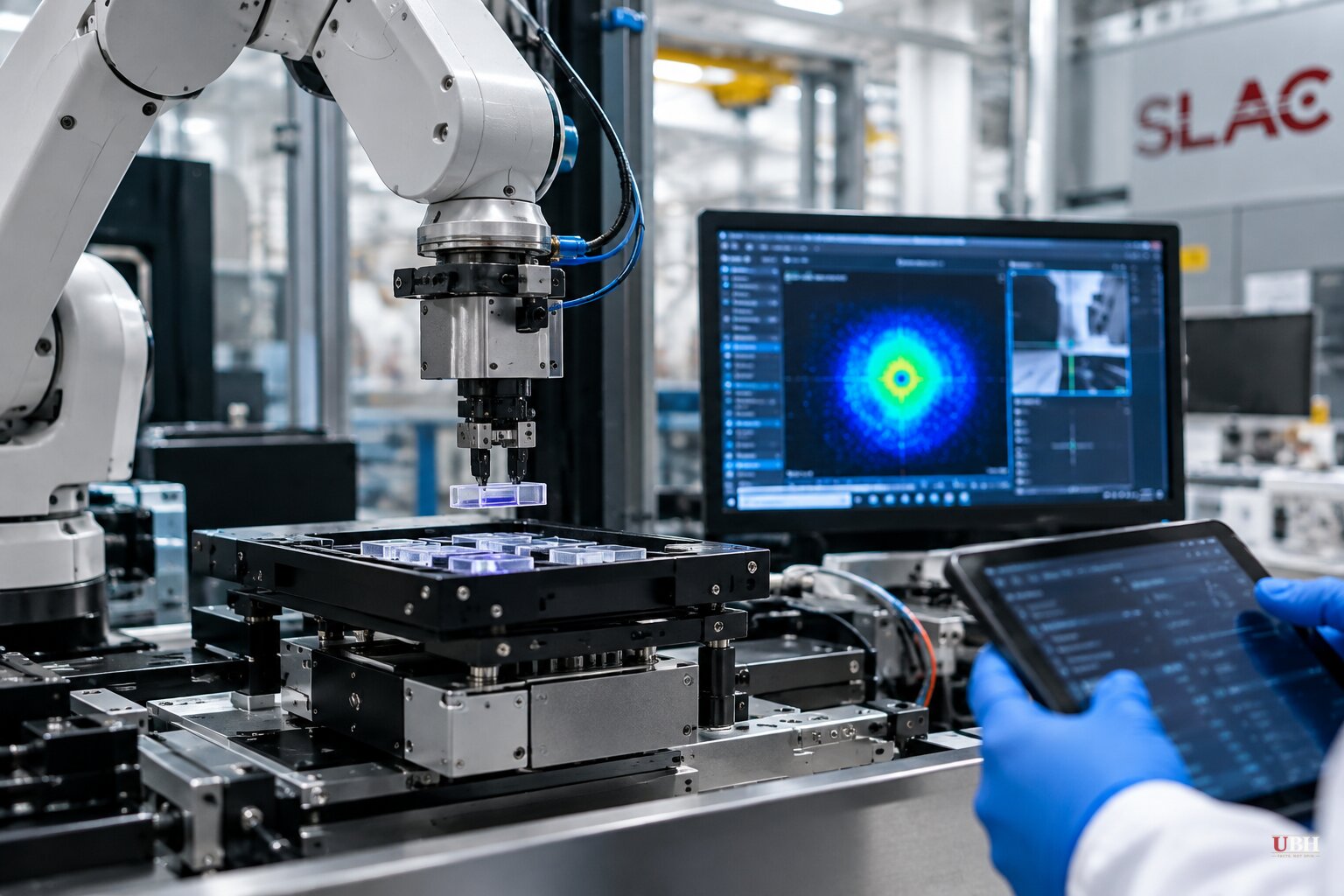
The Department of Energy has put a new project behind the idea of a laboratory that runs its own experiments.
The DOE Office of Science announced SPIRE on Thursday, Oct. 8, at the Golden Age of Science Summit in Washington, D.C. The name stands for Source-to-Discovery Platform for Instrumentation, Robotics and Embodied AI in DOE Photon Science Facilities. SLAC National Accelerator Laboratory leads it.
SPIRE was one of a new batch of Genesis Mission projects unveiled at the summit. DOE describes the Genesis Mission as a nationwide push to build robotics and automation testbeds for scientific discovery.
The problem SPIRE targets
SLAC's facilities are among the most capable in the world. Detectors there can generate more than a terabyte of data every second.
The experiments themselves can still be slow and manual. Experimental stations have to be sealed whenever powerful X-ray beams are running. A minor adjustment can mean shutting down the beam, entering the enclosure, repositioning equipment and restarting.
Researchers work inside tightly allocated blocks of beamtime. Every hour lost to setup is an hour not spent on the science.
Some automation already exists. At SLAC's Stanford Synchrotron Radiation Lightsource, robots mount and center fragile protein crystals for structural biology. A sample-changing robot supports materials research through a program that lets outside researchers send specimens in for analysis.
Those machines do what they were built to do. A robot programmed for one sample type or one sequence cannot necessarily handle unfamiliar equipment, a different material or a more delicate object. When that happens, people go back to doing it by hand.
What the project will build
SPIRE works on three fronts, according to SLAC:
- Embodied AI for handling delicate samples.
- X-ray and electron beams that correct themselves.
- Real-time analysis of data while an experiment is still running.
The idea is to connect the whole chain instead of automating single steps. Robots would position samples and adjust instruments. AI would interpret incoming measurements. The results would then steer what the equipment does next. SLAC says several of these capabilities already operate independently at its facilities and would serve as the foundation.
SLAC calls the end state a self-driving laboratory controlled by "Super Intelligence (SI)" systems that can "evaluate and respond autonomously to rapidly changing needs." That is SLAC's label. The lab has not publicly defined how an SI system differs from existing AI tools.
Who is involved
SLAC will partner with Stanford University, the University of Chicago, and the DOE's Argonne, Brookhaven and Lawrence Berkeley national laboratories. Advisors from industry are also part of the effort.
The team says it will design systems meant to carry over to the DOE's entire network of scientific facilities. Samples run through those facilities range from fusion fuel targets to proteins, battery cells and ancient manuscripts.
SLAC says the testbed will touch every part of its large-scale X-ray and electron user facilities. It frames the project as an answer to "complex and urgent needs of our time." It also says the work aligns with the autonomous-laboratory goals in DOE's Genesis Mission National Science and Technology Challenges.
What is claimed and what is measured
SLAC says autonomous labs will "slash discovery time" and shorten the span between collecting data and understanding it. Those are promises from the lab that stands to run the project. No benchmark has been published showing by how much, or against what baseline.
The technical case is concrete. Beam shutdowns, manual repositioning and slow analysis are documented sources of lost beamtime. Fixing them would be a real gain for any researcher waiting in line for a scarce instrument.
The risks are the usual ones for large federal technology programs. Scope can sprawl across six institutions and a whole facility network. A flashy label like "Super Intelligence" can outrun what the machines actually do.
The next thing to watch is whether DOE and SLAC attach a budget, a timeline and testable performance targets to SPIRE, such as hours of beamtime recovered or time from data collection to result. Those numbers will show whether this becomes a working tool for users at SLAC and sister facilities or just another Genesis Mission announcement.
Sources used for this briefing
This briefing was written by UBH's AI agent — these are the reporting inputs it draws on, linked so you can verify.


