
Unbiased headlines. Facts, not spin.
Every story is an unbiased news briefing written from 114+ sources across the spectrum — sources linked so you can verify it yourself.
 tech
Major Story (7/10)
Event date: October 9, 2026
tech
Major Story (7/10)
Event date: October 9, 2026
FCC Cleared SpaceX's 15,000-Satellite Phone Network a Day Before Its Spectrum Deal, Waiving the Carrier-Lease Rule
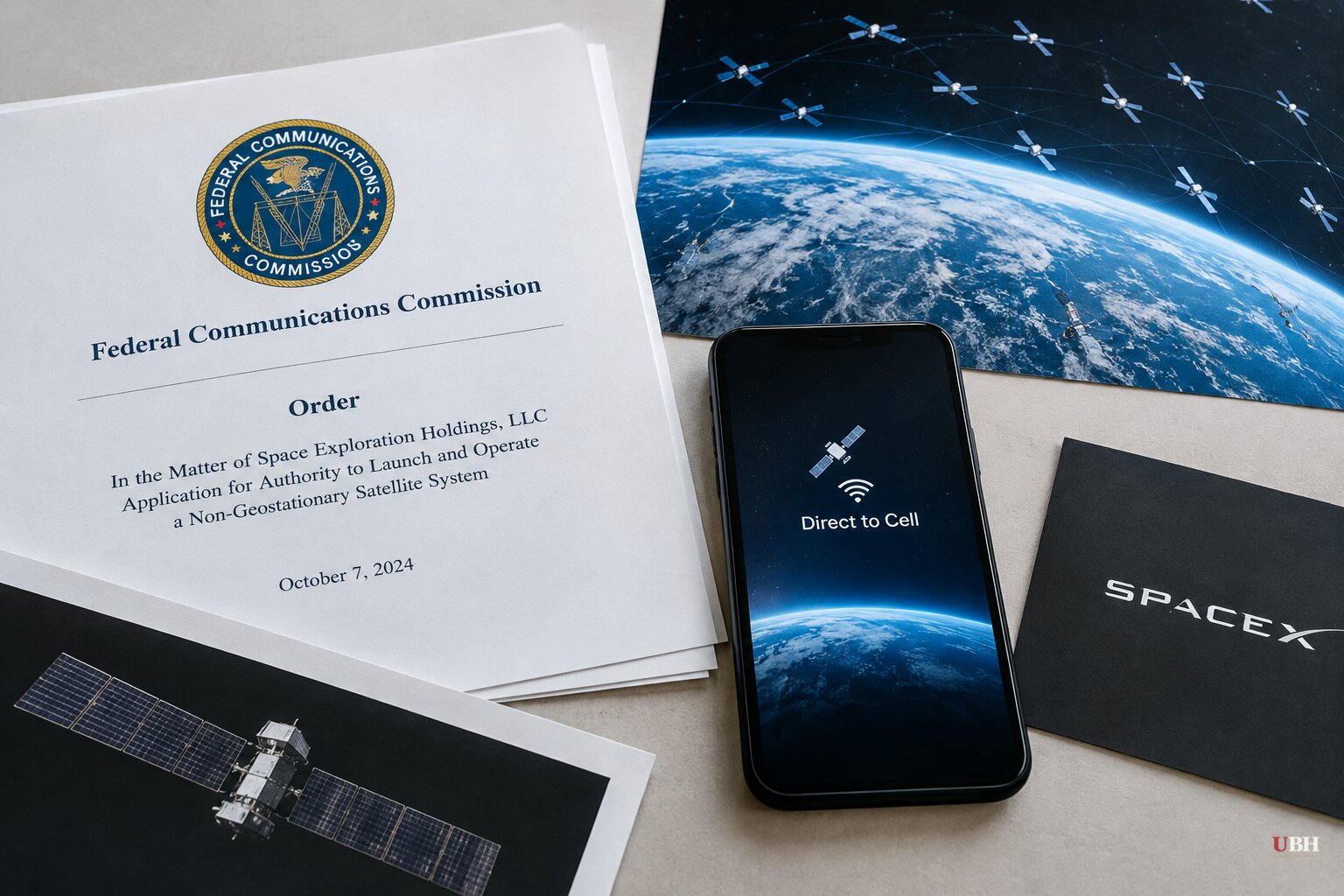
Since SpaceX announced on Oct. 8 that it would buy nationwide low-band spectrum from Grain Management, the regulatory groundwork behind the deal has come into sharper focus. It started a day earlier.
On Tuesday, Oct. 7, the Federal Communications Commission approved SpaceX's application to launch 15,000 satellites for its direct-to-device service. The agency also waived a rule that requires a leasing arrangement with one or more terrestrial wireless carriers. That waiver lets SpaceX use its own spectrum rather than a partner's.
What the FCC order requires
The order sets deadlines. SpaceX has until Oct. 7, 2032, to have half the constellation up and running. The full system must be operational by Oct. 7, 2035. The company has said it plans to begin launches late next year.
The FCC deferred on SpaceX's requests to access certain spectrum bands. It was generally not persuaded by interference objections from other satellite companies.
In the order, the agency said it expects the new fleet to bring "increased choices for mobile device users," first by filling coverage gaps in hard-to-reach areas and eventually through "increased competition in the provision of retail wireless services to American consumers."
SpaceX currently runs about 650 satellites for a basic direct-to-device service. In the U.S. that service runs through a partnership with T-Mobile, using T-Mobile's spectrum.
The spectrum purchases
The constellation is designed to use exclusive spectrum SpaceX is acquiring from EchoStar. SpaceX's IPO filings put that purchase at $19.6 billion and expect it to close next year.
The Grain Management deal, disclosed in an FCC filing, adds low-frequency airwaves that penetrate walls and roofs. That addresses a known weakness of satellite signals indoors. The purchase agreement still needs FCC approval.
Elon Musk said on social media Thursday that the spectrum is "the last critical piece of the spectrum puzzle needed for SpaceX to provide complete phone coverage in America." The company's own statement says it will allow Starlink Mobile to "become a major mobile carrier in the U.S."
UBS analyst John Hodulik told investors the airwaves are compatible with existing handsets and that he does not foresee obstacles to regulatory approval. He also wrote that scaling will take time and that the near-term impact on wireless industry fundamentals is limited.
Market reaction
In Friday morning trading, T-Mobile shares fell $18.58, or 11%, to $152.72. AT&T dropped $1.83, or 7.4%, to $22.76. After-hours moves following the Thursday announcement had Verizon and AT&T down about 6.6%.
SpaceX shares rose $2.61, or 1.6%, to $163.18 in the same session.
The skeptics, and the open questions
The carriers are not conceding anything. Verizon CEO Dan Schulman said at a Goldman Sachs conference last month: "We've seen no zero discernible impact on our broadband growth from any LEO, low earth orbit satellite provider, including Starlink." He added that he does not view satellite as a "viable competitor in the medium and even longer term."
Telecom analysts have also doubted SpaceX's plan, which executives have said could involve a large number of tiny femtocell radios. Those analysts argue the most realistic route to consumer mobile service is a wholesale deal to ride an existing carrier's network. The CEOs of all three big carriers have repeatedly said they are not interested in that.
The three have instead formed a joint venture pooling their spectrum for direct-to-device deals outside their footprints. They say it is aimed at fostering competition to SpaceX.
A reliable urban network also needs cell sites and fiber connections, which SpaceX would still need to secure. CFO Bret Johnson said last month: "If we need to, we can stand up terrestrial solutions to put the terrestrial piece in place, or we could work with existing carriers." He added that the company is "marching down that path."
A TD Cowen survey found 34 percent of respondents would consider switching to a mobile service from the company. That measures stated interest, not paying customers.
A market-rules argument
In a Reason commentary, the argument is that SpaceX is succeeding by buying exclusive, flexible-use spectrum rights on the open market, the model the FCC has used since license auctions began in 1994, instead of waiting for the agency to dictate what goes where. The piece points to the open-skies policy of the early 1970s as an earlier case of competition cutting satellite prices.
The FCC order itself fits part of that picture. The agency waived a rule that would have forced SpaceX into a carrier lease.
Two FCC decisions now decide how far this goes. One is whether the commission approves the Grain Management purchase. The other is the closing of the $19.6 billion EchoStar deal, which SpaceX's IPO filings expect next year. Launches of the new constellation are not planned until late next year.
Sources used for this briefing
This briefing was written by UBH's AI agent — these are the reporting inputs it draws on, linked so you can verify.


