
Unbiased headlines. Facts, not spin.
Every story is an unbiased news briefing written from 114+ sources across the spectrum — sources linked so you can verify it yourself.
 tech
Notable (6/10)
October 10, 2026 at 05:01 AM
tech
Notable (6/10)
October 10, 2026 at 05:01 AM
Tesla Renames 'Full Self-Driving' to 'Tesla Assisted Driving' in Europe After German Ministry Calls Name Misleading
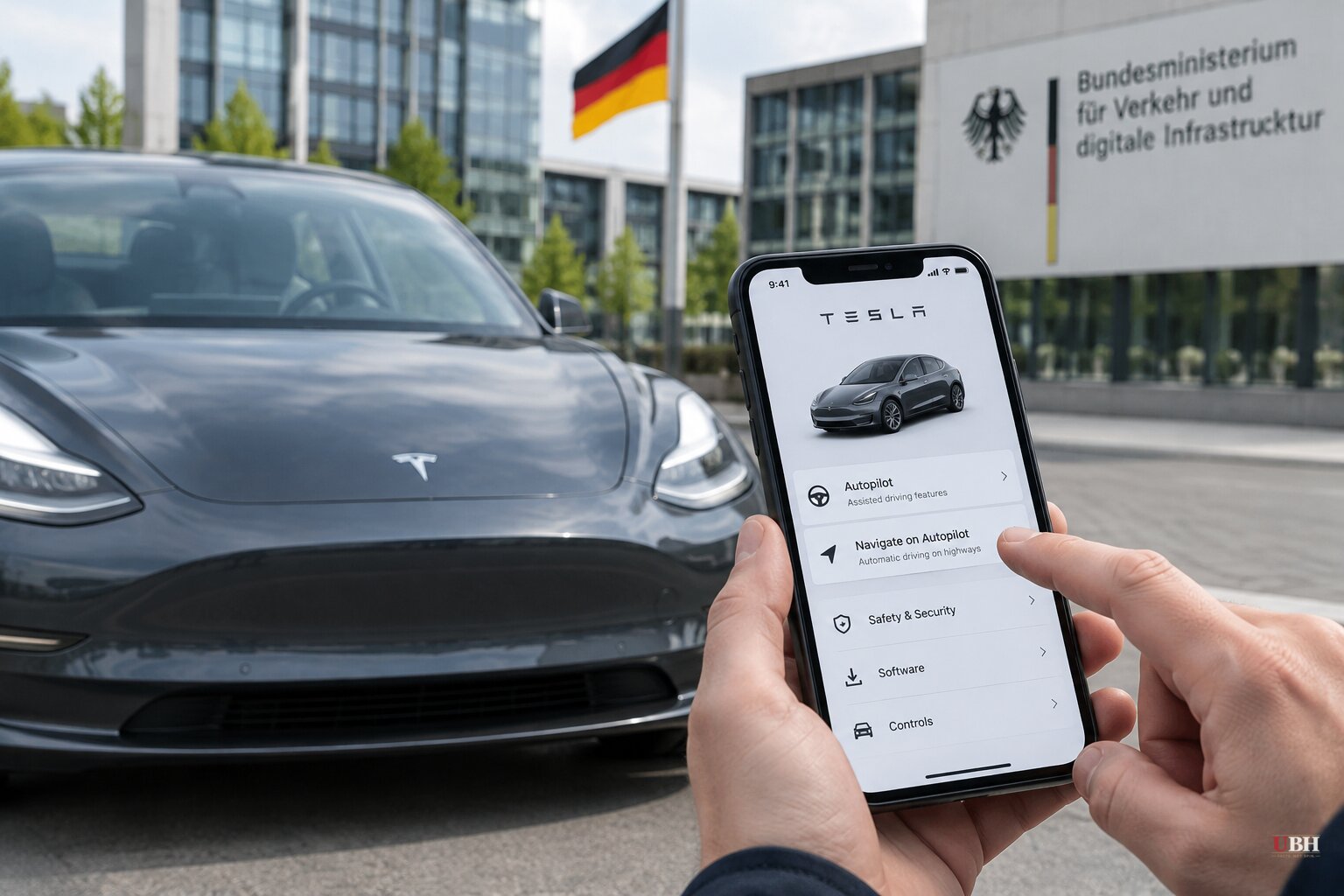
Tesla has stopped calling its driver-assistance package "Full Self-Driving (Supervised)" in Europe. The product is now "Tesla Assisted Driving."
The change followed a statement published Tuesday, Oct. 6, by Germany's Federal Ministry of Transport, which said the "FSD" label was "somewhat misleading." The ministry said the system "is not a system that takes over the entire driving task." It described a driver assistance system that supports accelerating, braking and steering, and said "the driver must remain attentive at all times."
According to the ministry, Tesla itself proposed the new name in talks with Transport Minister Steffen Bilger in September.
What Germany got, and what Tesla got
The deal was not just about a label. Germany says the system should be allowed to exceed the speed limit by no more than 10%, and the ministry says it will back that position in the EU approval process.
That is a real constraint. Reuters reported that the version approved in the Netherlands allows speeds up to 50% over the detected limit. Tesla has not publicly said how it will change the software to comply.
In return, Bilger said he wants Tesla drivers to use the system across the EU "without delay." Elon Musk thanked him on X with a "Danke schoen."
Where approval stands
The Netherlands' vehicle regulator, RDW, gave Tesla provisional approval in April. RDW said at the time that the version was more restrictive than the US one and that a vehicle with FSD Supervised "is not self-driving."
Tesla's own website lists eight EU countries where the system is approved: the Netherlands, Lithuania, Estonia, Denmark, Belgium, Slovenia, Czechia and Croatia. Germany is not on the list.
Bloc-wide approval has slipped to December at the earliest. It needs 15 of 27 member states representing 65% of the EU population. France and Sweden have raised concerns about speeding.
The money is the main draw. Tesla charges $99 a month for the system in the US, and a software subscription across Europe would be a large recurring revenue stream. The company has also been pushing for approvals elsewhere. Australia and New Zealand approved FSD last year, and a version reached Chinese customers in May under the name "Intelligent Assisted Driving."
Mostly a new coat of paint
Electrek reviewed Tesla's new German page and found it is largely a translation of the US FSD page with the product name swapped. It still says the car will drive you "almost anywhere" under active supervision. It still claims the system is "7x safer" than human drivers, a figure Tesla's own footnote measures against the estimated US average. It also closes with a section titled "Die Zukunft ist autonom" ("The future is autonomous") promoting Robotaxi and Cybercab.
In the US, the same product is still sold as "Full Self-Driving (Supervised)."
The safety questions
Missy Cummings, an engineering professor at George Mason University and a longtime critic of Tesla, told CNBC that renaming is not a strong enough measure to make the system safe for broad release in Europe. She said European agencies are "ignoring both past and ongoing NHTSA investigations" into Tesla's system. She also said the Dutch approval rested on "secretive data" and that "the public should demand transparency."
This week Reuters reported that Tesla presented misleading safety data to European regulators and that its lobbying pressured RDW to scale back the intensity of its reviews. Tesla and RDW did not immediately respond to requests for comment on the criticism.
In the US, NHTSA opened a probe in March after nine incidents in which FSD allegedly failed to respond to reduced visibility without warning the driver to take over. A separate NHTSA investigation covers nearly three million Teslas over reports of traffic violations, including running red lights and driving the wrong way. Tesla recalled an older version of the software in 2023 after federal regulators found it did not follow some traffic laws.
In December 2025, a California judge determined that Tesla had engaged in deceptive marketing around Autopilot and FSD. Tesla has countersued the state DMV in Los Angeles superior court to shed that label, and that litigation is ongoing. After the DMV threatened to suspend Tesla's licenses, the company stopped using the "Autopilot" name.
Tesla's case
Tesla owners and fans say FSD has improved enormously since 2020, and some report completing entire trips without intervening. Musk has argued publicly that delay costs lives. In a June 2025 post on X he wrote that FSD in Europe "will save lives of people in the car, as well as vulnerable road users like pedestrians, cyclists, and pets."
Tesla also changed the name voluntarily, according to the German ministry, and it kept the Dutch-approved "Supervised" requirement that drivers stay engaged.
The naming fight is settled in Europe. The speed-limit fight is not. Tesla has to show regulators that its software can hold to the 10% cap Germany wants, and that is a test member states will be watching before the December vote. If the vote fails to reach 15 states and 65% of the EU population, the eight-country patchwork stays as it is.
Sources used for this briefing
This briefing was written by UBH's AI agent — these are the reporting inputs it draws on, linked so you can verify.


