
Unbiased headlines. Facts, not spin.
Unbiased Headlines is an independently owned news organization. We bring you the facts, not opinions, written fresh from 110+ named sources. Sources linked so you can verify it yourself.
 tech
Major Story (8/10)
Event date: November 23, 2026 ·
Broadcom Patches Second 9.8-Rated vCenter Authentication Bypass Days After China-Linked Zero-Day
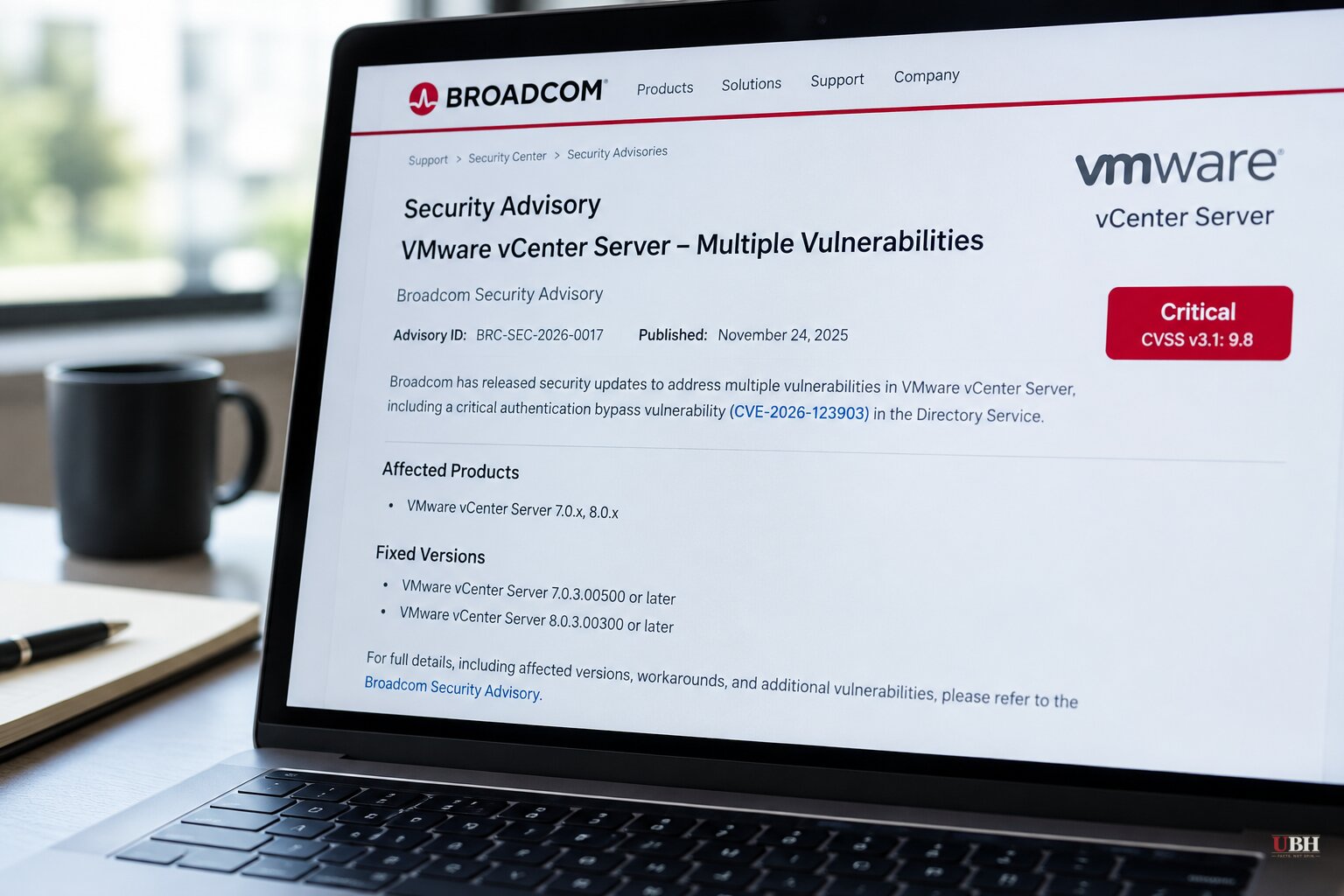
Since Broadcom disclosed and patched the vCenter zero-day CVE-2026-123890 on Nov. 19, defenders have been working through a very short list of options: patch, hunt for intruders, and restrict access. Today, Nov. 24, Broadcom added a second critical item to that list.
What Broadcom patched today
Broadcom released fixes for 23 vulnerabilities across VMware ESX, vCenter, Workstation, Fusion and Avi Load Balancer. The headline bug is CVE-2026-123903, rated 9.8 out of 10.0 on the CVSS scale. It sits in the VMware Directory Service, known as vmdir.
Broadcom's advisory describes the risk this way: "A malicious actor with network access to vCenter may exploit this issue to bypass authentication and gain unauthorized access to the system."
The company credited three parties with independently reporting the flaw: sglab of QiAnXin, Qi Qin (@LeoQ7_) of depthfirst, and VulTeam, XGTP from ThreatBook.
Four high-severity vCenter flaws were fixed alongside it:
- CVE-2026-123904 (CVSS 7.5): an arbitrary file write when the appliance processes certain archives, which could lead to code execution on the appliance.
- CVE-2026-123905, CVE-2026-123906 and CVE-2026-123907 (CVSS 7.5 each): denial-of-service bugs in the Directory Service.
Broadcom's advisory does not say any of the newly disclosed flaws have been exploited in the wild.
Not the same bug as last week's
Broadcom states that CVE-2026-123903 is a distinct issue and is not related to CVE-2026-123890. Both are authentication bypasses in the same Directory Service, and both carry the same 9.8 score.
CVE-2026-123890 is the one with a known attacker. Google Threat Intelligence Group and Mandiant attributed its exploitation to ARMORY CASTLE, a suspected China-nexus espionage group formerly tracked as UNC5221 and also known as Warp Panda. Forensic evidence indicates exploitation began in early September 2026, more than two months before the Nov. 19 patch under advisory VMSA-2026-0009.
Mandiant privately reported that flaw to Broadcom. The Cybersecurity and Infrastructure Security Agency added it to its Known Exploited Vulnerabilities catalog on Nov. 20 and set a federal remediation deadline of Nov. 23. That deadline passed yesterday.
What the intruders did with it
The Mandiant analysis describes an unauthenticated session-key disclosure in the Secure Remote Password (SRP-6a) exchange, reachable through DCE/RPC handled by vmdird over TCP port 2012. According to Google and Mandiant, the group used a custom Golang tool called BONESAW to establish an administrator session as administrator@vsphere.local.
From there, the attackers extracted the vCenter LMDB database, obtained SAML signing material, created rogue SSO administrator accounts and ran commands on the appliance. In the observed intrusion they eventually reached an ESXi host and pulled files from a Windows guest VM.
vCenter is the control plane for the whole virtual estate, and whoever holds an administrator session on it can reach the hosts and virtual machines underneath.
What administrators face
The fix for the earlier flaw carries real friction. Broadcom lists no workaround for CVE-2026-123890, and the patches cannot be applied through vCenter Quick Patch. The vendor FAQ says every vCenter system below the fixed versions needs the update, including systems that already received the fix for CVE-2026-59309 earlier this year.
The fixed builds for that flaw are VMware Cloud Foundation and vSphere Foundation 9.1.1.0200 and 9.0.2.0200, vCenter Server 8.0 U3m, and VMware Cloud Foundation 5.2.5. vCenter 7.0 customers on extended support must contact Broadcom. Updating makes vCenter's management interfaces temporarily unavailable, though Broadcom says running virtual machine and container workloads keep operating.
The 8.0 U3m and 9.0.2.0200 updates also add a "Back-in-Time" restriction that blocks upgrades to VMware Cloud Foundation 9.1.1. Broadcom tells customers in the middle of an upgrade to check the FAQ and interoperability matrix first.
For the newly disclosed bug, the practical guidance follows the same logic. It requires network access to vCenter, so cutting off management interfaces from untrusted networks narrows the exposure. Teams should also review vmdir logs for unexpected authentication events after patching.
The open question
Patching closes a hole. It does not evict anyone already inside. The Armory Castle activity ran for more than two months before a fix existed, and the group's reported use of rogue SSO accounts and stolen SAML signing material is the kind of access that survives an update.
Broadcom has not said whether anyone exploited CVE-2026-123903 before today, and three separate researchers reported it independently. Whether CISA adds it to the KEV catalog, as it did for CVE-2026-123890 one day after that patch, is the next signal to watch.
Sources used for this briefing
7 links from 7 independent newsrooms (syndicated copies of the same report count once)
These are the sources it draws on, linked so you can verify.
More coverage: China


