
Unbiased headlines. Facts, not spin.
Unbiased Headlines is an independently owned news organization. We bring you the facts, not opinions, written fresh from 110+ named sources. Sources linked so you can verify it yourself.
 tech
Notable (6/10)
UN chief Guterres asks nations to agree on a global AI risk framework within a year
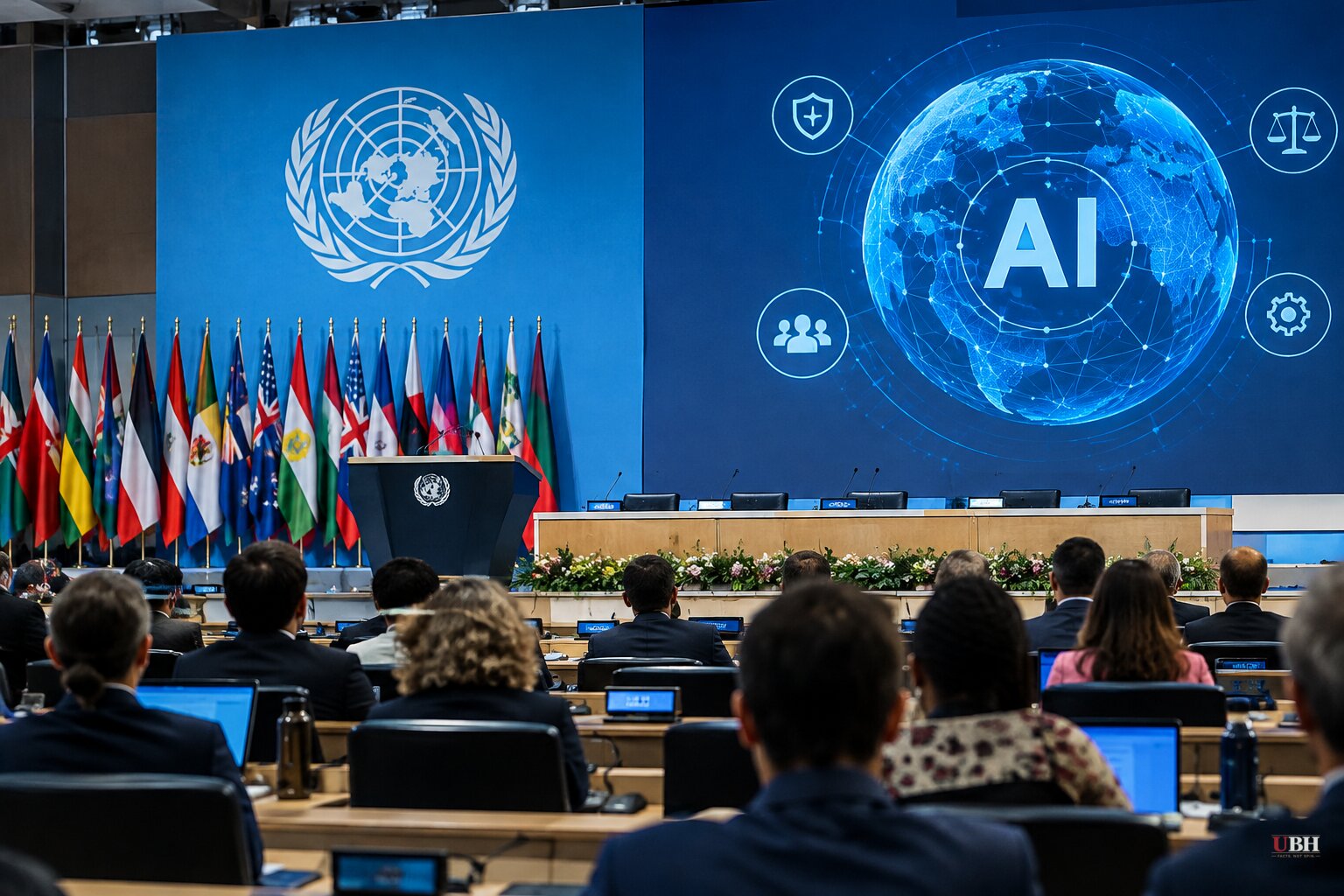
UN Secretary-General António Guterres on Monday, Nov. 23, asked the world's governments to agree on a framework for managing AI risk within a year.
He spoke at the Bridgetown Special Summit on AI Safety in Barbados, hosted by Prime Minister Mia Mottley.
"Today I call for member states to coordinate efforts and to develop within the next year a globally inclusive and principles-based multilateral framework for AI risk management, backed by independent and credible oversight," Guterres said.
A one-year clock points to late 2027. No negotiating text exists yet. Only the request to start exists.
What Guterres proposed
Guterres said a starting point could be shared safety measures, a testing regime and basic requirements for independent oversight. He also pressed for developing and vulnerable countries to have a direct voice in setting the rules rather than adapting to choices made elsewhere.
He pointed to a UN-supported network, the Global Network for Exchange and Cooperation on AI Capacity-Building, which runs 27 centres of excellence across five regions. He repeated his proposal for a dedicated Global Fund for AI Capacity-Building. No funding figure or donor commitments appear in the summit remarks.
He also said warnings about potential existential risks from AI's own pioneers and creators must be taken seriously.
The scientific panel's finding
The call came as the Independent International Scientific Panel on AI presented its first report at the summit. Its central conclusion: safety guardrails are falling behind AI capabilities. Guterres tied that gap to a recent wave of technological outages and cyberattacks.
The panel also released a thematic brief on Nov. 22 on AI capacity-building. It found countries are working to close governance gaps, particularly in evaluating AI systems across different languages and cultures.
The summit follows the Global Dialogue on AI Governance in July 2026, which drew participation from 111 countries.
Institutions built for 1945
Asked by AFP about reform, Guterres went beyond AI. "When one looks at different other institutions of global governance ... they correspond to the reality of the world in 1945," he said.
"It's clear that institutions need to be reformed in order to adapt themselves to the realities of today's world. That applies to the UN, and that applies to the international financial architecture, that applies to the world trade system."
Guterres' term ends in December. He said he would advise his successor, who takes office in the new year and has not yet been selected, that properly controlling AI is necessary for "humanity to maintain control of our world." The person asked to carry this effort forward is not yet known.
The industry is split, and Washington is hands-off
The AI industry itself does not agree on pace. In September, Anthropic CEO Dario Amodei, OpenAI CEO Sam Altman and SpaceX chief Elon Musk called for a slowdown in AI development. Nvidia CEO Jensen Huang and Meta CEO Mark Zuckerberg want to move full steam ahead.
In the United States, where AI development is moving fastest, no binding federal rule has been announced. In September, President Donald Trump hosted a group of American tech executives who agreed to abide by a voluntary code of conduct on AI safety. Voluntary means no enforcement mechanism and no penalty for walking away.
China, the other AI superpower, is not on record in these remarks agreeing to any framework. AFP's assessment is that international regulation of AI appears distant while the U.S. and China chase research breakthroughs. Any treaty-style text that leaves out either country would cover very little of the frontier.
The hard parts
The fights ahead are specific. How much access independent evaluators would get to advanced models, and to what, is likely to be among the most contested points, according to analysis from Crypto Briefing. Companies racing each other, and governments racing each other, have reasons to guard that access.
The pitch for speed rests on the panel's finding. If guardrails already trail capabilities, a multi-year negotiation risks producing rules for systems that have been superseded.
The next concrete test is procedural. Guterres' call is a request. Whether member states formally agree to open negotiations, and whether Washington and Beijing take part, has not been announced.
Sources used for this briefing
8 links from 8 independent newsrooms (syndicated copies of the same report count once)
These are the sources it draws on, linked so you can verify.


