
Unbiased headlines. Facts, not spin.
Unbiased Headlines is an independently owned news organization. We bring you the facts, not opinions, written fresh from 110+ named sources. Sources linked so you can verify it yourself.
 tech
Breaking / Critical (9/10)
Nvidia Ends Day Up 31.5% as Huang Returns to Office; Bubblemaps Flags Polymarket Accounts Funded Before the Announcement
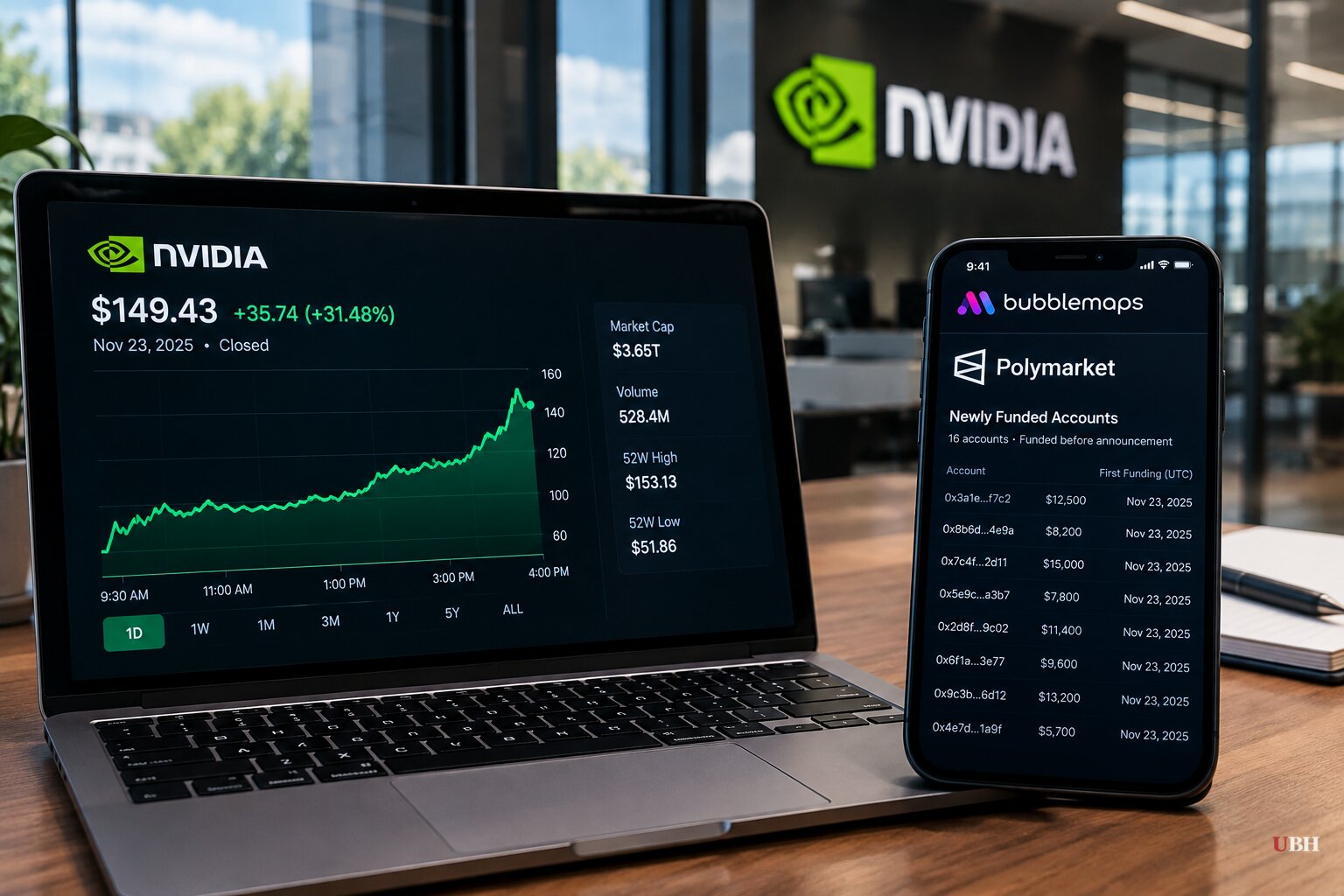
Eleven days after Jensen Huang resigned, and hours after the board reversed its rejection of his offer to return, Nvidia finished the Monday, Nov. 23 session up 31.48%. That is a one-day gain of $952 billion in market value and the stock's best day since 2003, according to CNN's market tally. The rally was the third-best single day in the company's history.
How the market closed
The Nasdaq Composite ended up 6.51% and the S&P 500 gained 4.73%. Both had their best day since April 2025, when Trump backed off some tariff threats. The Dow rose 1,448 points, or 3.01%, its best day since Nov. 4.
Nvidia touched a gain of 36.6% at its peak before paring back. CoreWeave, an Nvidia customer, closed up 22.3%.
The bounce follows a week in which all three major indexes lost 8% or more. The S&P 500 logged seven straight losing days, its longest streak since February 2020. The Nasdaq fell 1,261 points, or 5.3%, on Friday alone.
Huang back in the building
Huang returned to Nvidia's offices Monday to a standing, applauding crowd of employees, according to video of the moment. "Thank you all for the second chances. I'm gonna be a better CEO the second time around," he said.
He also told staff: "This is my first day at work. I'm terribly sorry for putting all of you through all of this," according to a video reported on by Business Insider.
Huang resigned Nov. 12 after reports of affairs, one with a woman U.S. officials suspected of working for Chinese intelligence and another with a direct report at Nvidia. Two days earlier he had admitted he was "unfaithful to my wife."
Washington's role
The board's statement said it "received input from senior levels of the United States government" that made it "confident" Huang's reinstatement "poses no national security risk." It said the vote was unanimous and followed meetings with Huang after which the board was "satisfied with respect to Mr. Huang's candor and ability to lead NVIDIA."
The White House said Trump was "totally involved" in the return. Trump told CNBC he discussed it with the board. "I believe my intervention was very important," he said. On Truth Social he wrote that the government "has no reason to believe that Jensen's return to NVIDIA poses any risk to National Security."
The New York Times reported that Trump asked Vice President JD Vance over the weekend to help the board get "the assurances it needed."
It was not immediately clear what changed between the board's quick rejection of Huang's offer less than a week before his reinstatement and Monday's vote. According to the Associated Press, the board is still examining whether a foreign spy targeted Huang.
Nigel Green, CEO of deVere Group, said he believes "the White House leaned hard on the board." He added that Huang now has "the backing of the board, the U.S. president and the market."
Polymarket accounts under the microscope
Bubblemaps, a blockchain analytics firm, said two clusters of anonymous Polymarket accounts began betting only on Nvidia-related markets within minutes of being funded. Five accounts were created and funded Nov. 16, the day Trump said publicly he would welcome Huang's return. Another 11 were funded Monday between 03:49 and 10:44 UTC, hours before the board's announcement.
The New York Post, citing Polymarket data, reported that one account began placing wagers soon after 2 a.m. ET Monday. Those contracts paid out if Huang was rehired by the end of November. They cost 3 cents each, which implied a 3% chance. The account spent about $2,700 and made nearly $47,000. The Post put the combined profit at more than $340,000.
Bubblemaps said it cannot determine who is behind the accounts and has no evidence linking them to one another. It grouped them because of similar trading patterns. Polymarket and rival Kalshi have both been accused of facilitating insider trading, and each has said it has taken steps to curb or flag suspicious activity.
Is this a bottom?
Strategists are split on whether the rally lasts.
Mark Gibbens of Gibbens Capital Management said, "I certainly believe this establishes a bottom and a floor in the AI trade." Art Hogan of B. Riley Wealth Management said stocks would have been higher Monday even without the Nvidia news. He pointed to Sunday-night futures and a tech sector trading at 16.3 times forward earnings against 20.5 for consumer staples.
Jay Woods of Freedom Capital Markets takes the opposite view. "I think the rally will probably fizzle out," he said, "because now people will pull back and still have the same questions we had before he was replaced." Woods said those questions may be aired in congressional hearings.
Jonas Goltermann of Capital Economics called the early Monday bounce a "dead cat bounce" before the Huang news, then said "this particular cat has another of its nine lives to live." Adam Crisafulli of Vital Knowledge wrote that most people see the uptick as "technical in nature, a partial reversal of extremely oversold conditions."
The concerns behind last week's rout are untouched. They include a possible slowdown in data center construction, tighter chip export restrictions and fears that hyperscaler spending has peaked. Goldman Sachs traders noted that before Monday, a 1% move in Nvidia shares affected the S&P 500 more than the same move in any of its 500 companies except two.
What remains open: the board's review of the alleged foreign targeting of Huang, the explanation for its reversal in under a week, and whoever was behind the Polymarket accounts that bought a 3% long shot hours before the news.
Sources used for this briefing
8 links from 8 independent newsrooms (syndicated copies of the same report count once)
These are the sources it draws on, linked so you can verify.
More coverage: Nvidia


