
Unbiased headlines. Facts, not spin.
Unbiased Headlines is an independently owned news organization. We bring you the facts, not opinions, written fresh from 110+ named sources. Sources linked so you can verify it yourself.
 tech
Major Story (8/10)
Event date: November 17, 2026 ·
Huntress: 688,000 Malicious File Requests Hit 42 ScreenConnect Servers, Targeting MSP Technician PCs
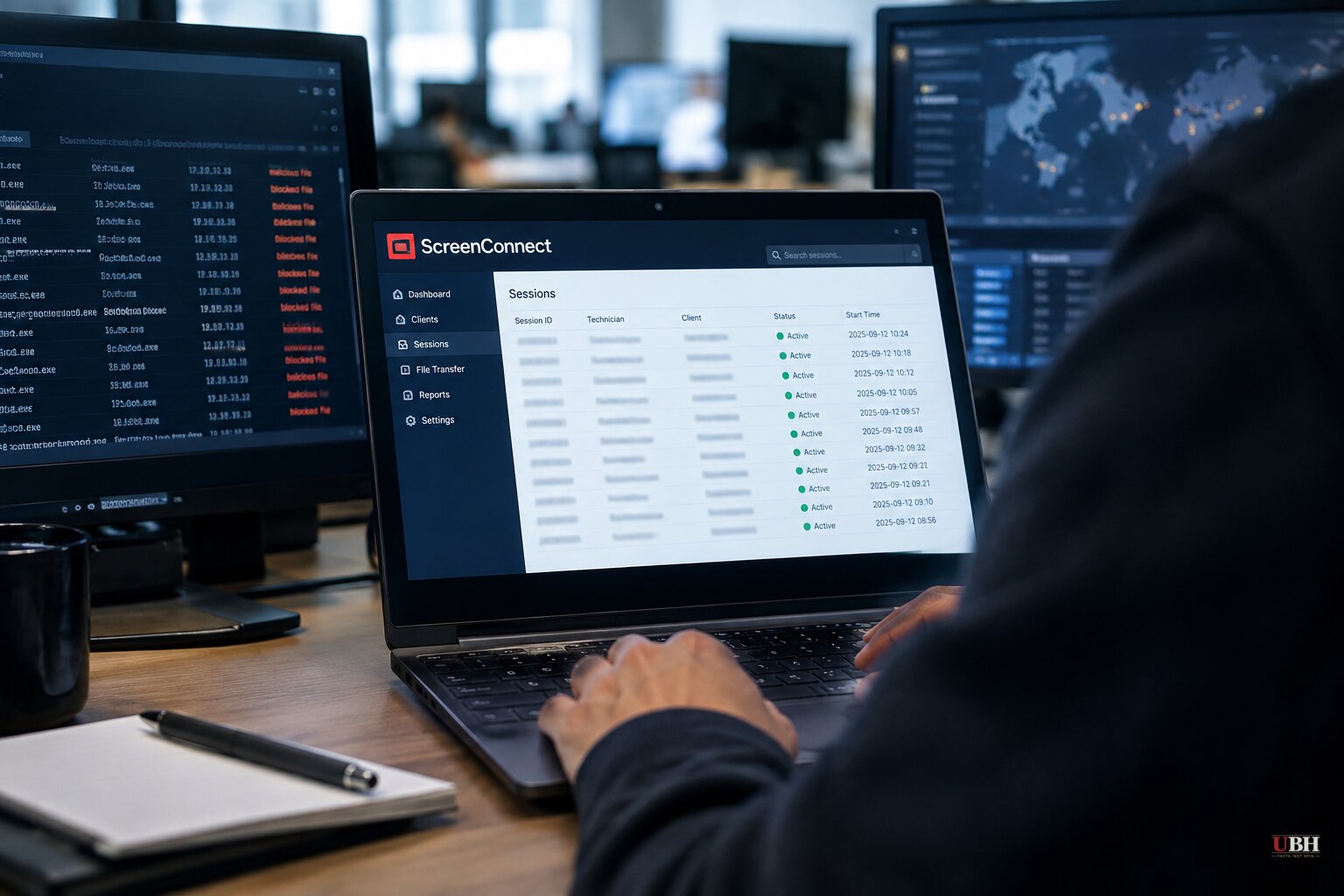
Since ConnectWise patched CVE-2026-84869 on Sept. 8 and CISA put it on its Known Exploited Vulnerabilities list three days later, the flaw has moved from a warning to a documented attack campaign against MSP technicians.
The new details come from Huntress, which published its findings on Monday, Nov. 16. The company says it recorded at least 688,000 guest "run file" requests between Oct. 20 and Nov. 16. The requests hit 42 MSP ScreenConnect servers and came from 29 IP addresses. They asked for files named update.bat or update_<8 hex>.bat.
These were delivery attempts, not 688,000 infections. The attackers sprayed servers and waited for a technician to join a session. Huntress has not confirmed that every attempted delivery executed or established persistence.
How the attack works
CVE-2026-84869 sits in the ScreenConnect client that technicians use to control guest machines. It is a missing-authorization and improper-privilege-management bug. A malicious guest can push a file to the technician's host and have it run, with no confirmation prompt. The technician only has to join the session.
The guest can be a machine the attacker controls, or the attacker can slip into a legitimate customer session as an extra guest.
On Thursday, Nov. 12, Huntress watched one MSP technician's workstation run a guest-pushed batch file. John Hammond, principal security researcher at Huntress, said the script reported to a Telegram bot, downloaded an installer from masterdarky[.]com, and started a rogue ScreenConnect client pointed at the attacker's own relay. The whole sequence took about nine seconds.
The installer was named WindowsUpdate.msi. It was unpacked as an administrative image rather than installed normally, so it left no standard installation record.
Canaries and October attempts
The next day, Nov. 13, a second technician's client opened a harmless text file, marker.txt, pushed from a guest machine at 91.224.92[.]167 two seconds after the technician joined. Huntress describes it as a canary that tells the operator the exploit works before the real payload goes out.
Huntress also traced October activity. In one targeted attack on an MSP server, the attacker joined three real sessions the technician had created and asked the client to run a file that dropped Sync.bat into the Windows Startup folder. Huntress says four additional technicians were compromised with malicious files during October.
A separate cluster involves thousands of guest sessions from machines with names like BITMEX-BOT, KUCOIN-SRV and LAPTOP-BINANCE, apparently meant to lure technicians into connecting. Huntress has seen no file transfers or command execution from that cluster.
Why the technician's PC matters
Roman Y. Sannikov, global research coordinator at iCOUNTER, called the technician's workstation "the most valuable machine an MSP has, because it holds the sessions, saved credentials and remote access into every client the technician supports." He said attackers "don't need to break into each client."
Hammond said the danger lies in how many pieces defenders must track: "there are a lot of parts and pieces to track and understand, and without that understanding, there's a lot of risk in using this RMM solution today."
Relationship to the SCKit campaign
This is a separate event from the SCKit campaign. ConnectWise reported that campaign beginning Nov. 11. Microsoft Threat Intelligence has confirmed the activity. A threat actor gained unauthorized access to cloud-hosted ScreenConnect instances belonging to MSPs through the RMM+ extension. The attacker installed unauthorized clients and deployed a worm, SCKit. ConnectWise then removed the RMM+ plugin and several related plugins from affected cloud-hosted servers. A second wave on Nov. 13 targeted on-premises instances through the same plugin.
Microsoft says SCKit includes a component called RelayTrap, built to deliver a malicious payload to a connecting technician. Microsoft also warns that deleting an unauthorized client does not remove SCKit's persistence, which uses scheduled tasks and registry Run entries, or invalidate exposed web sessions.
Hammond told Cybersecurity Dive that CVE-2026-84869 was meant to be part of the SCKit chain, used to "worm" downstream clients in a console takeover attempt, but "it never succeeded."
What defenders are told to do
ConnectWise urged on-premises users to upgrade to version 26.6.5. Cloud customers should reinstall their host clients and update access agents after patching. Huntress recommends updating every technician's host client to 26.6.5 or later. It also advises hunting for the host client spawning scripts from its Temp folder.
Federal civilian agencies had until Sept. 14 under CISA's catalog entry to mitigate. Private MSPs had no such deadline, and the Oct. 20 to Nov. 16 activity shows what happens to servers and clients that stay behind.
The open question is scale. Huntress has documented a Nov. 12 compromise and four additional technician compromises in October, but the 688,000 requests across 42 servers say nothing about how many other MSPs were hit outside its visibility. Neither ConnectWise nor Huntress has said how many technician machines remain unpatched.
Any MSP that ran a ScreenConnect client on an unpatched technician machine between Oct. 20 and Nov. 16 will need to hunt for the Temp-folder script activity Huntress describes. Deleting a rogue client is not enough on its own.
Sources used for this briefing
7 links from 7 independent newsrooms (syndicated copies of the same report count once)
These are the sources it draws on, linked so you can verify.


