
Unbiased headlines. Facts, not spin.
Unbiased Headlines is an independently owned news organization. We bring you the facts, not opinions, written fresh from 110+ named sources. Sources linked so you can verify it yourself.
 tech
Notable (6/10)
US-China Commission Asks Congress to Require Disclosure When Software Uses Chinese AI Models
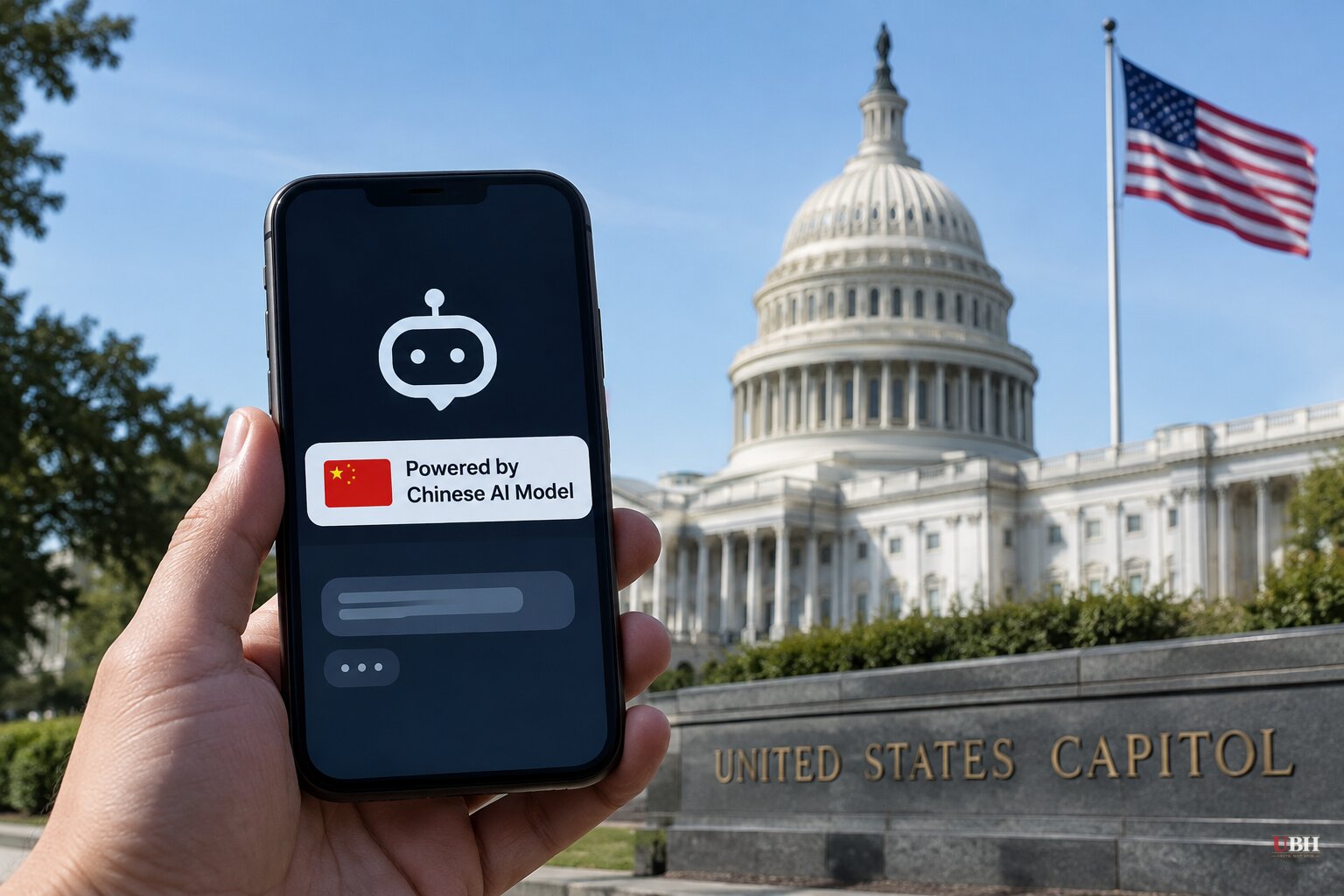
The US-China Economic and Security Review Commission (USCC) has recommended that Congress require disclosure when software relies on AI models developed by Chinese entities. The proposal is one of 30 recommendations in the commission's 705-page 2026 Annual Report to Congress, released November 18.
It is not law. The USCC is a legislative branch advisory body, and nothing takes effect unless Congress acts. No implementation timeline exists.
What the commission wants
The disclosure duty would reach well beyond the federal government. It would cover federal agencies, state and local governments, and any entity receiving federal funds or tax credits.
It would also cover private businesses. Any company using a Chinese-developed model in a product or service offered in the United States, to consumers or to other businesses, would have to say so on its website and in product documentation.
The definition is broad. It takes in models built by entities headquartered in China, organized under Chinese law, or owned or controlled by such entities. It also covers models fine-tuned from or derived from those systems, wherever they are hosted.
Disclosures would have to appear in clear language on public-facing platforms and in government filings. Publicly traded companies would describe related business risks in their SEC filings.
The commission also wants teeth. Failing to disclose would be treated as an unfair or deceptive act or practice, which puts it under Federal Trade Commission enforcement.
Why the commission is focused on these models
The report names two concerns. One is censorship: the risk that Chinese models reflect perspectives aligned with the Chinese Communist Party. The other is data security and privacy risk tied to models developed by Chinese entities.
DeepSeek, Alibaba and Moonshot AI are the developers drawing attention. Airbnb, DoorDash and Anysphere are among the US companies cited in connection with Chinese models. No law currently requires any of them to disclose that use, and none has been accused of violating one.
The commission's broader AI chapter, titled "Silicon to Sovereignty," explains why adoption is a worry. Chinese firms have produced near-frontier models with fewer advanced computing resources than their US rivals, according to the report. Inexpensive open-weight models have helped them spread internationally.
The commission's executive summary says China's frontier AI capabilities have largely kept pace with the United States despite export controls. It says Chinese developers use techniques such as distillation to copy the methods and outputs of leading US models. It also says Beijing restricts AI researchers at frontier labs, and their families, from leaving the country.
The rest of the technology package
Disclosure is one piece of a larger set of technology recommendations. Recommendation 18 would restrict Chinese open-weight models in systems that control critical infrastructure, perform national security functions, or process bulk sensitive personal data. The commission says that legislation should include narrow exceptions for security research and authorized national security work, plus annual reporting to Congress.
Recommendation 20 would condition AI chip exports on US capacity. It would reach upstream production, including advanced-node wafer fabrication, high-bandwidth memory and advanced packaging. It would require auditable capacity-allocation data submitted to the Bureau of Industry and Security, with criminal penalties for false certification.
The commission also recommended revising the Export Control Reform Act as it relates to AI chip exports to China.
On data, Recommendation 15 would have the Financial Accounting Standards Board set standards within two years for recognizing data held by federal agencies and US businesses as a balance-sheet asset. Data brokers would get two years to obtain consent for personal data they already hold or delete it.
The House went further
On November 20, a joint report from the House Homeland Security Committee and the Select Committee on China added its own recommendations. It called for prohibiting Chinese open-weight models in federal systems and critical infrastructure.
The House report also called for provenance standards for AI models. It proposed a national American open-weight AI initiative, a homegrown alternative to the cheap foreign models now in wide circulation.
That sets up a real policy fork. The USCC leans on labeling and FTC enforcement across the private sector. The House committees lean on prohibition in government and critical systems. Scrutiny has been building since April 2026, when investigations began and led to specific Chinese models being excluded from federal systems.
The compliance problem
A disclosure mandate sounds simple until a company has to comply. A model can sit inside customer support, document processing or a coding tool without the vendor's name appearing anywhere. Many companies may not have a clean inventory of which models power which products.
The proposal would require software developers, procurement teams, cloud providers and compliance staff to trace the lineage of every model, including fine-tuned and derived ones. It would also add a new FTC enforcement category for a federal regulator already stretched across consumer protection.
That is the tradeoff for Congress. Customers and investors would learn where a product's AI comes from. Businesses would take on a new tracing burden, and the "derived from" language would require them to establish a model's lineage.
No bill carrying the disclosure language has been identified in the commission's report or in the House committees' joint report. The open question is whether Congress takes up the USCC's labeling approach, the House committees' bans, or both.
Sources used for this briefing
7 links from 7 independent newsrooms (syndicated copies of the same report count once)
These are the sources it draws on, linked so you can verify.


