
Unbiased headlines. Facts, not spin.
Unbiased Headlines is an independently owned news organization. We bring you the facts, not opinions, written fresh from 110+ named sources. Sources linked so you can verify it yourself.
 tech
Major Story (7/10)
Event date: November 22, 2026 ·
OpenRouter Removes Three AI Providers and Pulls 125 Endpoints From Zero Data Retention After Dragos Findings
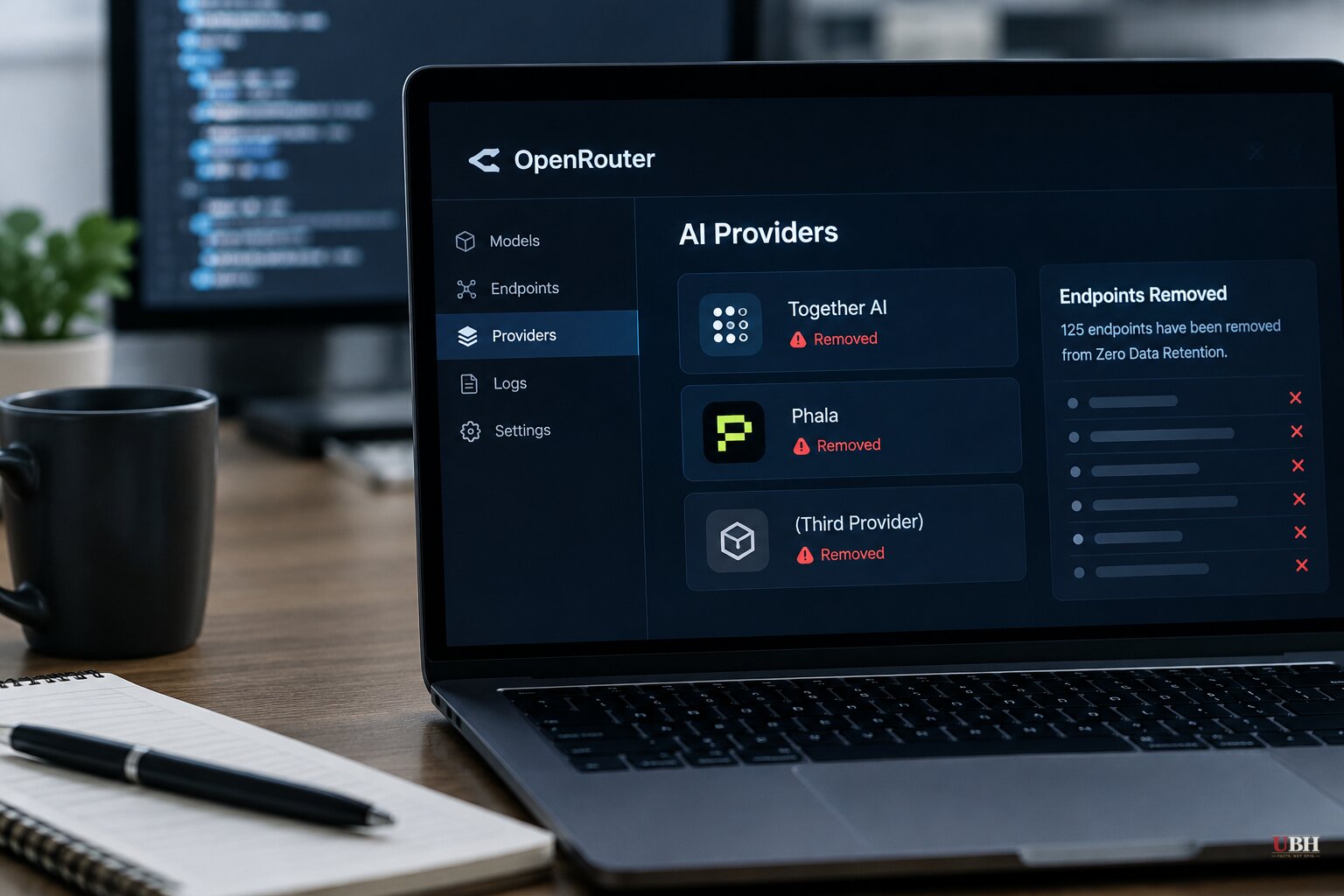
Since Dragos published its research on Nov. 19 showing attackers copying prompts from inside AI hosting firms, the fallout has moved from the researchers to the router: OpenRouter said on Nov. 22 that it removed three inference providers and stripped 125 endpoints of Zero Data Retention (ZDR) eligibility.
OpenRouter, which forwards developers' requests to third-party model hosts through a single API key, said it has notified all potentially affected customers. It also said the findings "did not show any breach or unauthorized access of OpenRouter." The company said the removals included precautionary cuts beyond the endpoints Dragos flagged.
Who got dropped
OpenRouter's own announcement does not name the three providers. BleepingComputer reported that they are Together AI, Phala and Novita. That naming comes from BleepingComputer's reporting alone. The same report says a fourth company, Atlas Cloud, will voluntarily withdraw its models from OpenRouter pending security testing after what it called a third-party incident.
Dragos has not named the three providers it says were breached. Neither Dragos nor OpenRouter has said whether the two groups of three are the same companies. Customers still cannot match the research to a specific host from those two sources.
What the providers say happened
The provider write-ups describe three different failures.
Together AI said an AI coding agent, while working in a public GitHub repository called xorl, committed a credential that opened a private Hugging Face repository. That repository held prompt samples from June and July covering MiniMax M3, GLM-5.2 and Kimi K2.6. Together said its scanning caught the commit and it was reverted, but an unauthorized party had already downloaded the samples. The intruder searched them for other service credentials and tested them. Five were Dragos canaries.
CEO Vipul Ved Prakash wrote that review of the affected prompt contents "is ongoing." Together has made zero data retention the default for new accounts and plans to contact its direct customers itself. The company also wrote, "We apologize for this incident."
Phala said an attacker used a legacy internet-facing service to reach management interfaces that did not authenticate callers on their own. The attacker later took over a new GPU server that was serving production traffic without full hardening, which exposed in-flight request data. The affected model is DeepSeek V4 Flash 0731.
Phala tells users to "treat request contents as exposed" for requests sent between Oct. 21 at 00:00 UTC and Nov. 8 at 05:35 UTC. Misused canary credentials came only from requests sent Oct. 21 and 22. Phala said the wider window is a precaution.
Novita, according to BleepingComputer's account of its announcement, said a routing misconfiguration sent some MiniMax requests, including ones relayed through OpenRouter, to MiniMax's official API between May 28 and Nov. 11. That is a different kind of problem from a break-in: the data went to the model maker's own endpoint rather than to an outside intruder.
All the providers say they are tightening security controls and advising potentially affected users to rotate any secrets that appeared in leaked requests.
What Dragos found, and what OpenRouter says
Dragos' HD Moore ran the study from July to November, sending about two million prompts that each carried a unique link or decoy credential. His team says a planted secret can only be learned by reading the prompt that held it, so any use of one proves someone looked.
The largest breach involved a couple hundred planted AWS keys, each sent once during short windows in late October. Dragos says every request in those windows was stolen, including some the provider had rejected before a model ran. The thief tested keys within hours, made tens of thousands of AWS API calls and tried to create Bedrock API keys and add IAM users. Dragos says one attacker appears to have compromised two providers from a single rented server. On Nov. 1, that attacker used the AI-driven penetration testing framework ARTEX to confirm held keys still worked.
Moore wrote that "a privacy flag doesn't help when the attacker is already inside," and that "Zero Data Retention is supposed to mean something." Dragos also reported that a Chinese AI lab it did not name fetched planted links from more than half the prompts sent to its models, including about two-thirds of those marked ZDR. Dragos recommends one first-tier provider under one contract and one privacy policy, or self-hosting, for prompts carrying customer data or credentials.
OpenRouter's position is narrower. It says the leaks happened at the provider level, not in its systems. It also says it is adapting Dragos' tests for continuous use to check whether providers forward or leak user requests to third parties, and that providers will need to pass validation before ZDR eligibility is restored. "Providers that want to be on OpenRouter will need to meet it," the company wrote of the higher bar.
What users need to do
OpenRouter says it has emailed affected users whether or not a provider posted publicly. It also says not every affected provider has published an incident write-up and that it is pushing them to.
Anyone who sent requests to DeepSeek V4 Flash 0731 through OpenRouter, or to MiniMax M3, GLM-5.2 or Kimi K2.6 at Together AI, should replace every API key, token and password that appeared in those requests, including credentials buried in pasted code or logs. Then check those accounts for unauthorized activity.
The open question is scope. Together's review of affected prompt contents is still underway, Phala's report is preliminary, and the identities of Dragos' three breached providers remain unconfirmed by Dragos itself.
Sources used for this briefing
7 links from 7 independent newsrooms (syndicated copies of the same report count once)
These are the sources it draws on, linked so you can verify.


