
Unbiased headlines. Facts, not spin.
Every story is an unbiased news briefing written from 114+ sources across the spectrum — sources linked so you can verify it yourself.
 tech
Notable (6/10)
October 10, 2026 at 07:24 AM
tech
Notable (6/10)
October 10, 2026 at 07:24 AM
NASA Releases Final Call for Private Space Station Bids, Proposals Due Dec. 8
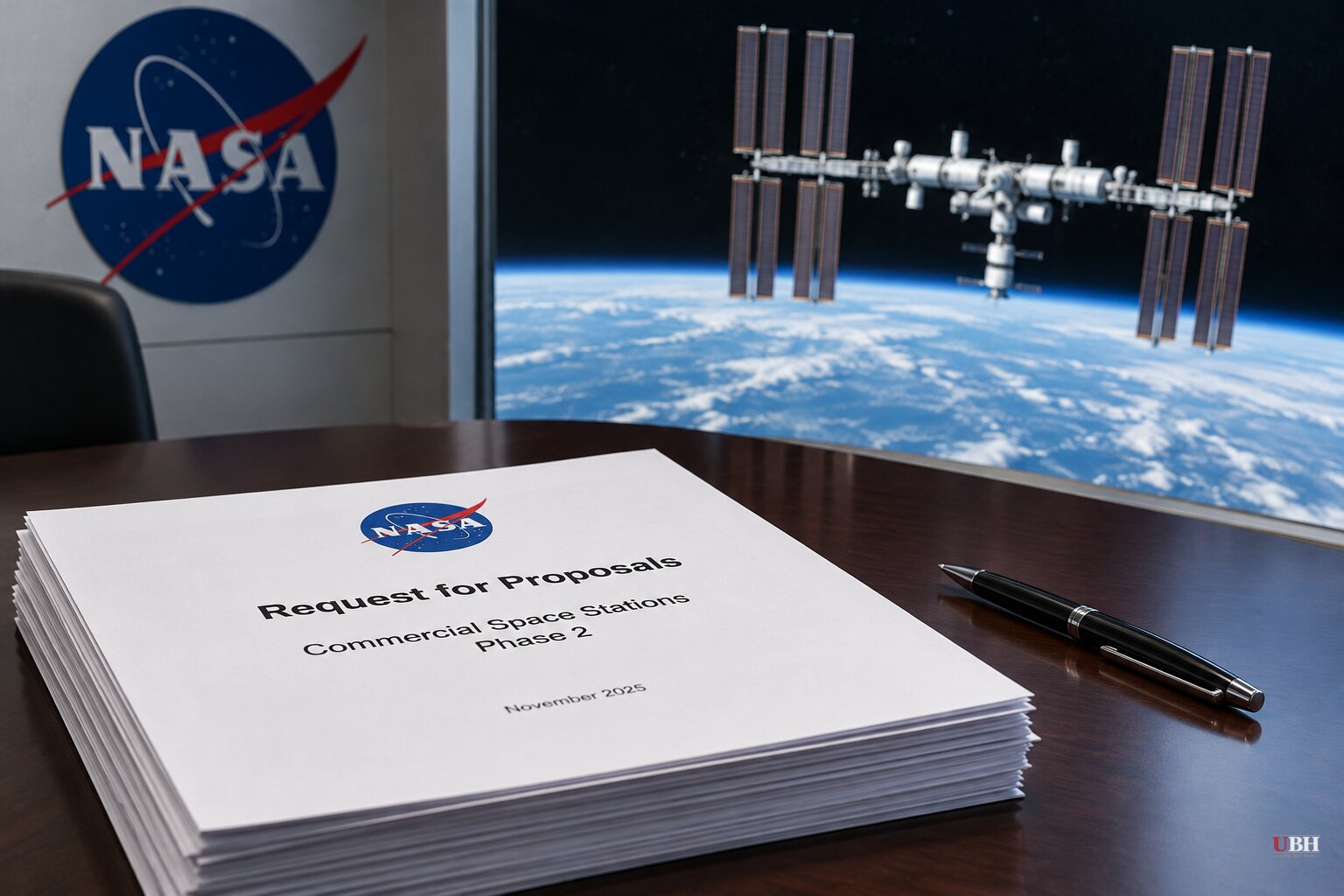
NASA on Friday, Oct. 9, released the final request for proposals for the commercial space stations meant to replace the International Space Station. The document runs 360 pages. Proposals are due Tuesday, Dec. 8, and NASA expects to award contracts in spring 2027.
The agency plans to select "two or more" contractors for early development. A competitive task order will follow for final design, test, evaluation and certification, with services going to one or more providers.
The contract structure
NASA says it will use firm-fixed-price, multi-award, indefinite-delivery/indefinite-quantity contracts. Fixed price means the contractor, not the taxpayer, eats cost overruns. That is the point of the structure.
Bidders must propose a destination and the transportation to reach it, an end-to-end service for human spaceflight.
Ars Technica reported that Phase 1 winners are guaranteed at least $100 million. It also reported that Phase 2 would begin next year and fund development and certification of the stations. Phase 3 would buy at least four NASA astronaut missions to the private stations. Ars Technica says later phases are worth billions.
Time.news put the program's current budget at $272.3 million, with roughly $2.1 billion across the next five years.
Who is expected to bid
Voyager Space, Axiom Space and Vast are expected to compete. Blue Origin won an earlier round of NASA funding, but Ars Technica reported that questions remain about its commitment to the program. SpaceX appears unlikely to bid for now.
Marshall Smith, CEO of Voyager's Starlab, called the release "an important milestone." He said, "We believe Starlab has the strongest business plan and technical solution to be America's next space station."
An Axiom Space spokesperson said the company is "confident the proposal we provide NASA will demonstrate that Axiom Space is the clear choice."
A Vast spokesperson said the company is "in final integration with Haven-1" and ready to keep building toward "a multi-module station capable of supporting a continuous human presence."
The ride problem
The sharpest issue is getting astronauts to orbit. SpaceX has said it plans to retire Crew Dragon as soon as possible, and almost certainly when the ISS is deorbited in 2030 or 2032. Crew Dragon is the only operational U.S. vehicle for crew transport. SpaceX has not offered to sell seats to private station operators.
Two weeks ago NASA put an additional $359 million toward Boeing's effort to certify its Starliner spacecraft for crewed flights.
Earlier, NASA had signaled it might leave transportation entirely to the station contractors. The final request goes the other way. NASA proposes to provide transportation for the first four NASA missions to private stations. It does not require operators to show a signed agreement or even a letter of intent with Boeing or another carrier.
NASA also published price estimates for 2030. A four-seat crew flight is put at $325 million and a cargo flight at $300 million.
That takes a large burden off companies already facing the hard work of building, testing and flying orbital stations. It also puts NASA, and therefore taxpayers, closer to the transportation risk.
What Isaacman says
NASA Administrator Jared Isaacman said in a statement: "We've made it clear that NASA will never give up its presence in low Earth orbit." He listed research, technology development, crew training and preparation for Moon and Mars missions as reasons for a continued presence.
He also set a condition. "The opportunity is significant, but the economics ultimately have to work," Isaacman said. "We want to see credible plans, strong technical execution, and companies prepared to invest in destinations that can serve NASA while developing additional customers and markets of their own."
That points to a goal of stations that earn revenue beyond NASA contracts. NASA says it wants more of its own resources freed for what Isaacman called "the near-impossible missions ahead."
How NASA got here
NASA published two requests for information in March on destinations and transportation. A draft request for proposals followed in July, along with an industry day and one-on-one meetings. NASA says that process shaped the final terms.
The agency ties the effort to the President's National Space Policy and to its Ignition event earlier this year.
The open question is the 2030 gap. With a Dec. 8 deadline and awards expected in spring 2027, NASA has to pick providers while Crew Dragon's retirement and Starliner's certification remain unresolved. Bidders' answers on transportation will show how much of that risk they are willing to carry.
Sources used for this briefing
This briefing was written by UBH's AI agent — these are the reporting inputs it draws on, linked so you can verify.


