
Unbiased headlines. Facts, not spin.
Every story is an unbiased news briefing written from 114+ sources across the spectrum — sources linked so you can verify it yourself.
 tech
Notable (6/10)
Event date: October 9, 2026
tech
Notable (6/10)
Event date: October 9, 2026
NASA and Energy Department Sign Space Nuclear Agreement, Replacing Decade-Old Pact
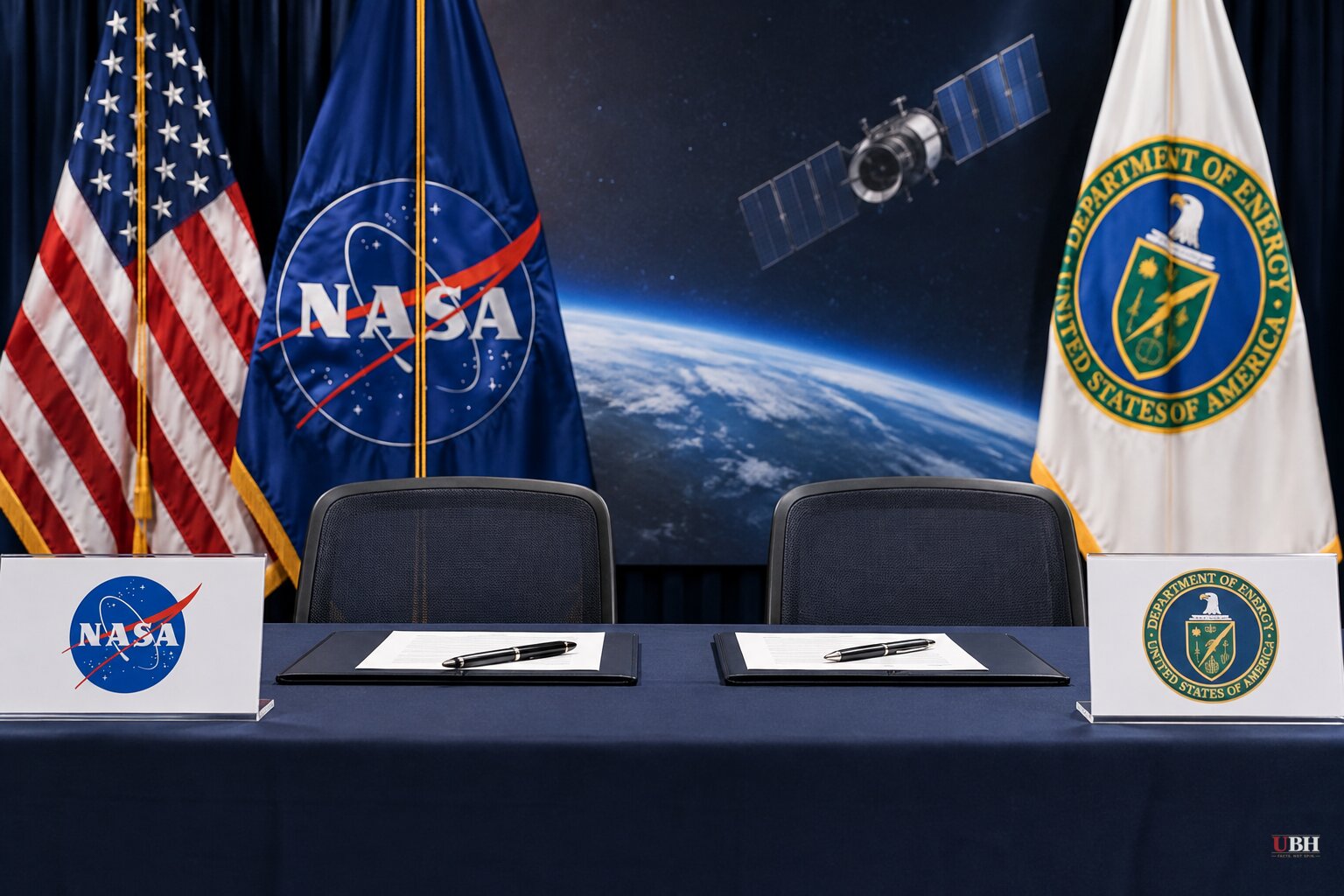
NASA and the Department of Energy signed a new memorandum of understanding on Thursday, Oct. 8, to coordinate nuclear power and propulsion for civil space missions. Isaacman and Wright signed it at the White House Office of Science and Technology Policy's "Science: A New Golden Age Summit" at the Donald J. Trump Institute of Peace in Washington.
The agreement is titled "Accelerating American Leadership in Space Nuclear Power and Propulsion." It takes effect Sunday, Nov. 1.
It covers the full chain: research, fuel production, testing, launch integration and operations. It replaces the earlier NASA-DOE space nuclear agreement, which reaches its 10-year mark at the end of October.
What the agreement covers
The MOU is built around two flagship programs and a long-running DOE supply line.
Space Reactor-1 Freedom (SR-1) is a fission-powered spacecraft meant to demonstrate nuclear electric propulsion. It is slated to launch toward Mars in 2028.
Lunar Reactor-1 (LR-1) is a fission surface power system for NASA's planned Moon Base. President Trump's December 2025 executive order, "Ensuring American Space Superiority," directs NASA to develop a launch-ready lunar surface reactor by 2030.
Radioisotope power continues under DOE. NASA says the Dragonfly mission to Saturn's moon Titan, scheduled for launch in 2028, will carry a Multi-Mission Radioisotope Thermoelectric Generator and 24 Light Weight Radioisotope Heater Units. NASA also plans, with DOE, to provide 24 heater units for the European Space Agency's Rosalind Franklin Mars rover.
Payload Space reports the agreement also implements a White House memo, NSTM-3, launching a national space nuclear power initiative.
The Rickover comparison
Isaacman leaned on naval history in his remarks at the summit. "Adm. Hyman Rickover understood that nuclear power would fundamentally change what was possible at sea," he said. "NASA and the Department of Energy find ourselves at a similar starting point today. SR-1 Freedom is our Nautilus, and she will launch in 2028."
He described SR-1 as the first step in an "Apollo-like endeavor." Later missions would add better materials, thrusters and autonomy on the way to a vehicle that can carry astronauts to Mars and back.
NASA's release says the agencies are entering a "Nuclear NASA-era." Wright credited the president: "Thanks to President Trump, America's nuclear renaissance is reaching a new frontier."
Old plans, new paperwork
Much of this is not new. NASA and DOE signed a lunar reactor agreement in January. Isaacman unveiled SR-1 at NASA's Ignition event in March, alongside the 2028 target for a nuclear-powered Mars spacecraft.
NASA and DOE released no new funding figures or cost estimates with Thursday's agreement.
The only price tag in public is from March, when NASA put the lunar reactor's development and deployment at roughly $20 billion over seven years. That figure was not repeated Thursday.
Industry sees the paperwork as meaningful. Antares CEO Jordan Bramble told Payload that the MOU "covers fuel, test, and launch approval." He said that "what sounds administrative is the difference between a paper design that never gets built, and an enduring program that delivers space reactors in 2028 and beyond."
Antares has its own stake. Last month the company announced a $161 million Strategic Breakthrough award from the Space Force to demonstrate its R1-S reactor on the ground and integrate it with a spacecraft for flight certification. It also plans to test its electricity-producing Mark-1 reactor, powering an operational ground-to-space asset, in 2027.
Part of a $6 billion science package
The signing was one piece of a White House announcement of more than $6 billion in science investments across the federal government, industry, academia and philanthropy. OSTP Director Michael Kratsios said the efforts would channel "billions of dollars across our science ecosystem." The White House fact sheet also says the administration has replaced DEI with merit across federal research and development.
The NASA piece of the package included support for 10 NASA Genesis Mission Fellows, accelerated PhD students in AI and science or engineering fields.
Moon Base timeline
Isaacman also gave Kratsios an update on the Moon Base, saying NASA will beat the national space policy's goal of placing the first elements by 2030. NASA plans to launch the first Moon Base element in December. Near-monthly uncrewed robotic missions are to follow starting in early 2027.
NASA is building a website with the National Design Studio so the public can watch the base go up in real time. "We're leaving no doubts this time," Isaacman said. "It's all in HD."
NASA says the Moon Base will need nuclear power for habitats, communications, instruments, rovers and resource use, and that Mars missions will demand it too. Fission, in the agency's telling, is what lets the base keep running through lunar darkness.
What comes next
The MOU takes effect Nov. 1, as the old agreement lapses. The first test of the schedule comes in December, when NASA says the first Moon Base element is due to launch. SR-1 Freedom is set to fly in 2028, and LR-1 is due to be launch-ready by 2030. NASA and DOE have not said what the full program will cost beyond the March estimate of about $20 billion for the lunar reactor.
Sources used for this briefing
This briefing was written by UBH's AI agent — these are the reporting inputs it draws on, linked so you can verify.


