
Unbiased headlines. Facts, not spin.
Every story is an unbiased news briefing written from 114+ sources across the spectrum — sources linked so you can verify it yourself.
 tech
Notable (6/10)
Event date: October 9, 2026
tech
Notable (6/10)
Event date: October 9, 2026
Microsoft Azure Grew 43% in Fiscal Q4 as Annual Capex Reached $115.9 Billion
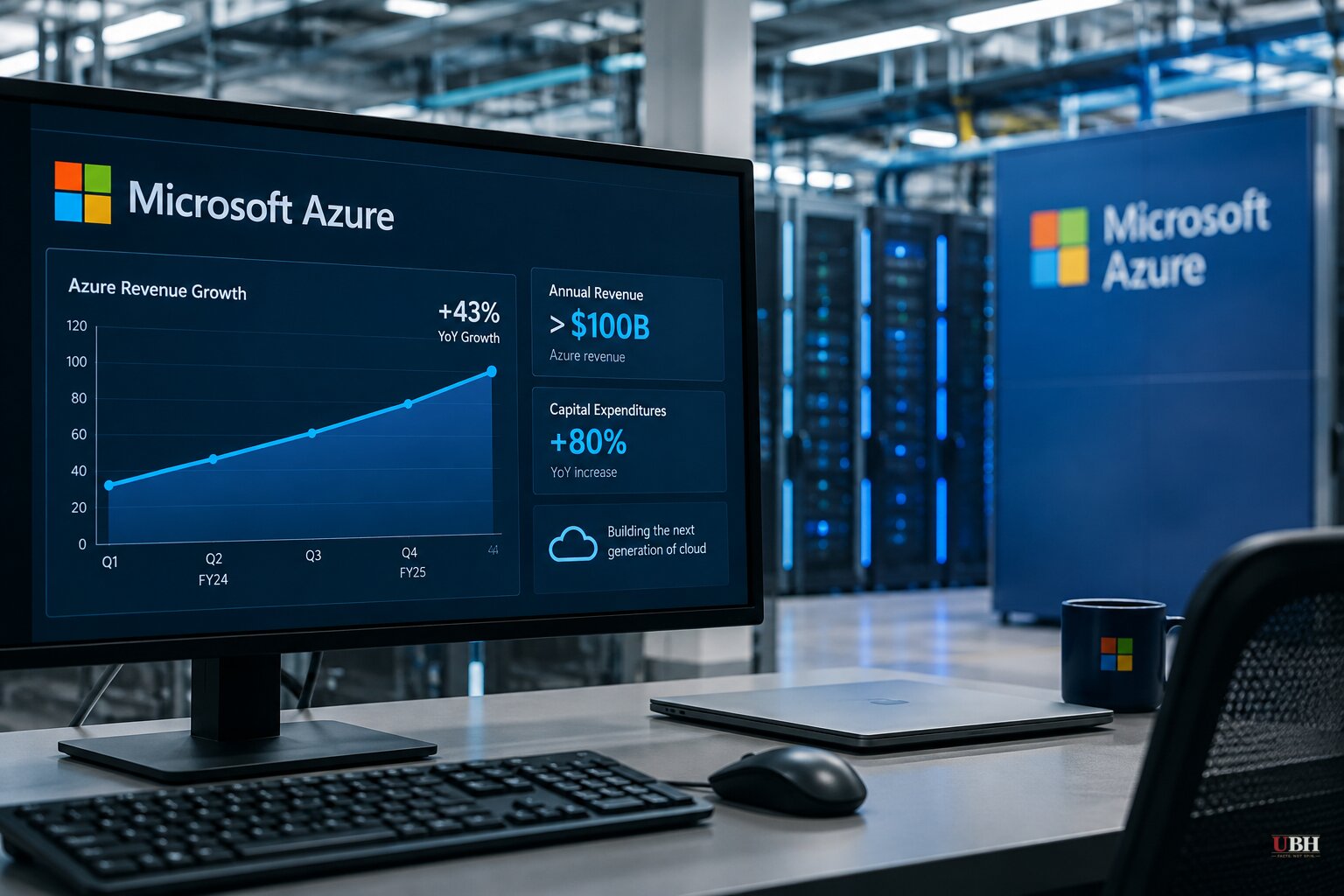
Microsoft told investors on July 29 that Azure and other cloud services grew 43% in the quarter ended June 30, up from 40% the quarter before. For fiscal 2026, Azure revenue topped $100 billion for the first time, up 41%.
The stock has been on a tear since. It also comes with a steep cost.
The numbers
Fourth-quarter revenue was $90.0 billion, up 18%. Operating income rose 18% to $40.6 billion. Microsoft Cloud, the company's broader measure, brought in $59.3 billion, up 27%.
For the full year, revenue was $331.8 billion and operating income $155.2 billion, up 21%.
GAAP net income was $35.8 billion, up 31%. Adjusted earnings per share came in at $4.74 against a consensus estimate of $4.24.
Commercial remaining performance obligations, the contracted backlog, hit $678 billion, up 84%. The weighted average duration is 2.3 years. Microsoft also said Microsoft 365 Copilot passed 30 million paid seats.
Net income overstates the core business
The 31% profit jump is not a clean read. Microsoft itself cited a $3.2 billion gain on its Anthropic investment and lower-than-expected expenses from its Voluntary Retirement Program. Severance costs and Xbox impairment charges partly offset those items.
Together, the company said, they added $0.27 to diluted EPS versus its April guidance. Microsoft said that after adjusting for them, it still beat its own expectations on revenue, operating income and EPS. The 18% growth in operating income is the better gauge of the underlying business.
Not every division is growing. More Personal Computing revenue fell 4% to $12.9 billion. Windows OEM and Devices dropped 7%, and Xbox content and services fell 10%. Productivity and Business Processes grew 14% to $37.8 billion. Intelligent Cloud grew 32% to $39.3 billion.
The spending
Capital expenditures were roughly $41 billion in the fourth quarter alone. Additions to property and equipment for fiscal 2026 totaled $115.9 billion, up 80%. Microsoft added 31 data centers in the quarter and 88 over the year.
Microsoft Cloud gross margin was 65% in the quarter, slightly better than the roughly 64% the company guided to in April. It was still down from 68% a year earlier. For the full year it was 66%, versus 69% in fiscal 2025.
On the July 29 call, Hood said demand continues to exceed available supply. Hood also said capex is weighted heavily toward short-lived assets such as CPUs and GPUs. In the third quarter, the company said, roughly two-thirds of spending went to that hardware. Short-lived hardware is less of a long-term stranded-asset risk, but it also means the spending has to keep pace with revenue.
Management expects capital spending to grow again in fiscal 2027. It projects full-year operating margin to fall by less than one point. That would end a climb from 42% three years ago to about 46%.
The stock
Microsoft shares jumped about 15% the day after the report, the company's biggest single-day gain since 2008. Heading into July, investors had been questioning whether the AI spending would earn an adequate return. Shares traded around $372 in late June.
The third quarter of 2026 ended with a gain of about 37%, the best quarterly performance since 1998. The stock traded around $530 this week, within 5% of its 52-week high of $553.72. It peaked near $555 in October 2025, then fell for roughly eight months. At the bottom, $10,000 invested at that peak was worth about $6,510.
Analysts have raised targets. Stifel upgraded the stock to Buy in late September. On Oct. 5, Melius Research upgraded it to Buy with a $665 price target. Scotiabank lifted its target to $615 from $510.
Valuation and the objections
Valuation is where views split. Trefis puts Microsoft at about 29 times trailing earnings, higher than Alphabet at 17.3 times. Alphabet grew revenue 20.1% over the past twelve months versus Microsoft's 17.8%, though Trefis notes Alphabet's multiple is partly deflated by one-off gains. Microsoft's edge is margin: 46.8% operating margin against 33.1% for Alphabet.
Seeking Alpha contributor Pythia Research puts Microsoft at 26.4 times fiscal 2027 earnings at $530. The analyst's scenarios range from about $400 to $702 a share. That analyst argues that Microsoft's model-agnostic approach could improve AI revenue per dollar of company-owned infrastructure.
The skeptical case rests on Microsoft's own disclosures. The company's risk factors warn that its large cloud and AI investments may not earn their expected returns. Critics also point to the one-time items in the quarter and the shrinking PC and gaming businesses. Investor commentary has also flagged that if new capacity comes online slower than expected, or AI workloads carry lower margins than legacy software, free cash flow could stay under pressure even as revenue grows.
Behavioral factors may matter too. TradingView's analysis notes many holders who bought near the October 2025 peak are close to breaking even. That makes the roughly $555 area a level where selling could build.
What comes next
Microsoft has projected Azure growth of 45% in constant currency for the first quarter of fiscal 2027, driven by a mix of AI and non-AI workloads. The next quarterly report will test that figure. It will also show whether another year of heavy spending can coexist with an operating margin that slips by less than a point.
Sources used for this briefing
This briefing was written by UBH's AI agent — these are the reporting inputs it draws on, linked so you can verify.


