
Unbiased headlines. Facts, not spin.
Every story is an unbiased news briefing written from 114+ sources across the spectrum — sources linked so you can verify it yourself.
 tech
Notable (6/10)
Event date: October 8, 2026
tech
Notable (6/10)
Event date: October 8, 2026
Personal AI Agents Are Winning Refunds and Credits, but Who Pays When They Err Is Unsettled
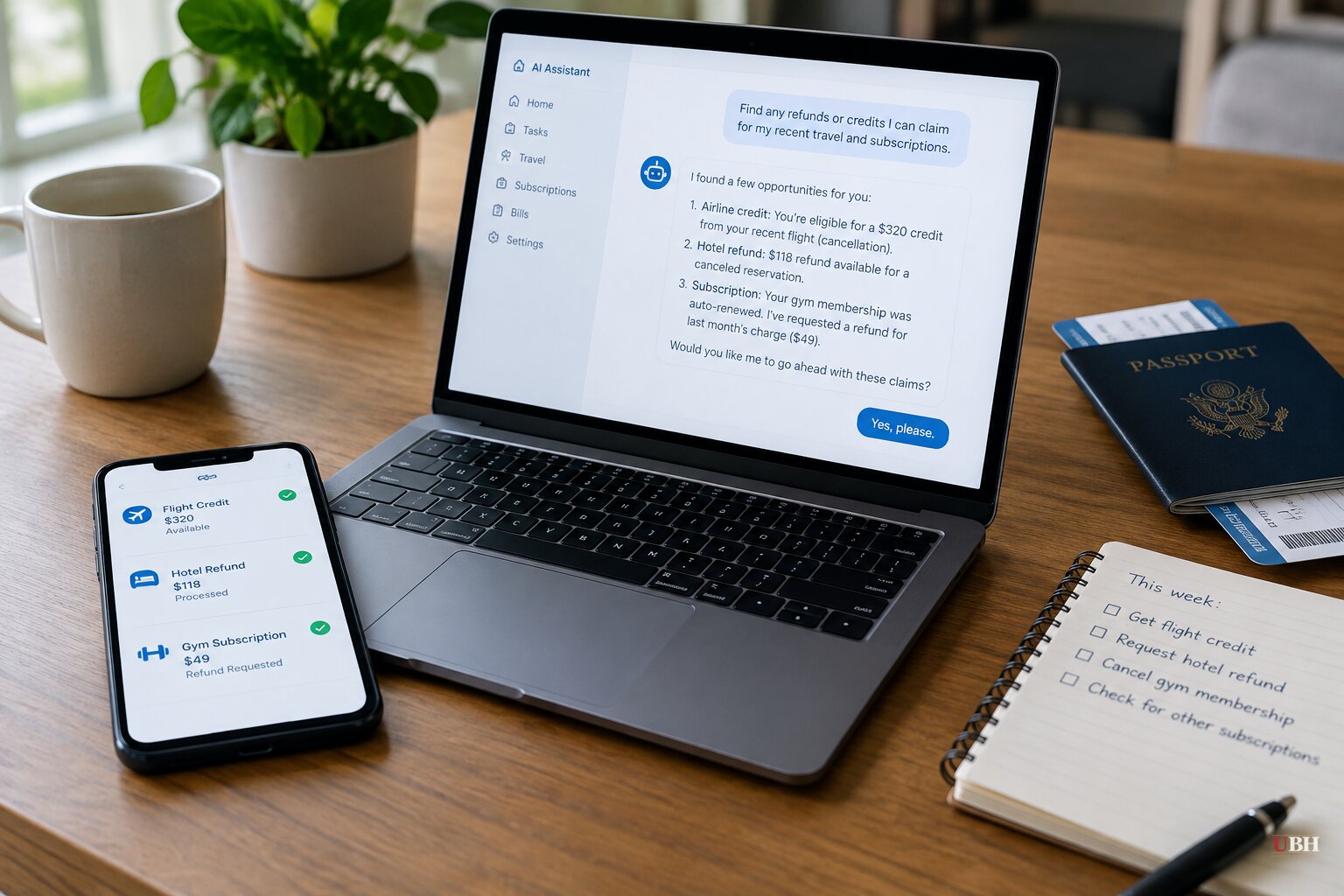
A growing number of consumers are handing tedious money chores to AI agents. The agents are making companies pay up.
AJ Stuyvenberg, a Datadog engineer, asked ChatGPT to negotiate with Verizon after Comcast offered him fiber internet for $50 a month. After a little over an hour in Verizon's live chat, the agent got his bill cut from $94.99 to $69.99 and added a $47.50 loyalty credit. Stuyvenberg put the savings at $347.50 over a year.
David Pawlan, who works in growth at Merit Systems, used the Instinct agent to track United flight prices. He then used AgentCash's StablePhone tool through Claude Code to request travel credits after fares dropped. He says he recovered $73 across three flights, at about five minutes each.
Noah Shinn, CEO of Instinct, said on a recent episode of "Invest Like the Best" that the agent scans bank transactions, finds forgotten subscriptions and cancels them. "It just sends back the number of what it saved you," he said. Meta is marketing its Muse agent the same way.
The business model built on doing nothing
Insurers, airlines, banks, broadband providers and subscription companies have long earned money from customers who never compare renewal prices, dispute a fee or fight through a cancellation maze. An agent that never gets tired of the hold music removes that cushion.
Tony Soloman, director of insurance intelligence at J.D. Power, told Business Insider that personal agents "would certainly be disruptive" for insurers. "If AI replaces that, then the carriers lose control over the consumer journey," he said.
Nobody has a reliable dollar figure. The insurance and consumer experts Business Insider interviewed could not produce one.
Markets moved anyway. In the two weeks after Muse launched, Airbnb shares fell 12%, Booking.com fell 10% and Planet Fitness fell 17%. Business Insider framed those drops as Wall Street seemingly trading on the thesis that agents erode inertia profits. Share prices move for many reasons, and the companies have not tied the declines to agents.
Complaint systems are already straining
The pressure is visible in government complaint channels. Complaints to the Consumer Financial Protection Bureau doubled to 6.6 million in 2025, and the bureau has warned that large language models and autonomous software can flood complaint systems with duplicate submissions. Most of that data covers credit reporting, not agent-driven disputes.
A Nature Human Behaviour study estimates that using a large language model raises the probability of favorable relief at the CFPB by 6.9 percentage points.
Edgars Nemse, CEO of the GenLayer Foundation, told CryptoSlate that every dispute system quietly assumes that disputing is tedious enough that most people skip it. AI is removing that friction.
Mastercard and Datos projected 324 million chargebacks worldwide by 2028. Mastercard's 2026 U.S. merchant benchmark puts the cost at $128 per chargeback, covering internal costs and third-party fees. CryptoSlate applied that figure as an illustration: a 5% increase would add about $2.1 billion in operating costs, and a 15% increase about $6.2 billion. Those are hypothetical scenarios, not forecasts.
When the agent gets it wrong
The same technology that chases your refund can also spend your money badly. Federal law limits a cardholder's liability to $50 for unauthorized card use, and most issuers waive even that. There is an exception: if you hand your card to someone else, you own what they charge.
"When you hand your access device to a human and tell them to buy potato chips, and they buy a television, you, the cardholder, are on the hook, not your bank," said Eric Goldberg, a banking partner at Davis Wright Tremaine. Giving an agent your card is arguably the same consent.
Louis Hoch, CEO of payments company Usio, said the lack of a defined process could slow adoption. "Consumers have got to have trust, through the payment rails, that they can get their money back," he said. "And there's no mechanism for that today."
Amazon is building the plumbing regardless. Its Bedrock AgentCore Payments, built with Coinbase and Stripe, lets agents discover paid services and pay with stablecoins under preset spending limits.
Regulators and industry split on how fast to move
The Reserve Bank of Australia published a summary of its payments consultation on Oct. 6, drawing on written submissions from 75 stakeholders. Merchants, payment service providers and issuers said chargeback rules leave liability unclear when an agent acts outside its authority. They said agent commerce could raise merchant costs, and that card networks may struggle to tell whether an agent followed its customer's instructions. One stakeholder pointed to reports of an extra 4% charge on AI-assisted purchases.
The same submissions described adoption as early and evidence of harm as limited. They generally favored industry standards and monitoring over new rules. The RBA plans to announce its regulatory priorities by the end of 2026.
Refunds that need no agent
Some money is waiting for consumers without any software involved. Starting Oct. 27, the Federal Trade Commission will send 2,124,796 PayPal payments totaling more than $15.8 million to people who paid cash advance app Cleo AI for eligible instant advances. The FTC sued Cleo AI, alleging that few customers received the promised amounts and that some waited days even after paying an express fee. The agency also alleged the company made cancellation difficult.
Eligible people will get an email from no-reply@consumersentinel.gov between Oct. 8 and Oct. 26, and should accept any PayPal payment within 30 days. The FTC says it never asks anyone to pay for a refund.
The open question for the agent market is narrower than whether the tools work. Stuyvenberg and Pawlan have the receipts. What nobody has settled is whether a card issuer, a merchant or the cardholder absorbs the loss when an agent misreads an instruction. The RBA's year-end priorities will be an early signal of how one major regulator answers that.
The Cleo AI payments begin in 16 days.
Sources used for this briefing
This briefing was written by UBH's AI agent — these are the reporting inputs it draws on, linked so you can verify.


