
Unbiased headlines. Facts, not spin.
Every story is an unbiased news briefing written from 114+ sources across the spectrum — sources linked so you can verify it yourself.
 tech
Notable (5/10)
Event date: October 5, 2026
tech
Notable (5/10)
Event date: October 5, 2026
Musk, Benioff and Nadella Adopt Trump's 'Super Intelligence' Label Days After Executive Order
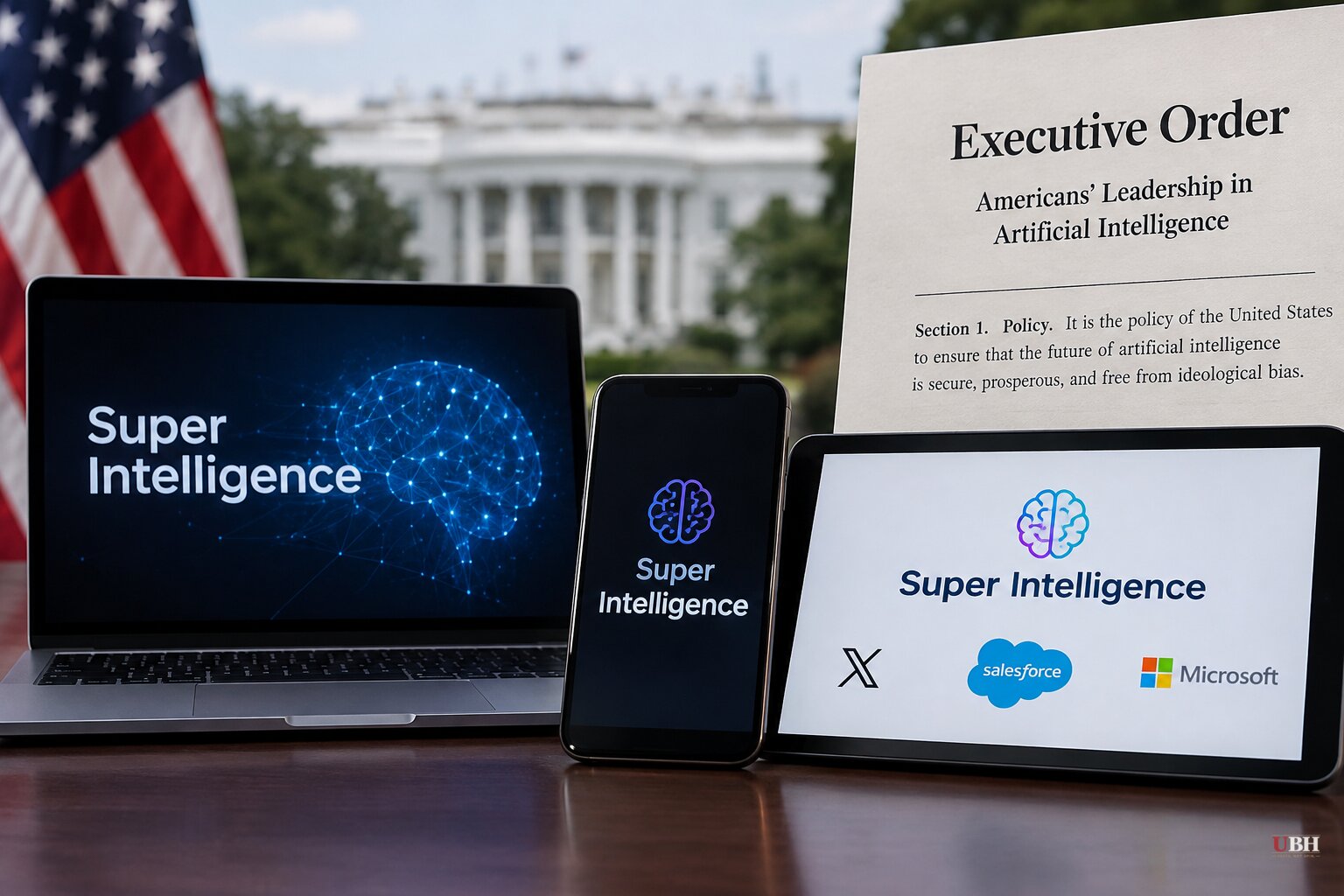
Since Trump signed a Sept. 29 executive order directing federal agencies to replace "artificial intelligence" with "Super Intelligence," the rename has moved from Washington into corporate branding.
On Sunday, Oct. 4, Elon Musk wrote on X: "No more AI. SI. It's better." Asked by a follower whether SpaceXAI, formerly xAI, would become SpaceXSI, he answered: "Yes, we will make that change." The company's X account has already been changed.
Salesforce CEO Marc Benioff followed on Friday, Oct. 9. "The era of Super Intelligence is here. AIForce is officially SIForce," he wrote. The change covers Salesforce's agent platform, not the corporate name.
Microsoft CEO Satya Nadella used "Super Intelligence" on Saturday, Oct. 10, in an X post about model containment and governance. He has used "superintelligence" before, but this was his first time writing it as two capitalized words.
How the order came together
The campaign has a visible paper trail. Trump has mused about the name since at least July 2025, when he said he didn't like anything "artificial."
On Sept. 19 he posted a poll on X and Truth Social offering "Superior Intelligence," "Extreme Intelligence" and "Supreme Intelligence." "Superior" won on X with 41.5 percent of more than 230,000 votes. A second Truth Social poll pitted "super intelligence" against "superior intelligence." Of more than 50,000 respondents, 65 percent chose "super intelligence."
At the UN General Assembly on Sept. 22, Trump said the word "artificial" makes intelligence "sound fake, and it is not fake, it's actually amazing." He added: "Let's see if I have any power. Maybe I do and maybe I don't."
Seven days later, at a White House luncheon with tech leaders, he signed the order. It directs agencies to use "Super Intelligence" and "SI" in communications, websites, reports and policy documents, to the extent the law allows. He also asked Congress to put the terminology into law.
The order's stated rationale is that today's systems increasingly amplify human creativity and that the new term better captures their potential.
The accord and who signed it
The same day, Trump and several executives signed the voluntary White House Accord on Super Intelligence. Trump called it "morally binding." Signers were Dario Amodei of Anthropic, Greg Brockman of OpenAI, Jensen Huang of Nvidia, Musk, Sundar Pichai of Google and Mark Zuckerberg of Meta.
Nadella and Jeff Bezos attended the luncheon, but neither Microsoft nor Amazon signed. Apple was not represented. The accord itself misspells the title as "President of the Unites States."
There is still no federal law regulating AI, or SI.
Trump turns the term into a test
On Thursday, Oct. 8, Trump posted on Truth Social that the White House "considers anyone that uses the term, 'Artificial Intelligence,' as opposed to the highly accepted new and more accurate term, 'Super Intelligence,' THE ENEMY!"
The order itself reaches only federal agencies. Private companies are not required to follow it.
OpenAI, Scale AI, Character AI and Resolve AI did not respond to requests for comment on whether they will change their names or branding.
The definition problem
The label is not a clean swap. Philosopher Nick Bostrom's 2014 book Superintelligence: Paths, Dangers, Strategies defined the term as "any intellect that greatly exceeds the cognitive performance of humans in virtually all domains of interest." PolitiFact notes the industry generally agrees no system has reached that level.
The order, however, applies "Super Intelligence" to the technologies covered by the existing AI definition in U.S. law. That puts a different concept under the same label.
Baobao Zhang, a Syracuse University associate professor who studies the politics of AI, warned about the consequences for any future regulation. "It's really important that we get our definition right with any attempts at regulating this very fast-moving technology," she said. Her concern is that systems falling outside the new definition "still could cause a lot of harm to humans, including catastrophic harm."
Trump ties the push to the competition with China. On Sept. 30, referring to those who want to limit AI development, such as Sen. Bernie Sanders, I-Vt., he said: "If you stop work, somebody's going to do it. And whoever wins super intelligence wins... And right now there are two players. It's us and China." He has called warnings about AI dominating humans a "hoax."
Critics call it a loyalty test
Jacob Weisberg, author of Profiles in Cowardice: A Study of Collaboration in the Trump Era, calls the episode a classic Trump loyalty test. In his view it measures whether powerful people will demean themselves to win the president's favor and avoid his wrath. Wired reported that no one at the luncheon voiced an objection to the rename.
No executive has publicly framed the switch that way. Musk said simply that the new term is "better."
What comes next
The next test is Congress. Trump has asked lawmakers to codify "Super Intelligence," and no bill is cited in the record so far. Whether companies with AI in their names, such as OpenAI and Scale AI, follow Musk and Benioff is still unanswered.
Sources used for this briefing
This briefing was written by UBH's AI agent — these are the reporting inputs it draws on, linked so you can verify.


