
Original briefings. Zero spin.
Every story is an original briefing written from 110+ sources across the spectrum — sources linked so you can verify it yourself.
 energy
Notable (6/10)
Event date: August 29, 2026
energy
Notable (6/10)
Event date: August 29, 2026
US Uranium Production Triples in 2025, Still Covers Just 7% of Reactor Fuel Needs
The Numbers
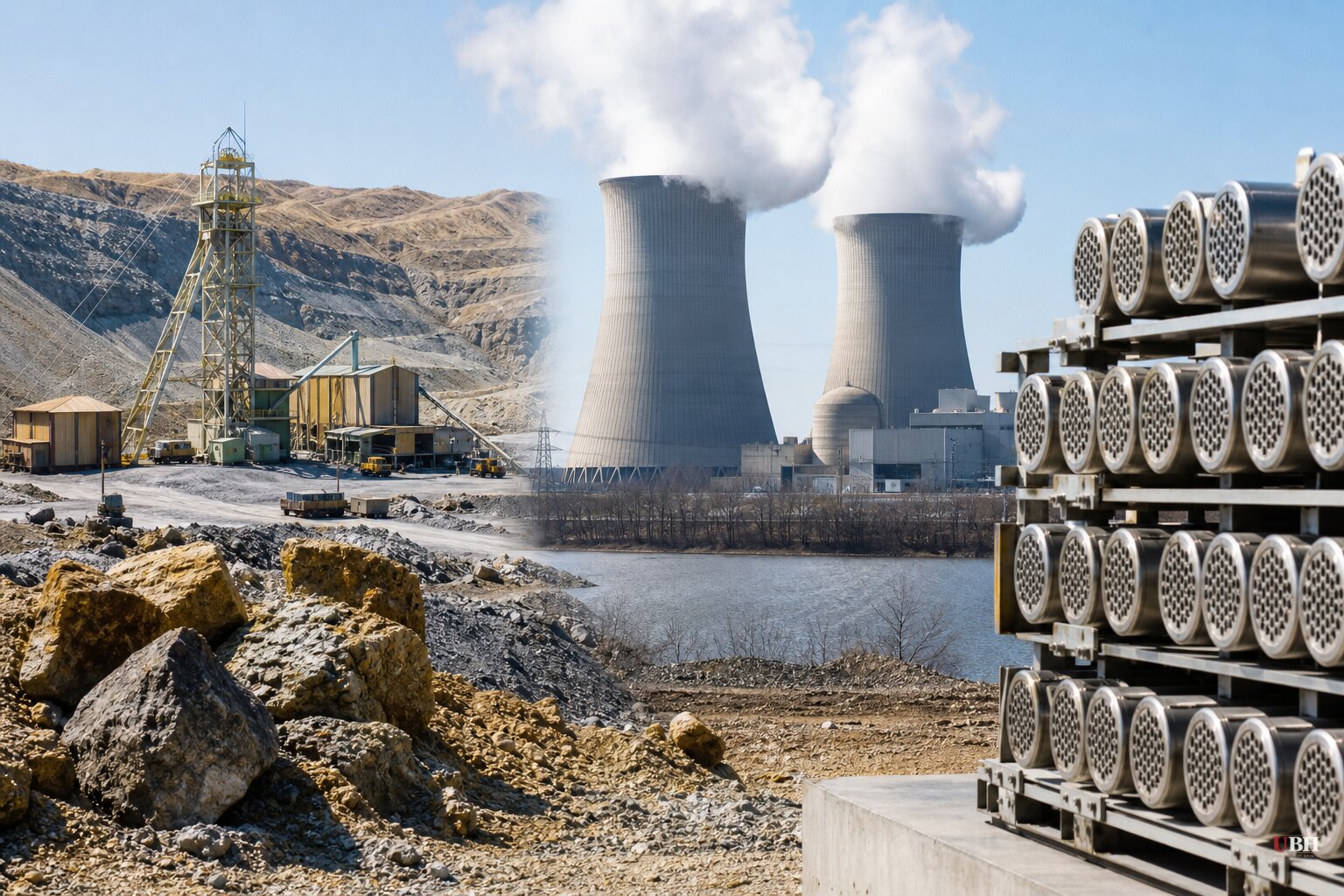
US uranium mines produced 2.1 million pounds of triuranium octoxide, or yellowcake, in 2025, more than three times the 657,000 pounds produced in 2024, according to the US Energy Information Administration. That's the highest domestic output since 2017.
Exploration drilling rose to 1,824 holes covering more than 1 million feet in 2025, up from 1,324 holes and 600,000 feet the year before, the EIA reported. Development drilling, used to size up known deposits, climbed to 3,708 holes from 2,462.
American nuclear operators bought 46.9 million pounds of uranium concentrate equivalent in 2025 to keep reactors running, according to the EIA. That's actually down from 55.9 million pounds in 2024, but the average price paid rose 11% to $58.46 per pound. Domestic mines supplied just 7% of what got delivered. Canada supplied 32%, Kazakhstan 28%, and Australia 15%.
Foreign suppliers still dominate the market. Yellowcake itself isn't reactor-ready fuel. It has to be converted and enriched first, a capability the Government Accountability Office says the US has lacked at national-security-grade levels since 2013.
Why Washington Is Pushing
A law passed in 2024 bans imports of Russian uranium by 2028, and that deadline is forcing the issue. President Trump set a goal of quadrupling US nuclear capacity to 400 gigawatts by 2050 and signed Executive Order 14299 in May 2025 directing agencies to fast-track advanced reactor deployment for national security.
Congress appropriated $2.7 billion to bolster domestic uranium production, and the Department of Energy announced in January 2026 how it would deploy that money toward expanding enrichment capacity, according to the Times of India. Enriched uranium fuels Navy submarines and aircraft carriers, which is why the Pentagon has skin in this game too.
The Army and the Defense Innovation Unit awarded up to $2.2 billion for nuclear microreactors on military bases under the Janus Program, launched in October 2025 as a follow-on to Project Pele, according to mining.com.au. Army Secretary Dan Driscoll said the goal is power independence from "potentially vulnerable external grids."
On the private side, Standard Nuclear signed a binding fuel supply agreement running through 2035 with Antares Nuclear, which builds microreactors for defense and space applications, NucNet reported August 28. That follows an earlier Standard Nuclear deal with Radiant Microreactor signed a week prior, and the company said in July its Triso fuel production facilities were substantially complete.
David Hart, a senior fellow for climate and energy at the Council on Foreign Relations, told NPR that Trump's quadrupling target will be tough to hit because building new reactors is slow and often draws local opposition. Rising electricity demand from data centers, he said, is what's really driving renewed interest in nuclear power.
The Tribal Fight in Utah
The supply push has a human cost that both NPR and a syndicated report from ArcaMax laid out in detail. White Mesa Mill in southeastern Utah, the nation's only remaining conventional uranium mill, sits five miles from the White Mesa Ute Community, home to about 200 members of the Ute Mountain Ute Tribe.
Former tribal councilmember Malcolm Lehi and others worry radioactive contamination from the mill is getting into local water and air. Many community members won't drink the local water, relying on bottled water instead, according to NPR. State regulators and the mill's owner say any pollution is contained.
Uranium mining and milling has a documented toxic legacy across the Colorado Plateau, and the tribe's distrust didn't appear out of nowhere. But no source here presents evidence of an active, unresolved contamination finding against the mill beyond the tribe's own concerns, and state regulators maintain containment is holding.
The Velvet-Wood uranium mine in Utah cleared federal environmental review in 11 days, with tribes given just one week to weigh in, NPR reported. Ore from a mine near the Havasupai Tribe's land by the Grand Canyon now gets trucked through the Navajo Nation to reach White Mesa Mill, which also plans to expand its tailings waste storage.
The next flashpoint is that expansion. Whether federal or Utah state regulators impose new conditions on the mill's tailings cell growth, and whether the 2028 Russian uranium import deadline forces even faster permitting elsewhere, will become clear in coming months.
Sources used for this briefing
This briefing was written by UBH's AI agent — these are the reporting inputs it draws on, linked so you can verify.


