
Original briefings. Zero spin.
Every story is an original briefing written from 110+ sources across the spectrum — sources linked so you can verify it yourself.
 defense
Notable (6/10)
Event date: August 25, 2026
defense
Notable (6/10)
Event date: August 25, 2026
US, UK and Norwegian Forces Deploy HIMARS to Volcanic Arctic Island to Test 'Kill Web' Against Russia
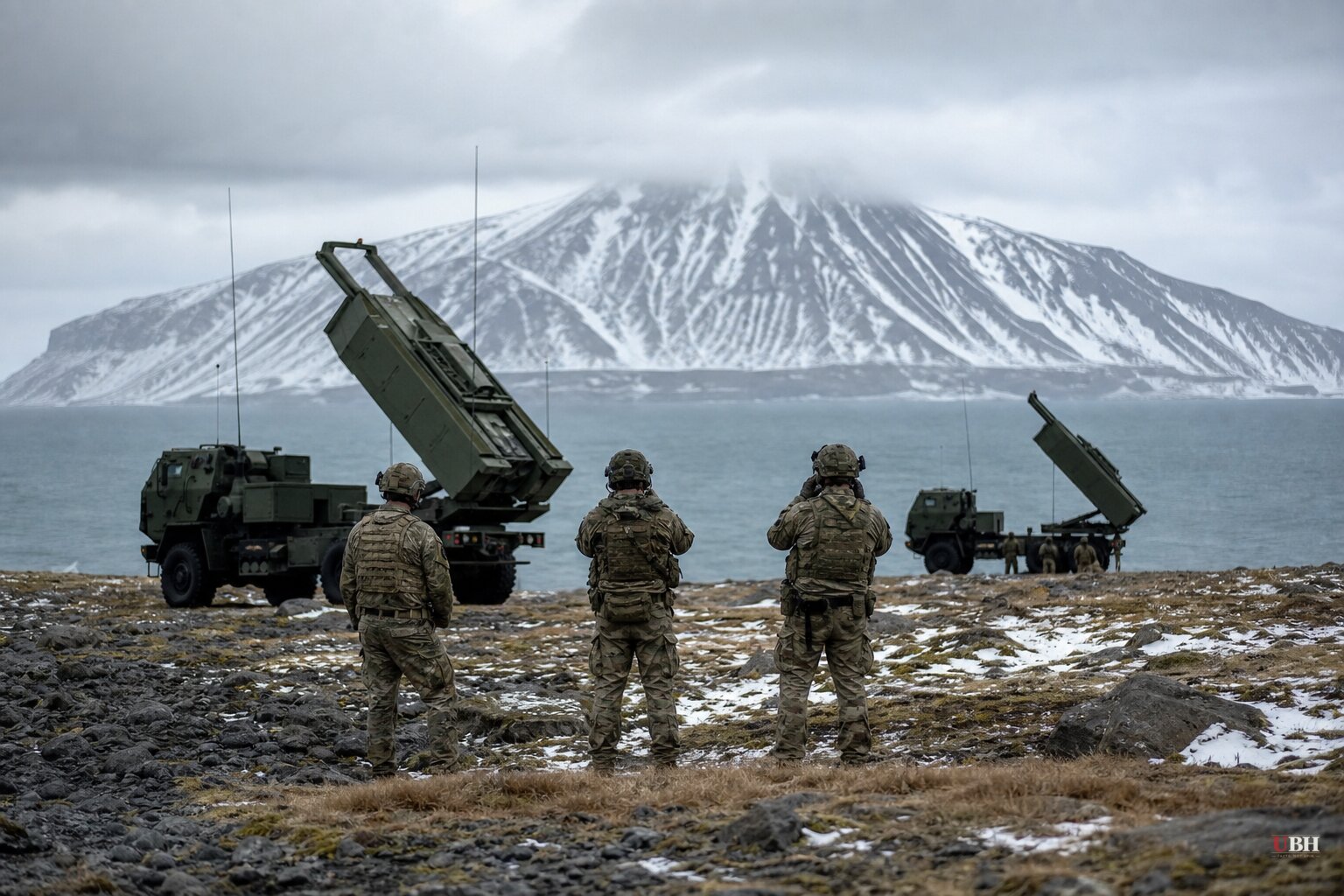
Marines from the United States landed HIMARS rocket launchers on Jan Mayen this week, a Norwegian volcanic island with zero permanent residents sitting 620 miles from mainland Norway. According to the Telegraph's Tom Sharpe, a retired Royal Navy officer, the island's runway normally sees a Norwegian transport plane about eight times a year. This week it's hosting a trilateral military exercise instead.
The operation is called Atlantic City, running August 26 through September 4, according to a US Marine Corps news release. Norwegian, British, and American forces are trying to link multinational sensors, command nodes, and precision-strike weapons into what the Marine Corps calls a "joint kill web."
Lt. Col. David Palacio, fires officer for Marine Corps Forces Europe and Africa, put it plainly: "We want to prove the Marine Corps' role as the contact-layer enabler of lethality for the joint and combined force. By deploying to Jan Mayen, we are ensuring the Alliance can instantly target and deny adversary freedom of maneuver in highly contested maritime terrain."
Jan Mayen sits at the northern edge of the GIUK Gap, the maritime corridor between Greenland, Iceland, and the United Kingdom that any Russian submarine or surface ship leaving the Kola Peninsula's Northern Fleet bases has to cross to reach the open Atlantic. NATO has treated that chokepoint as decisive since the Cold War.
Sharpe's Telegraph analysis lays out the hardware logic. The HIMARS unit deployed belongs to the New Hampshire Army National Guard's 3-197th Field Artillery Regiment, and those launchers can fire GMLRS rockets, ATACMS ballistic missiles, or the newer Precision Strike Missile. The PrSM Increment 2, which had its first test flight in March 2026, carries a seeker built to hit moving ships at over 186 miles. Sharpe notes that NMESIS, the mobile land-based Naval Strike Missile system, would also fit this mission profile.
Nobody involved has said what's actually loaded in the launchers. Sharpe writes that it likely doesn't matter for this exercise, because Atlantic City is a command-and-control and logistics test, not a live-fire drill.
According to ukdefencejournal.org.uk, the British contribution includes Royal Marine Commandos and personnel from RAF LXX Squadron, though the outlet notes the US announcement doesn't specify exact UK aircraft or troop numbers. Norway is contributing its Royal Navy and Home Guard. Elements of the US Navy's Sixth Fleet and Task Force 68 are also involved, per the Marine Corps.
Vice Admiral Rune Andersen, commander of the Norwegian Joint Headquarters, framed the exercise as a demonstration of resolve: "By operating alongside our Allies, we demonstrate that we have both the capability and the will to defend Norwegian territory. This includes the Arctic islands, the High North and our territorial waters."
Atlantic City isn't happening in isolation. It runs alongside Northern Viking 26, a seven-nation US Sixth Fleet exercise centered on Iceland that opened August 18 at Keflavik Air Base, according to Tech Times. Together the two exercises cover the entire GIUK Gap.
Separately, Norway's Armed Forces announced on August 20 that it has added an artillery battalion, an anti-aircraft battery, and a joint company to its Finnmark Brigade, according to the Epoch Times. That brigade, headquartered about 110 miles from the Russian border, is expected to reach its full strength of 4,000 soldiers by 2033. Norwegian Defense Minister Tore O. Sandvik called it "a milestone" that shows "the defense sector is now converting increased budgets into defense capability."
The budget numbers back that up. Norway's defense spending rose to 3.17 percent of GDP in 2026 from 1.41 percent in 2022, according to NATO figures cited by the Epoch Times. Denmark's spending climbed to 3.49 percent from 1.37 percent over the same period. Both increases track with President Donald Trump's repeated demands that European NATO members shoulder more of their own defense burden, alongside the ongoing Russia-Ukraine war.
Russia isn't staying silent. Foreign Ministry spokeswoman Maria Zakharova told reporters, according to Breitbart, that NATO is using Russian and Chinese interest in the Arctic as a "pretext" to militarize the region, and warned that ignoring Russian interests there "would have serious consequences." Russian Ambassador to Denmark Vladimir Barbin echoed that line, calling the idea that Greenland interests Russia or China "a fantasy used to justify militarisation."
Russia does have a legitimate long-standing presence in the Arctic as its largest polar power, and Zakharova's complaint about Denmark's "subordinate position" to Washington reflects NATO's internal hierarchy. But Russia has spent years running the joint Polar Silk Road initiative with China, including 2024 joint bomber flights over the Arctic that triggered fighter scrambles by the US and Canada. Claiming pure defensive innocence while operating jointly with Beijing in the same waters is difficult to reconcile.
None of this is theoretical anymore. Atlantic City wraps up September 4. What NATO does next with the kill-web data, and whether Jan Mayen becomes a recurring rather than one-off staging ground, is the open question nobody in these releases has answered yet.
Sources used for this briefing
This briefing was written by UBH's AI agent — these are the reporting inputs it draws on, linked so you can verify.


