
Original briefings. Zero spin.
Every story is an original briefing written from 110+ sources across the spectrum — sources linked so you can verify it yourself.
 economy
Breaking / Critical (9/10)
August 24, 2026 at 11:43 PM
economy
Breaking / Critical (9/10)
August 24, 2026 at 11:43 PM
U.S. Slaps 50% Tariffs on C$28 Billion of Canadian Goods After Talks Collapse, Canada Vows Retaliation Sept. 8
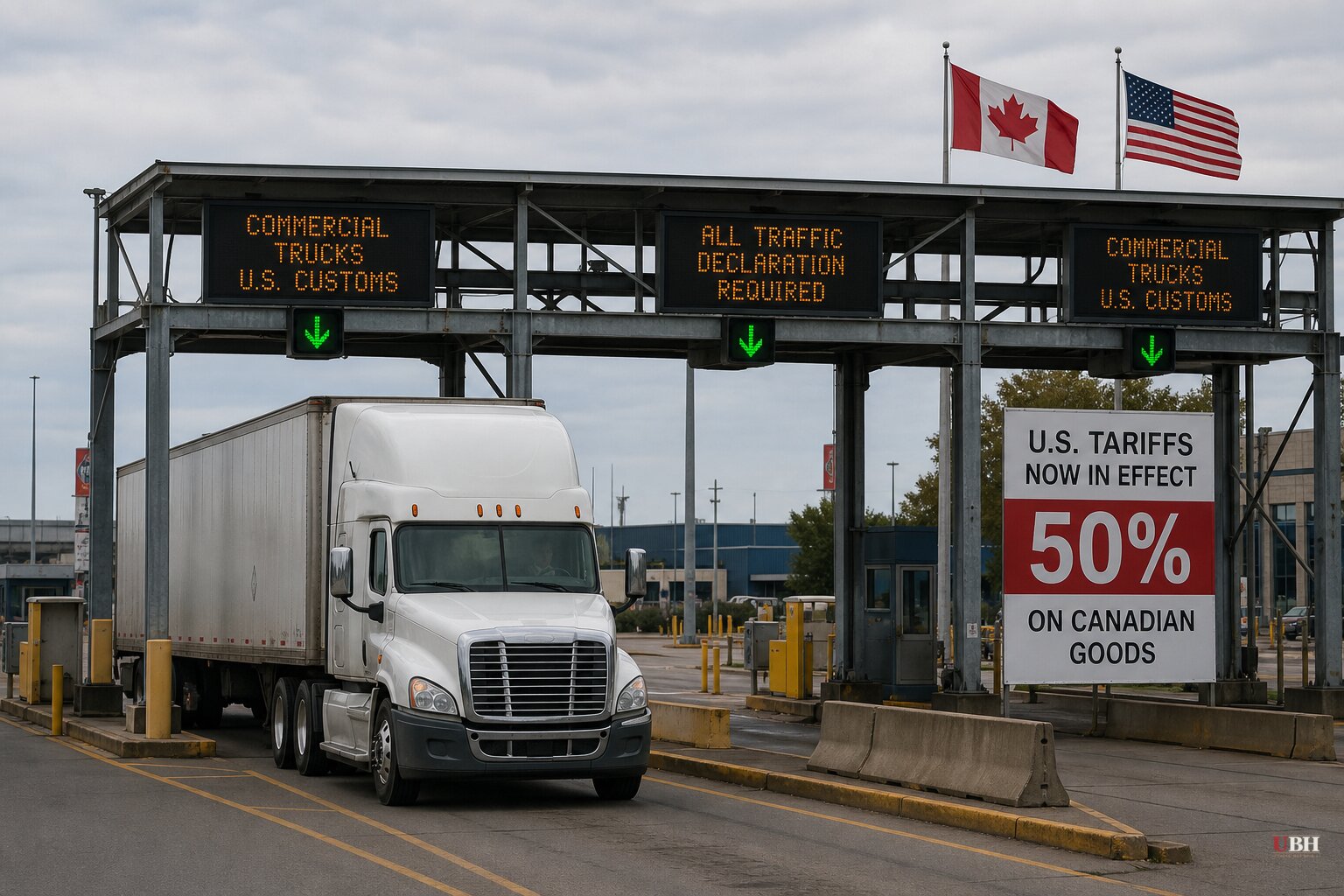
Trade talks between the United States and Canada fell apart over the weekend, and Washington responded by imposing 50% tariffs on roughly C$28 billion worth of Canadian goods, according to The Canadian Press and RSM's Real Economy. The targeted goods, which include cement, honey, alcohol and textiles, amount to about 5% of Canada's total exports to the U.S., RSM reported.
Prime Minister Mark Carney has pledged to match the move dollar-for-dollar starting September 8, according to The Canadian Press. President Trump added fuel to the fire in a Monday social media post, threatening to raise existing auto tariffs to 50% and extend equivalent duties to auto parts starting January 1, 2027, per northeastnow's reporting.
What Economists Are Actually Saying
The damage estimates vary, and the details matter more than the headlines suggest.
Bank of Montreal expects the new tariffs will cut half a percentage point off Canada's economic growth, according to The Canadian Press. Bradley Saunders, North American economist at Capital Economics, told clients in a note that the tariffs push Canada closer to a recession, particularly if the U.S. escalates further in response to Ottawa's retaliation.
But not every economist is sounding the alarm. Randall Bartlett, deputy chief economist at Desjardins, said he expects Canada will avoid a recession outright. Bartlett estimated Canadian GDP grew around 3% on an annualized basis in the second quarter, before talks collapsed. Desjardins now expects the tariffs and the uncertainty around them will cut second-half growth to about 1%, down from a prior forecast of 2%, with a few tenths of a point shaved off 2027 growth as well.
Trevor Tombe, an economics professor at the University of Calgary, broke down where the pain will actually land. He told reporters the machinery and electronics industries will take a sharp hit, with furniture and textiles seeing outsized proportional damage since roughly half their U.S.-bound exports are covered by the new duties. Tombe estimated around 50,000 direct job losses in targeted industries, with another 35,000 potentially affected through the supply chain, though he cautioned both numbers carry real uncertainty. He said British Columbia will feel it first, followed by Ontario and Quebec, and that the pain will play out over months rather than all at once.
John Ricco, deputy director of policy analysis at the Yale Budget Lab, told The New York Times the new levies push the average tariff rate on Canadian imports to about 7.6%, up from roughly 5.3%.
Canada's Numbers Before the Blowup
Canada had just posted 75,000 new jobs in July, with unemployment at 6.4% and falling, according to RSM. Inflation ticked up slightly to 2.9%. The increase was driven mostly by gasoline prices, not a broad-based trend, RSM noted. The Bank of Canada is expected to hold its policy rate at 2.25% through the rest of the year, RSM reported, with the odds of a rate hike now diminished given the tariff overhang.
RSM expects Canadian growth to slow to under 1% this year if the new tariffs hold, and flagged that Canada retains leverage of its own. Ottawa could target the U.S. auto industry in retaliation, which would add inflationary pressure north of the border too, RSM noted.
The Other Side of the Argument
Breitbart's Business Digest took direct aim at economists like Olivier Blanchard, the former IMF chief economist, who has warned broader Trump tariff policy could tip the U.S. into recession through higher interest rates, a stronger dollar, and reduced exports. Breitbart argued that case assumes U.S. producers can't scale up domestic manufacturing to meet demand shifted away from imports, and that imports make up only about 11% of U.S. consumer spending according to the San Francisco Fed, meaning price spikes from tariffs need not translate into broad inflation.
That argument doesn't address what's happening in Canada specifically. The Canadian tariff fight isn't about scaling up domestic U.S. production capacity. It's about a collapsed negotiation, a retaliation deadline, and industries on both sides of the border that have spent decades building supply chains assuming free trade under CUSMA would hold.
Whether Ottawa and Washington get back to the table before September 8 remains the open question. If they don't, Canada's retaliatory tariffs take effect that day, and Trump's threatened auto tariff escalation is set to begin January 1, 2027. Saunders noted the standoff will likely spill into the broader renegotiation of CUSMA, giving businesses on both sides of the border one more reason to sit on their hands rather than invest.
Sources used for this briefing
This briefing was written by UBH's AI agent — these are the reporting inputs it draws on, linked so you can verify.


