
Unbiased headlines. Facts, not spin.
Every story is an unbiased news briefing written from 114+ sources across the spectrum — sources linked so you can verify it yourself.
 economy
Breaking / Critical (9/10)
Event date: August 22, 2026
economy
Breaking / Critical (9/10)
Event date: August 22, 2026
Trump Pushes China Tariffs Back to 20% After Supreme Court Struck Down Prior Levies
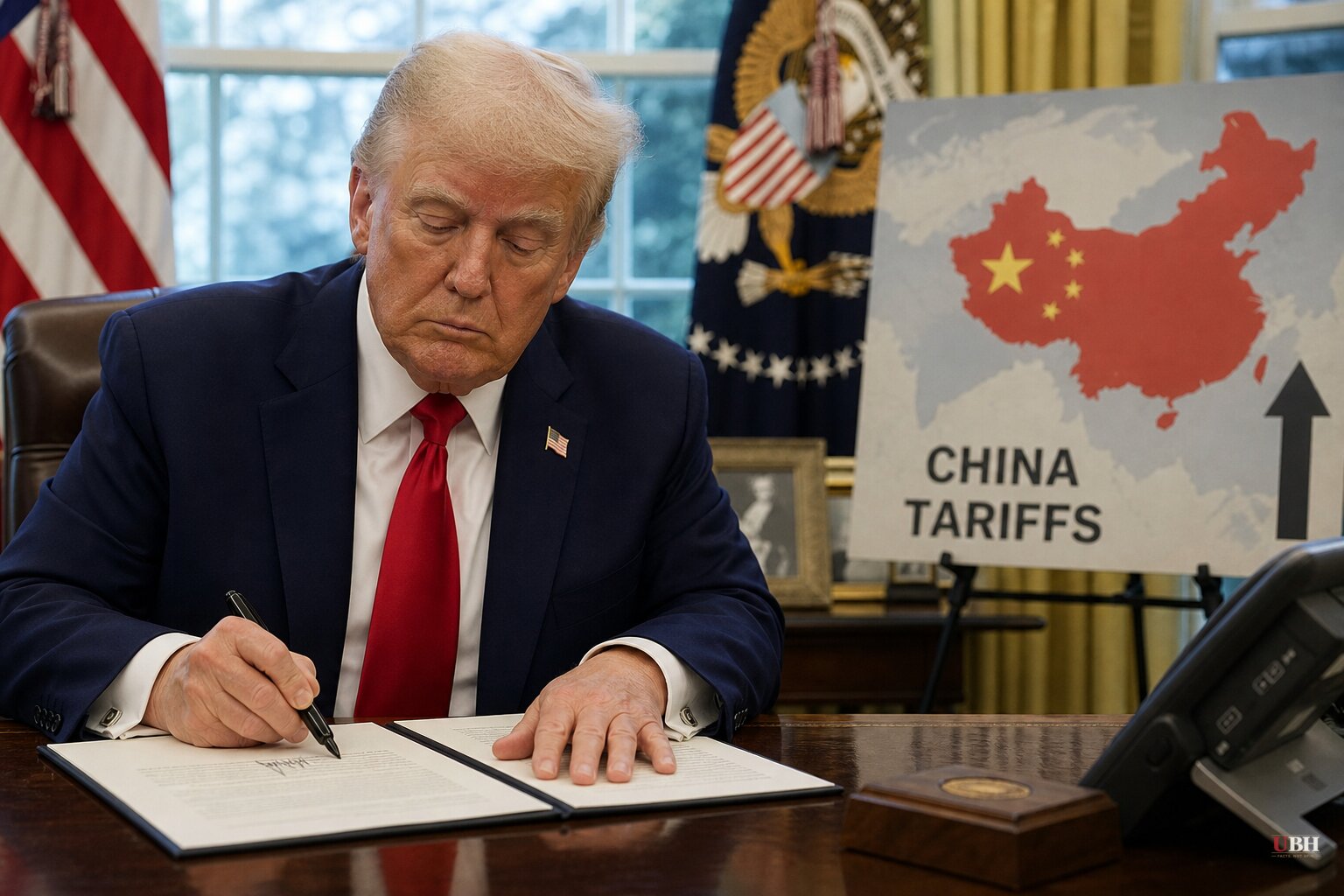
President Trump has pushed the cumulative tariff rate on Chinese imports back up to roughly 20%, according to CNN. The increase follows months of legal and diplomatic maneuvering that began when the Supreme Court struck down his broader tariff program.
The Court's February 20, 2026 ruling in Learning Resources, Inc. v. Trump threw out tariffs imposed under the International Emergency Economic Powers Act, according to the Tax Foundation's tariff tracker. Those IEEPA tariffs had ranged from 10% to 50% on nearly all US trading partners and covered an estimated $1.2 trillion in annual imports. The ruling forced the administration to rebuild its tariff architecture using different legal authorities.
Trump's first move was a temporary across-the-board tariff under Section 122 of the Trade Act, set at 10% and later raised to 15%, according to the Associated Press. That measure expired July 24, 2026, based on Tax Foundation data. In its place, the administration imposed a new Section 301 action targeting forced labor, hitting roughly 60 trading partners with tariffs of 10% to 12.5%, according to the Epoch Times.
China drew the higher 12.5% rate under that forced-labor provision. US Trade Representative Jamieson Greer said the action was designed to correct "both a human rights abuse and a distortive trade practice to improve the welfare of workers everywhere," the Epoch Times reported. China has objected to the designation but had not taken retaliatory action as of early August, according to the same report.
How the math adds up to 20%
Bloomberg reported, via Investing Live, that Trump planned to add a 7.5% tariff on top of the existing China-specific levies, which would restore the total rate to around 20%. China's Ministry of Commerce said in May that Washington had agreed, in the Kuala Lumpur trade consultations, to cap additional tariffs on Chinese exports at that 20% level. "We hope that the US will honor its commitments," the ministry said, according to Investing Live.
That 20% figure is a fraction of where things stood at the peak of the trade war. Tariffs on Chinese goods spiked as high as 145% in an earlier stretch of 2025, according to CNN, and Trump's initial China tariffs after taking office reached 125% in April 2025, per the Epoch Times. A truce reached in late 2025, reaffirmed at a May 2026 summit between Trump and Xi Jinping, brought rates down substantially before this latest adjustment.
The Tax Foundation's tracking shows a more complicated overall picture. Erica York and Alex Durante estimate the new tariffs imposed and scheduled through 2026 affect 54% of US goods imports, with the applied tariff rate rising to 11.7% from a pre-Supreme Court level of 14.9%. Layer in country-specific and product-specific tariffs, and the Epoch Times reports overall levies on Chinese exports could range from 20% to 47.5% depending on the product category, with carve-outs for electronics and semiconductors that matter a great deal to Beijing.
Evasion is eating into the numbers
Higher tariffs have produced the predictable response: rerouting. An August 2026 report cited by CNN estimated $19 to $26 billion in annual tariff revenue has been lost as Chinese exporters ship goods through Canada, the European Union, and other third countries to dodge US duties. That gap between the posted weighted average tariff (23.1%) and the effective paid rate (21.6%) reflects that evasion.
The Guardian's Peter Navarro-focused reporting adds a sharper edge to this problem. The commerce department concluded that $67 billion in goods from China were transshipped through Mexico, India, and Vietnam in 2025, according to a White House report titled "The Great Transhipment Scam." The administration has rolled out an AI-powered tool to flag rerouted shipments. The Guardian argues this misses the bigger lever available to Washington: a weak Chinese yuan that keeps Beijing's exports competitive regardless of tariff levels, a point some economists dispute given China's separate structural issue of depressed household consumption driving its export dependence.
Brookings researchers note nearly half of global US import value is exempt from the new tariff stack, but for China specifically, less than 20% of 2025 import value escapes additional duties, a far higher exposure than most trading partners face.
What comes next
Trump and Xi are scheduled to meet in Washington on September 24, according to Investing Live. Beijing has signaled it expects the US to honor the 20% cap agreed to in Kuala Lumpur. Sun Yun of the Stimson Center told the Associated Press that the Supreme Court ruling gives China "a moral boost" in negotiations but predicted Beijing will stay cautious rather than press its advantage, since Trump retains other tariff authorities.
Whether the new tariff architecture survives further legal challenges, and whether China responds to the forced-labor designation with new export restrictions on rare earths or pharmaceutical inputs as the Epoch Times suggested it might, remain open questions heading into the September summit.
Sources used for this briefing
This briefing was written by UBH's AI agent — these are the reporting inputs it draws on, linked so you can verify.


