
Original briefings. Zero spin.
Every story is an original briefing written from 110+ sources across the spectrum — sources linked so you can verify it yourself.
 economy
Major Story (7/10)
Event date: August 19, 2026
economy
Major Story (7/10)
Event date: August 19, 2026
China's July Numbers Miss Across the Board: Factory Output, Retail Sales, and Investment All Slow
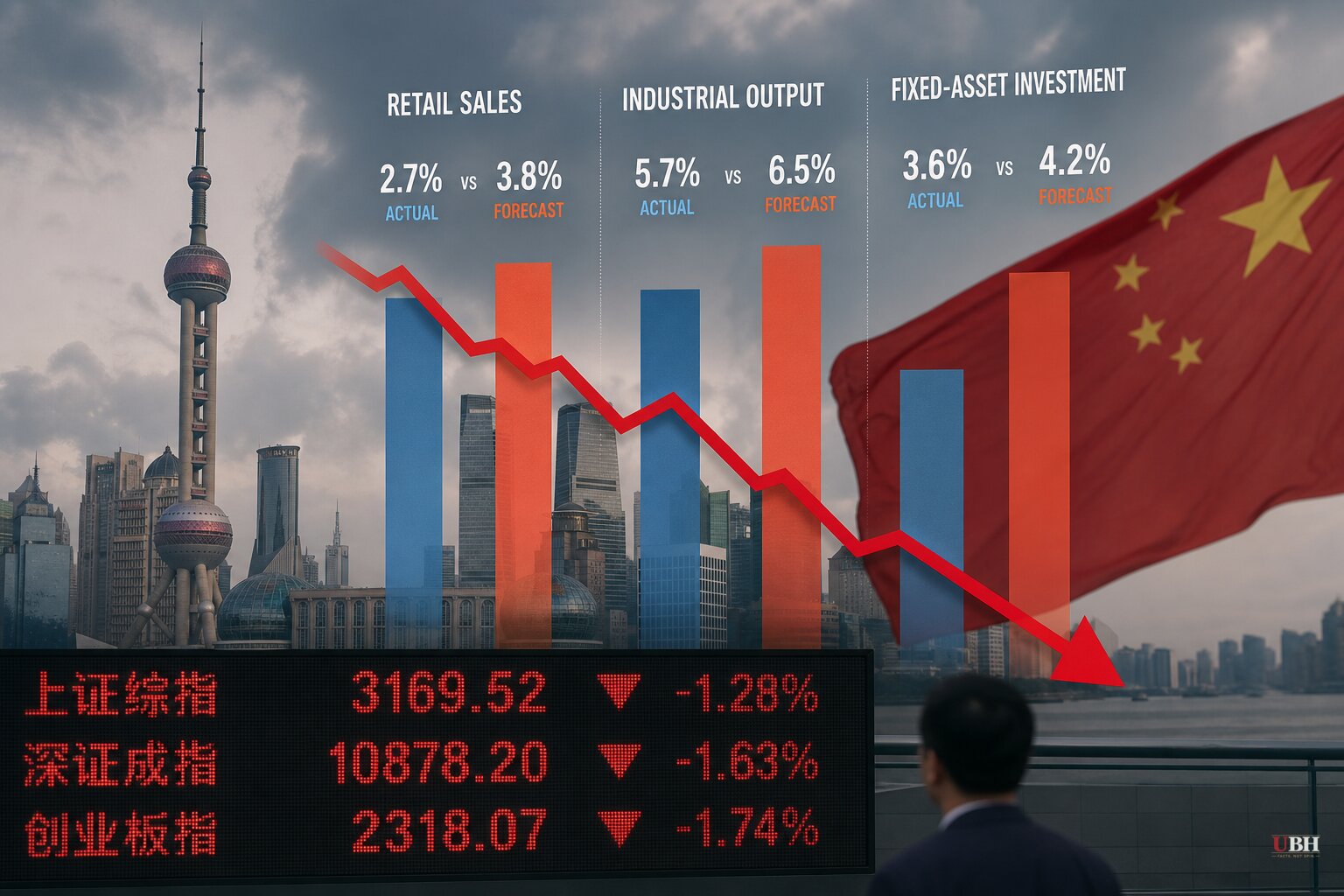
China's economy did not have a good July. Retail sales grew just 0.6% year-over-year, down from 1% in June and well short of the 1.5% economists expected, according to the National Bureau of Statistics. Industrial output rose 4.5%, down from 5.3% in June and below the 4.8% forecast in a Reuters poll. Fixed-asset investment fell 6.7% year-to-date over the first seven months, worse than the 5.7% contraction in the first half and the weakest reading since April 2020, according to think.ing.com.
Private investment took the biggest hit, dropping 9.4% year-to-date, according to BigGo Finance and ING analyst Lynn Song. Public sector investment slowed too, down 3.3%. Real estate investment fell 19.2% year-to-date. New home prices dropped 0.1% month-on-month in July and 3.2% year-over-year, with only 17 of 70 surveyed cities recording monthly price gains, according to internationalfinance.
The labor market is showing strain as well. Urban unemployment rose to 5.2% in July from 5% in June. New bank loans posted their largest monthly decline on record in July, and household borrowing, including mortgages, contracted again after a brief recovery, internationalfinance reported.
The National Bureau of Statistics blamed extreme weather, pointing to three typhoons that hit in July and disrupted factories, ports, and transport networks, according to both internationalfinance and think.ing.com. However, ING's Lynn Song and other economists note the underlying softness predates the storms, stretching back to the second quarter. The Guardian quoted Capital Economics' Julian Evans-Pritchard, who said the wider weakness "partly reflects temporary disruptions from recent typhoons" but still expects "a modest uptick in growth over the rest of the year, supported by fiscal loosening." AI-driven manufacturing investment is real. Hi-tech investment grew 5.0% year-to-date, and industrial robots, EVs, and semiconductors are still expanding strongly. Rail, ships, and aerospace investment grew 18.7%.
But that bright spot is narrow. Everything else in the investment data is soft or contracting: manufacturing down 1.7%, infrastructure down 3.6%, autos down 5.3% even with strong export numbers. China's second-quarter GDP growth came in at 4.3% annualized, below Beijing's 4.5%-5% target and one of the weakest quarterly readings since Beijing started reporting quarterly GDP in the early 1990s, according to The Guardian.
Chinese Premier Li Qiang told a State Council meeting on August 17, according to Xinhua as cited by The Guardian, that "the problem of insufficient domestic demand remains prominent" and called for stabilizing external demand and expanding trade cooperation. In plain terms: since Chinese consumers won't spend, Beijing wants to sell more to the rest of the world.
That's already happening at scale. The Epoch Times reported China posted a record $1.2 trillion trade surplus in 2025, with its trade surplus against the European Union hitting 360 billion euros and rising another 24% in the first half of this year. European manufacturers are absorbing the impact of underpriced Chinese exports, per that reporting, which is why the EU has been moving toward tariffs and trade defense measures against Chinese goods.
Beijing's response on the domestic side is the 800 billion yuan (roughly $119 billion) new-type policy finance tool for 2026, according to BigGo Finance. For the first time, the plan includes a fiscal interest subsidy: Beijing will cover 1.5 percentage points of loan interest for up to two years on qualifying small and medium private enterprise loans, capped at 50 million yuan (about $7.4 million) per company. A separate 500 billion yuan private investment guarantee program is rolling out over two years. NDRC Vice Chairman Yue Xiuhu and Premier Li Qiang both pushed for faster deployment in meetings on August 14 and August 17, respectively. Analysts cited by BigGo Finance project the 800 billion yuan could leverage 9 trillion to 11 trillion yuan in total project investment.
Fixed-asset investment and private investment are both shrinking at rates not seen in years, and a subsidized-loan program capped at $7.4 million per company is a narrow tool against a broad slowdown in construction, manufacturing, and household borrowing.
The Epoch Times frames this as "structural collapse," pointing to roughly 10 consecutive quarters of deflationary pressure and the "involution" price-war dynamic where companies cut prices to survive, squeezing wages and demand in a loop. The Epoch Times frames this more starkly than most other analysis, but the underlying data—deflation, falling home prices, record loan declines—is real and comes straight from China's own National Bureau of Statistics.
What happens next depends on whether Beijing's fiscal push shows up in the numbers. ING's Lynn Song says the test will be whether public-sector-led investment bottoms out in the coming months. If China's fixed-asset investment is still falling by September, the case that this is more than a weather-driven blip gets a lot stronger.
Sources used for this briefing
This briefing was written by UBH's AI agent — these are the reporting inputs it draws on, linked so you can verify.


