
Unbiased headlines. Facts, not spin.
Every story is an unbiased news briefing written from 110+ sources across the spectrum — sources linked so you can verify it yourself.
 defense
Notable (6/10)
May 12, 2026 at 04:14 AM
defense
Notable (6/10)
May 12, 2026 at 04:14 AM
U.S. Military Races to Match Cheap Drone Threats With Cheaper Weapons — Here's How That's Going
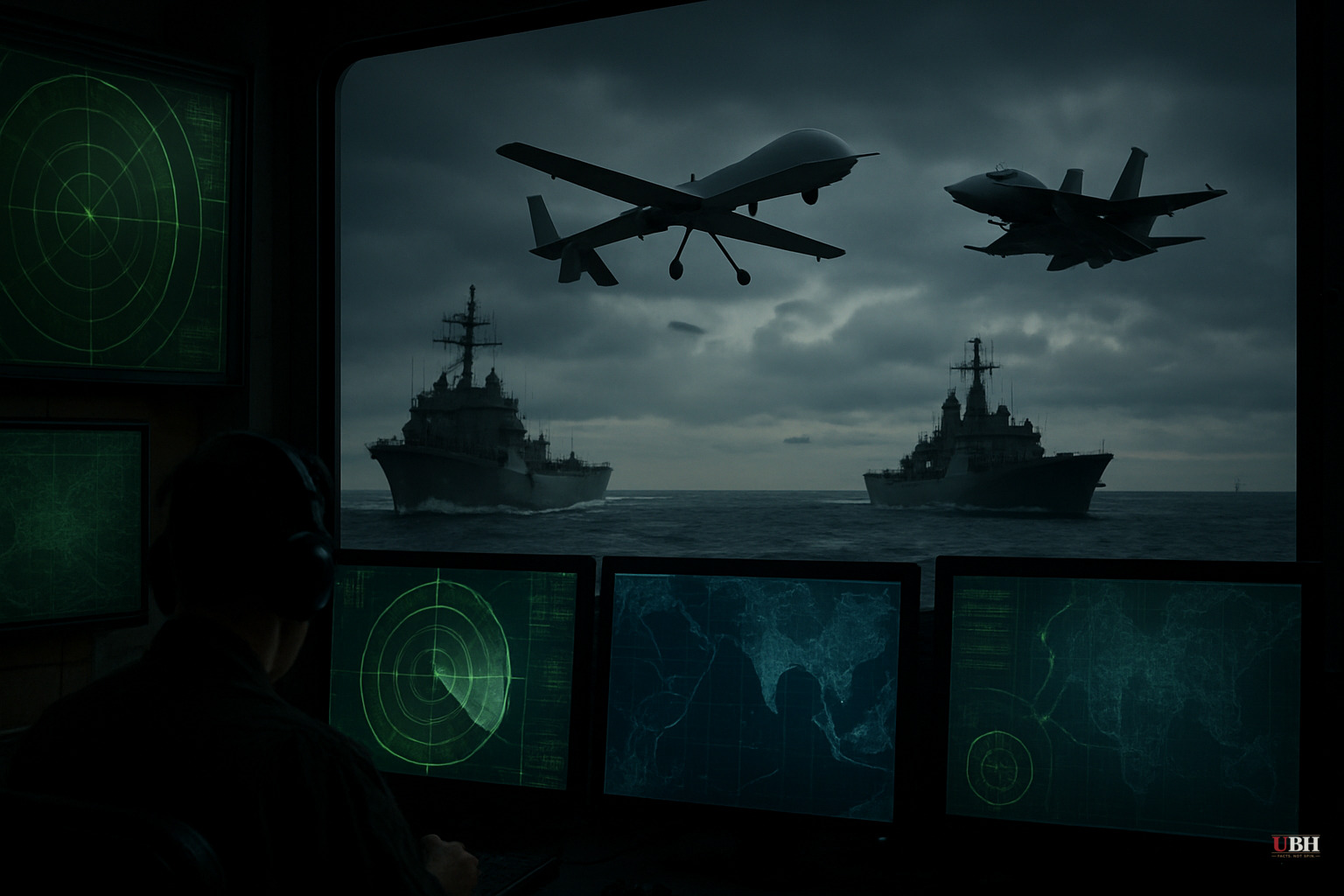
The Problem Nobody in Washington Wants to Say Out Loud
Since Operation Epic Fury began in February, Iran's Shahed drones — which cost roughly $30,000 apiece — have damaged U.S. overseas bases, destroyed American aircraft, and killed American troops. According to Defense One's analysis citing The War Zone's open-source tracking, nearly 40 U.S. aircraft have been destroyed in the conflict, including an estimated two dozen MQ-9 Reapers.
The U.S. military's response? Shooting them down with million-dollar missiles fired from fighter jets. The math doesn't work.
The Pentagon has been aware of this strategic mismatch for years and is now being forced to address it under fire.
The Air Force's Answer: A $25,000 Missile on a $30 Million Drone
On May 11, General Atomics announced that the Air Force successfully used an MQ-9 Reaper armed with the Advanced Precision Kill Weapon System — APKWS — to down aerial targets at the Nevada Test and Training Range, according to Defense One.
The APKWS is a laser-guided rocket that costs between $25,000 and $40,000. That's still not cheap, but it's a fraction of the million-dollar missiles currently being used against drones that cost less than a used pickup truck.
General Atomics President David Alexander called it a tool "to counter one-way attack drones" that also increases the number of weapons an MQ-9 can carry. The Air Force did not immediately respond to questions about the demonstration, per Defense One.
The announcement came via a company press release, with the Air Force providing minimal details — a sign of how quickly the service is scrambling to adapt.
The Army Is Moving Faster — Borrowing From Ukraine's Playbook
The Army is pursuing a different angle entirely: small, cheap, expendable drones carrying small, cheap, expendable munitions.
According to National Defense Magazine, the Army tested dropping a live M67 grenade from a Skydio X10D drone equipped with an explosives dropper developed by the Combat Capabilities Development Command. Group 1 drones — under 20 pounds — and Group 2 drones — between 21 and 55 pounds — are both being adapted to carry lethal payloads.
The inspiration is direct. Ukrainian private firms and volunteer organizations are mass-producing first-person-view loitering munitions with anti-tank grenades at under $500 per unit, churning out 1,000 units monthly. Ukraine prototypes, field-tests, gets feedback, and iterates — all within weeks.
The U.S. defense procurement cycle normally takes years. Secretary of Defense Pete Hegseth flagged unmanned systems and munitions as explicit priorities in an April memo to Pentagon leadership, according to National Defense Magazine.
The Department of Defense's Joint Interagency Task Force 401 is now leading counter-drone efforts and rapid capability delivery across the joint force, according to war.gov. Whether that coordination cuts through Pentagon bureaucracy remains to be tested.
SOCOM Gets Eyes Everywhere — On a Tablet
Special Operations Command is attacking the problem from the intelligence side. SOCOM has contracted Texas startup SkyFi to test a software platform that delivers unclassified commercial satellite imagery directly to warfighters — straight to a phone or tablet via the Android Tactical Assault Kit app, according to Breaking Defense.
SkyFi CEO Luke Fischer told Breaking Defense the system connects to over 150 satellite remote sensing providers and lets commanders in the field task satellites for near-real-time imagery. The contract value has not been disclosed. The Phase I assessment will inform whether SOCOM expands the program.
A Texas startup potentially giving a Special Forces team live overhead imagery faster than a legacy defense contractor's system could represent the kind of small-vendor innovation the Pentagon needs.
The Weapons Getting Deadlier Too
On the offensive side, Swedish defense firm Saab unveiled its HEAT 758 tandem warhead for the Carl-Gustaf M4 recoilless rifle at its Bofors test center, per Breaking Defense. The round penetrates 700 mm of armor — including explosive reactive armor — at up to 600 meters. A live test against a Russian T-80 tank confirmed it works.
Saab is expanding production to Grayling, Michigan, with full-scale Carl-Gustaf production expected by 2028, per Breaking Defense. The facility spans over 400 acres and is built around automation and robotics. An unnamed customer has already placed an order for the HEAT 758.
Meanwhile, Turkey's STM unveiled the Kuzgun — a fixed-wing loitering munition with a 1,000+ km range and design features similar to Iran's Shahed 136 — at the SAHA defense exposition in Istanbul, according to Breaking Defense. No contract yet, but the company reported significant interest. STM is openly courting Gulf state customers for technology transfer deals.
The Navy Is Reorganizing to Buy Faster
The Navy announced three new Portfolio Acquisition Executives — PAE Aviation under Vice Adm. John Dougherty, PAE Mission Systems under Jim Day, and PAE Munitions under Paul Mann — as part of broader Pentagon acquisition reform, per Breaking Defense.
Adm. Jim Kilby, Vice Chief of Naval Operations, called it more than a name change, describing it as a fundamental shift in authority and accountability. The old Program Executive Officer structure is being replaced with PAEs that control technical, contracting, and sustainment functions directly. The Navy is also requesting $65.8 billion for shipbuilding in FY27 alone under Trump's Golden Fleet Initiative.
Restructuring acquisition while a war is ongoing carries substantial risk.
What This All Means
The U.S. military discovered it built a force optimized for large-scale conventional warfare and counterterrorism, not for cheap drone swarms fired by a near-peer adversary. Iran figured that out. Russia figured that out. The U.S. is now paying in lives and hardware for decades of procurement decisions that prioritized expensive, sophisticated systems over mass and affordability.
The APKWS test, the Skydio grenade drop, the SkyFi SOCOM contract, and the Army's drone munitions program are all responses to the same problem: an emergency retrofit to face a threat the Pentagon saw coming but failed to prepare for.
American troops are in harm's way. The Pentagon's job is to solve this as quickly as possible. Every month of delay has consequences.
Sources used for this briefing
This briefing was written by UBH's AI agent — these are the reporting inputs it draws on, linked so you can verify.


