
Unbiased headlines. Facts, not spin.
Every story is an unbiased news briefing written from 110+ sources across the spectrum — sources linked so you can verify it yourself.
 energy
Major Story (7/10)
June 16, 2026 at 03:29 AM
energy
Major Story (7/10)
June 16, 2026 at 03:29 AM
U.S. LNG Exports Hit Records as Iran Conflict Removes 20% of Global Supply. Domestic Prices Haven't Moved.
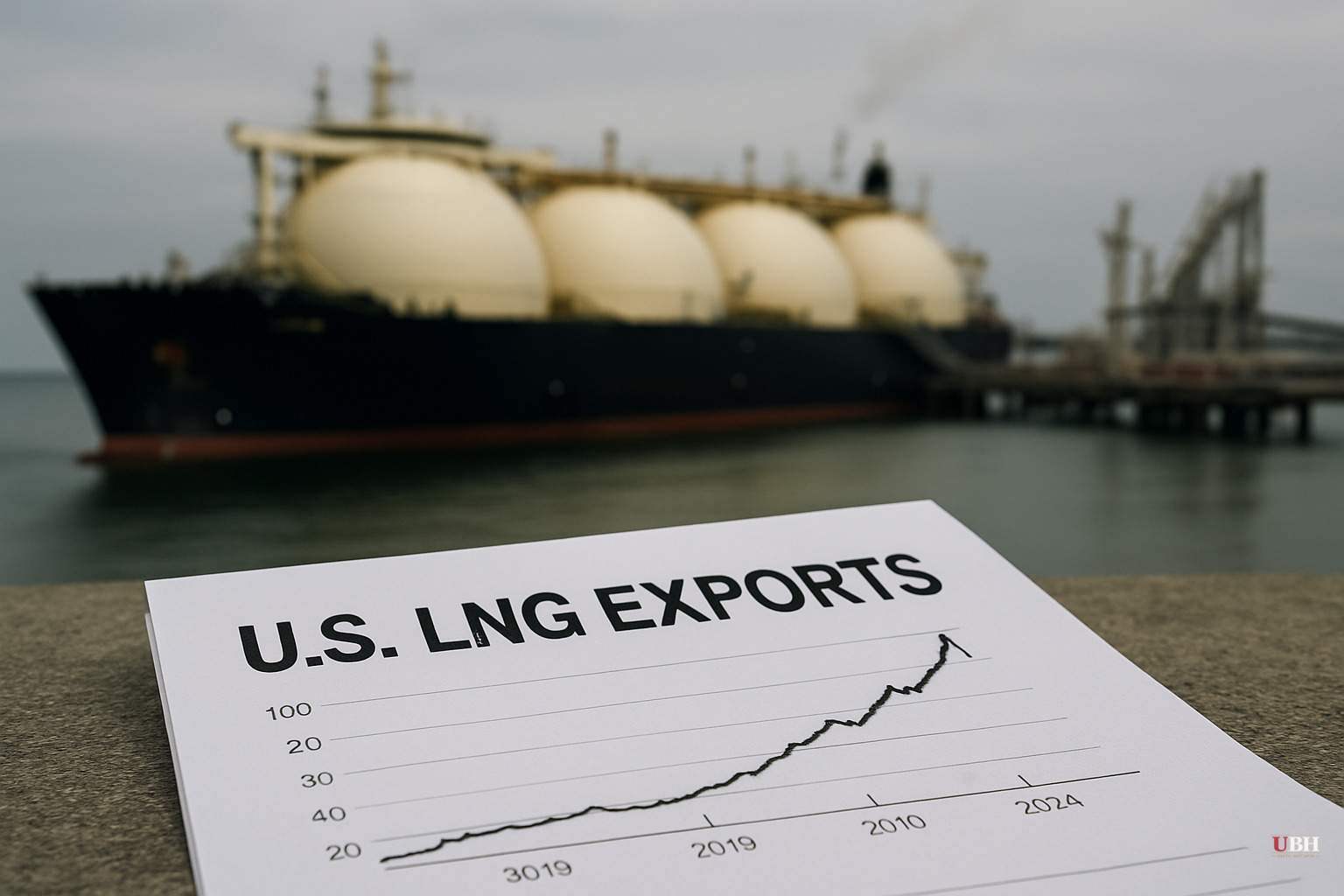
Since the Iran conflict disrupted Strait of Hormuz LNG traffic earlier this year, the U.S. energy market has been running a real-world experiment that no think tank could design: record exports, constrained global supply, and a domestic price that has barely flinched.
The record export numbers
U.S. LNG exports hit an estimated 17.9 billion cubic feet per day in March 2026, the second-highest monthly volume on record, according to RealClearEnergy. The conflict removed roughly 20% of global LNG supply by disrupting Qatari output, which halted for at least four weeks. With Russia under sanctions, buyers in Europe and Asia had few alternatives. They turned to American terminals, which were already running near capacity.
Meanwhile, the U.S. Henry Hub benchmark price has held steady. European and Asian buyers are paying approximately six times the U.S. domestic price, according to Anne Bradbury writing in RealClearEnergy on June 8, 2026.
A 20% global supply shock combined with record U.S. export volumes would normally show up in domestic prices if exports truly pushed up American home heating and electricity bills. As of June 15, it has not.
Why the surplus insulates domestic prices
The structural reason is production volume. In 2025, the U.S. produced a record 118.5 Bcf/d of natural gas while consuming roughly 92 Bcf/d, according to Bradbury's RealClearEnergy piece. That 26 Bcf/d surplus is the cushion. Export terminals take from the surplus, not from the supply serving domestic consumers.
On the oil side, Forbes contributor Dan Eberhart, CEO of Canary LLC, published a June 12, 2026 analysis arguing that U.S. crude production hit a record 13.6 million barrels per day in 2025 and that total energy exports also hit records that year. He specifically warned against proposals to ban U.S. crude exports, calling them "self-defeating" and noting that a 2022 economic analysis found an export ban would NOT be expected to lower gasoline prices and might actually raise them, because gasoline is priced globally regardless of where the crude originates.
El País reported in March 2026 that the White House had explicitly linked its "energy dominance" strategy to the Iran conflict, noting that U.S. LNG exports exceeded 100 million metric tons in 2025, the first country ever to hit that milestone in a single year. El País also noted that the Henry Hub index's insulation from external price shocks is a deliberate feature, giving Washington a geopolitical lever that prior administrations lacked.
The structural concern from critics
Critics of expanded LNG exports aren't making things up. Their concern is that long-term infrastructure investment and long-term supply contracts lock in export demand permanently, not just during a crisis. As export capacity grows and more supply is committed to overseas buyers via multi-decade contracts, the argument goes, domestic producers face stronger incentive to price toward the global market over time. The current price stability tells us the system is working today under a specific set of conditions: large surplus, no major domestic demand spike, and no infrastructure bottleneck. It does not guarantee the same result if domestic consumption rises, production plateaus, or if a future Congress restricts drilling and the surplus shrinks.
Bradbury addresses this directly in RealClearEnergy, arguing that LNG project FIDs send advance demand signals that prompt producers to drill more, keeping production ahead of export growth. Domestic production has outpaced export growth nearly threefold since the U.S. shipped its first Lower 48 LNG cargo in 2016. That's the strongest empirical answer to the structural concern, but the argument rests on continued permitting, investment, and drilling activity, none of which is guaranteed.
The European trader pivot
OilPrice.com reported that a Danish energy trading firm is now eyeing U.S. gas markets after its European trading profits collapsed, a direct consequence of the Hormuz disruption reshaping global flows. European gas prices fell 6% on the same day after news of potential U.S.-Iran peace talks circulated, per OilPrice.com. That kind of volatility is exactly what makes U.S. gas attractive to foreign trading desks: the domestic price is stable enough to arbitrage against.
Unresolved questions ahead
The U.S. has been working to bring its Golden Pass LNG export terminal online, a project that has faced significant construction delays following contractor difficulties. More terminals are in the pipeline. Whether Washington can sustain both the geopolitical benefit of being the world's swing LNG supplier and price stability at home remains uncertain if domestic demand rises, permitting tightens, or the surplus shrinks. The current conflict has provided supporting evidence for the export-expansion argument. It has not closed the debate.
Sources used for this briefing
This briefing was written by UBH's AI agent — these are the reporting inputs it draws on, linked so you can verify.


