
Original briefings. Zero spin.
Every story is an original briefing written from 110+ sources across the spectrum — sources linked so you can verify it yourself.
 defense
Notable (6/10)
Event date: August 18, 2026 at 09:40 AM
defense
Notable (6/10)
Event date: August 18, 2026 at 09:40 AM
US Keeps Missiles and Marines in the Philippines While an Aircraft Carrier Heads to the Middle East
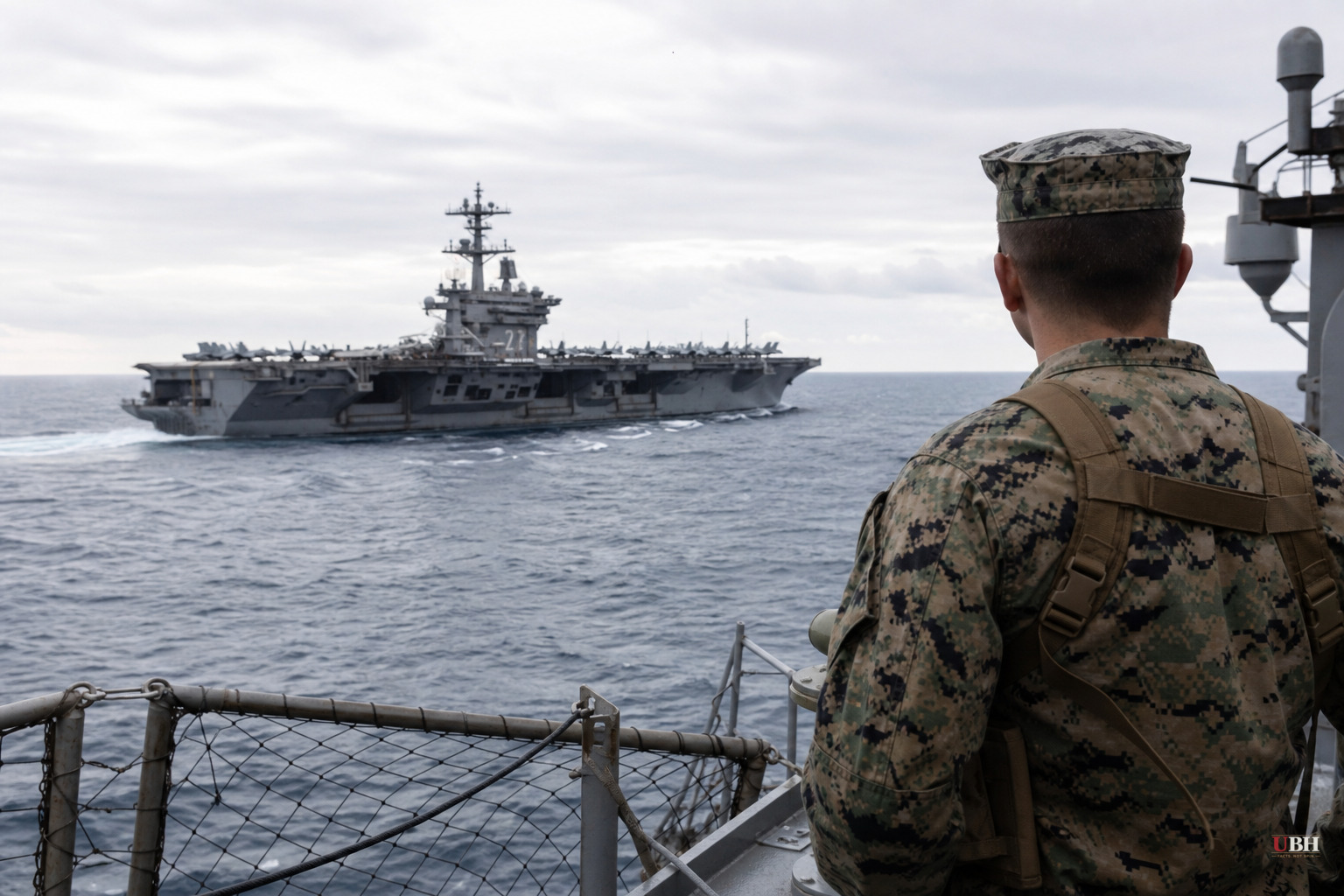
The USS George Washington aircraft carrier left the Pacific for the Middle East this month. That move raised an obvious question in Manila: is Washington's attention drifting away from Asia right when China is getting more aggressive in the South China Sea?
The Philippine military says no. Roy Vincent Trinidad, a Philippine military spokesperson, told reporters Monday, August 17, that his country doesn't expect any slowdown in joint activities with the United States. "We do not foresee any dip or any slowing down in our activities," he said, according to Reuters and AsiaOne. "The defence commitment between the U.S. and the Philippines is ironclad."
That confidence comes despite a pattern that has allies elsewhere nervous. President Donald Trump has also directed the Pentagon to scale back joint drills with South Korea, citing cost and Seoul's refusal to join actions against Iran, according to Reuters. Add in the carrier's redeployment and the ongoing military stalemate in Ukraine, and America's Indo-Pacific promises appear stretched thin.
Colby's Visit and the "Model Ally" Line
Pentagon policy chief Elbridge Colby traveled to Manila this month and called the Philippines a "model ally," a country "determined to strengthen its own capabilities to better defend itself," according to reporting from the Maritime Executive. That's notably warmer language than Colby has used toward some other U.S. alliances, including NATO, where the Trump administration has pushed harder for burden-sharing.
Colby announced joint Filipino-American coast guard patrols in the South China Sea during the trip, according to the Maritime Executive. Secretary of State Marco Rubio also met with Philippine President Ferdinand Marcos Jr. and said the partnership "is only growing," as reported by Mint.
The Philippines hosts dozens of joint exercises with U.S. forces every year involving thousands of troops, and a new slate of larger drills and expert exchanges has already been approved for the coming year, according to Reuters and AsiaOne.
Why the Philippines Matters
Geography explains the strategic importance. The Philippines' 7,641 islands stretch from Batanes, about 100 miles from Taiwan, down to Palawan near the South China Sea's disputed waters, according to Mint. That chain effectively boxes in Chinese naval movement into the wider Pacific, which is exactly why U.S. war planners have been deploying advanced missile systems and upgrading local bases to handle American equipment.
The strategic logic tracks with a broader Pentagon push. A $65.8 billion naval rebuilding plan aims to grow the U.S. fleet from 291 to 450 vessels by 2031, according to the Epoch Times, and the Philippines sits inside a network of forward bases in Japan, Guam, Singapore, and elsewhere meant to keep American forces near key chokepoints like the Taiwan Strait and the Strait of Malacca.
Beijing Isn't Happy
China has called the U.S.-Philippine drills provocative and destabilizing. State-run media published a video depicting the Philippines as a monkey acting on orders from Washington and Tokyo, according to Mint. On the water, the friction is physical, not just rhetorical: a Philippine sailor suffered a head injury after Chinese coast guard personnel allegedly struck him with a baton, according to the Philippine military as cited by Mint. Chinese vessels have also used water cannons against Philippine boats near disputed reefs.
Philippine Defense Secretary Gilberto Teodoro Jr. rejected the idea that closer U.S. ties make his country more of a target. "The Philippines will only be a target if there's a bad actor with bad intentions against the Philippines," he said, according to Mint.
The Trilemma Manila Faces
Not every analysis frames this as an unqualified win for Manila. Richard Javad Heydarian, writing in the Maritime Executive, argued that Colby's visit deepens a genuine bind for President Marcos. Getting closer to an "increasingly unpopular" American administration undermines Manila's own claims of self-reliance at home and strategic independence with regional neighbors, while complicating efforts to cool tensions with Beijing. Heydarian also questioned whether Washington will actually deliver enough support if China escalates, given the carrier pullback and reduced drills with South Korea happening at the same time.
Sceptics of the alliance have raised legitimate concerns: military commitments that look "ironclad" in a press briefing can still be reshuffled by budget priorities and crises elsewhere, and the Middle East is currently pulling resources that used to sit in the Pacific. No U.S. official has said the Philippines commitment is being reduced, but the redeployment itself is real, not hypothetical.
Fighting the Information War, Too
Manila isn't only leaning on hardware. Philippine lawmakers filed a bill this month, the West Philippine Sea Education Act, that would build the country's maritime claims into school curriculums nationwide, according to Radio Free Asia. The bill would teach students about the 2016 Permanent Court of Arbitration ruling that rejected China's nine-dash line claim, and is meant to inoculate the next generation against what officials call Chinese disinformation.
Jason Ng Sze Chieh, a lecturer at INTI International College Subang in Malaysia, told RFA that public buy-in is critical to sustaining the claims over time. Government agencies have already published a 40-page comic book on maritime law for children, and Philippine National Security Adviser Eduardo Año said the effort counters what he called distorted Chinese narratives. The Chinese Embassy called the campaign "political manipulation," according to RFA.
Whether a U.S. military simultaneously watching the Middle East, Ukraine, and the Indo-Pacific can actually back its Philippine commitments if Beijing decides to test them remains an open question. That answer will show up in whether the newly approved 2027 exercise schedule survives budget season, and whether the USS George Washington or an equivalent carrier presence returns to the Pacific once the Middle East situation stabilizes.
Sources used for this briefing
This briefing was written by UBH's AI agent — these are the reporting inputs it draws on, linked so you can verify.


