
Original briefings. Zero spin.
Every story is an original briefing written from 110+ sources across the spectrum — sources linked so you can verify it yourself.
 defense
Major Story (7/10)
Event date: September 2, 2026
defense
Major Story (7/10)
Event date: September 2, 2026
US, Japan and South Korea Proceed With Freedom Edge Drills as Trump Weighs Fourth Kim Summit
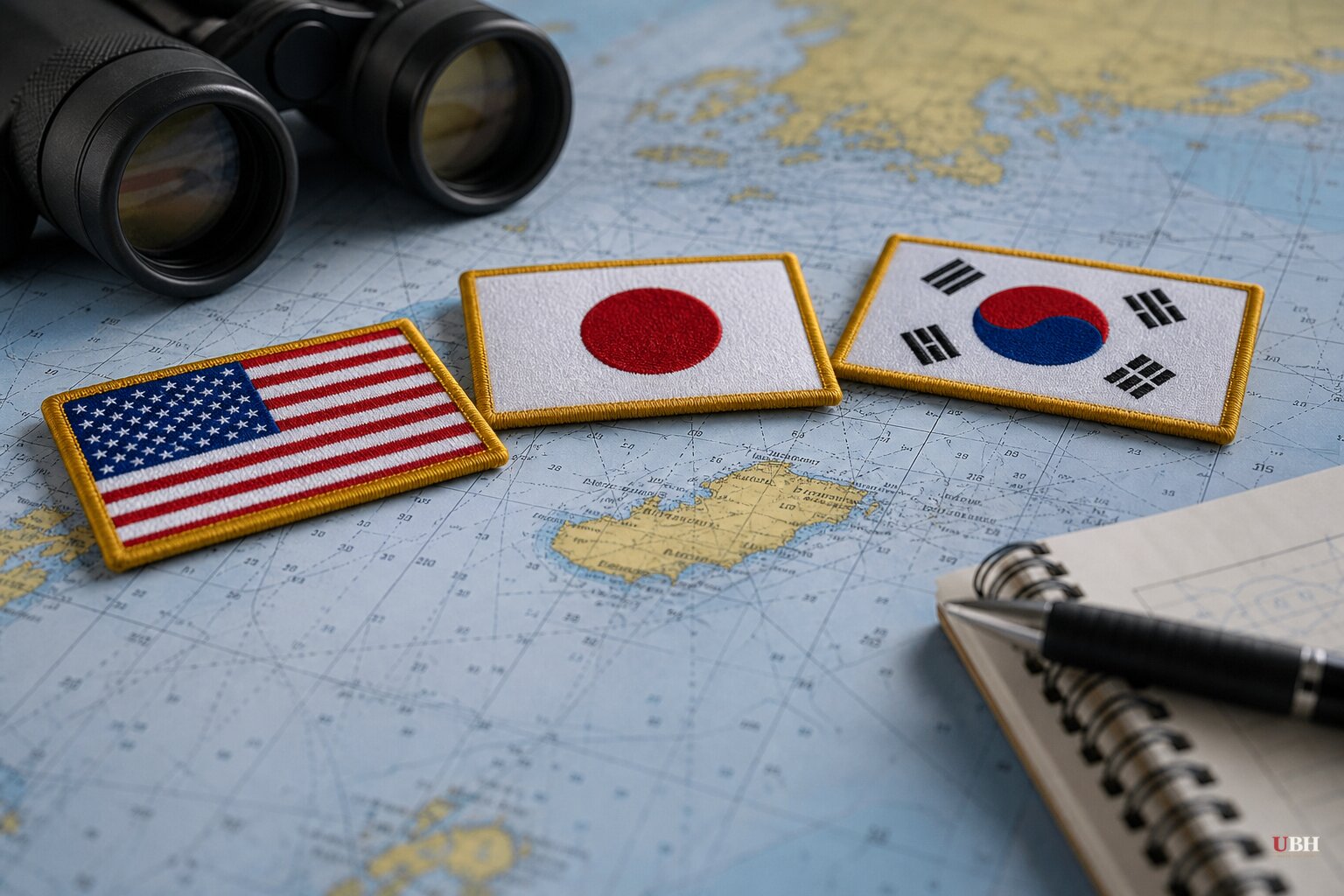
The trilateral Freedom Edge exercise involving the United States, Japan and South Korea is scheduled to run Sept. 7-11 in waters east and south of Jeju Island, according to South Korea's Joint Chiefs of Staff. Navy Capt. Jang Do-young, the Joint Chiefs spokesperson, told reporters Wednesday there had been "no changes to the plan so far," despite North Korea's latest warning.
North Korea's Foreign Ministry called the exercise part of Washington's "hostile policy" and vowed a "toughest counteraction," according to state media cited by the Korea Herald. This is the fourth iteration of Freedom Edge, which grew out of the 2023 Camp David summit among the three nations' leaders and has run three times since June 2024.
A Split Approach to Two Different Drills
Washington's posture looks different depending on which exercise you're talking about. Last month, President Trump ordered the Pentagon to "significantly" scale back the bilateral Ulchi Freedom Shield exercise with South Korea, and the drill ended six days early, according to Korea JoongAng Daily. Trump has said the reduction reflects his good relationship with Kim Jong Un and cited cost to taxpayers.
But the trilateral Freedom Edge drill is proceeding on schedule. U.S. Indo-Pacific Command has framed the exercise as demonstrating an "unwavering commitment" to the three countries and to a free and open Indo-Pacific, according to Korea JoongAng Daily's reporting. That outlet's editorial board argues the contrast shows China, not North Korea, remains Washington's top security priority in the region, with the first island chain running from Korea through Japan, Taiwan and the Philippines still central to U.S. planning.
Whether a U.S. aircraft carrier will join Freedom Edge this year remains unresolved. No carrier participated last year for the first time since the exercise began, and Jang told reporters the U.S. is still reviewing the matter, per the Korea Herald. South Korean concerns center on U.S. naval assets being redirected to the Middle East following American and Israeli strikes on Iran in February.
Trump-Kim Summit Speculation
Speculation over a fourth Trump-Kim summit has intensified. The Wall Street Journal reported in August, according to the Institute for the Study of War, that Trump has privately discussed meeting Kim during an expected November trip to China for the APEC summit in Shenzhen. Trump said in August he expects to meet Kim again in 2026.
Kim Yo Jong, Kim Jong Un's sister and a senior Workers' Party official, said on Aug. 19 she was not aware of any direct communication between the two leaders but acknowledged her brother retains "good memories and feelings" about Trump, according to the Straits Times. On Sept. 1, South Korea's National Intelligence Service told lawmakers in a closed briefing that a summit could happen "at any time," citing signs of dialogue between Washington and Pyongyang.
The Denuclearization Fight
The Institute for the Study of War assesses that North Korea is pressuring the United States to abandon its denuclearization policy in exchange for future engagement. A State Department spokesperson reaffirmed on Aug. 26, per Yonhap News Agency as cited by ISW, that the U.S. commitment to North Korea's complete denuclearization is unchanged. Pyongyang's Foreign Ministry responded on Aug. 31 that repeated U.S. statements on denuclearization "would not weaken or dilute" its status as a nuclear-weapon state.
ISW's assessment is that North Korea will not accept U.S. requests for dialogue based on arms control until Washington explicitly drops denuclearization as a goal, and that Pyongyang may try to present any future meeting as recognition of its nuclear status even without a formal U.S. policy change.
Seoul's Dilemma
South Korean President Lee Jae Myung has pitched his government as a "pacemaker" for renewed U.S.-North Korea dialogue, telling overseas advisers on Sept. 2 that peace on the peninsula "ensures the security of Northeast Asia and also world peace," according to the Straits Times.
That framing carries real risk for Seoul. Cheong Seong-chang, vice-president of a Seoul-based think tank cited by the Straits Times, has warned that a U.S.-North Korea deal focused narrowly on reducing threats to the American mainland could leave South Korea and Japan still exposed to North Korea's shorter-range missiles. If Washington negotiates arms control terms that address intercontinental capability while leaving regional strike systems untouched, South Korea gains little security benefit even as North Korea gains sanctions relief or reduced U.S. military pressure. South Korean officials have not been shown to have a seat at any Trump-Kim planning table, and the Lee government's public praise for Trump's Ulchi Freedom Shield cutback, made without prior consultation according to Korea JoongAng Daily, has left it in an awkward spot now that Washington is keeping the trilateral drill at full strength.
Separately from the military track, Japan and South Korea are deepening nuclear energy cooperation with Washington. Reporting from OilPrice.com describes both countries setting aggressive nuclear power expansion targets, partly to compete with Russian and Chinese reactor exports to developing nations, a parallel track of trilateral alignment even as the security relationship strains.
No date for a Trump-Kim summit has been confirmed by either government. The Freedom Edge exercise begins Monday, Sept. 7, and whether a U.S. carrier joins it will be one of the clearest early signals of how much weight Washington is still putting behind its Korea-Japan defense posture.
Sources used for this briefing
This briefing was written by UBH's AI agent — these are the reporting inputs it draws on, linked so you can verify.


