
Unbiased headlines. Facts, not spin.
Every story is an unbiased news briefing written from 110+ sources across the spectrum — sources linked so you can verify it yourself.
 economy
Major Story (8/10)
September 14, 2026 at 10:38 PM
economy
Major Story (8/10)
September 14, 2026 at 10:38 PM
US Inflation Stuck at 3.4% as Diesel Hits Record $6.23 a Gallon and the Fed Weighs a Rate Hike This Week
The US Bureau of Labor Statistics reported that annual inflation held at 3.4% in August, unchanged from July, according to data cited by engine.online and Epoch Times reporter Andrew Moran. Core inflation, which strips out food and energy, slowed slightly to 2.4%. The month-over-month number told a less comfortable story: prices rose 0.4% in August, up sharply from just 0.1% in July, the first meaningful acceleration since the Iran war began on February 28, according to engine.online.
Stephen Innes, managing partner at SPI Asset Management, said the reading was tame enough that "nobody needed to reach for the fire alarm." But he also said the data has "enough heat underneath the surface" to make a September rate hike by the Federal Reserve "much easier to justify."
Diesel Just Keeps Climbing
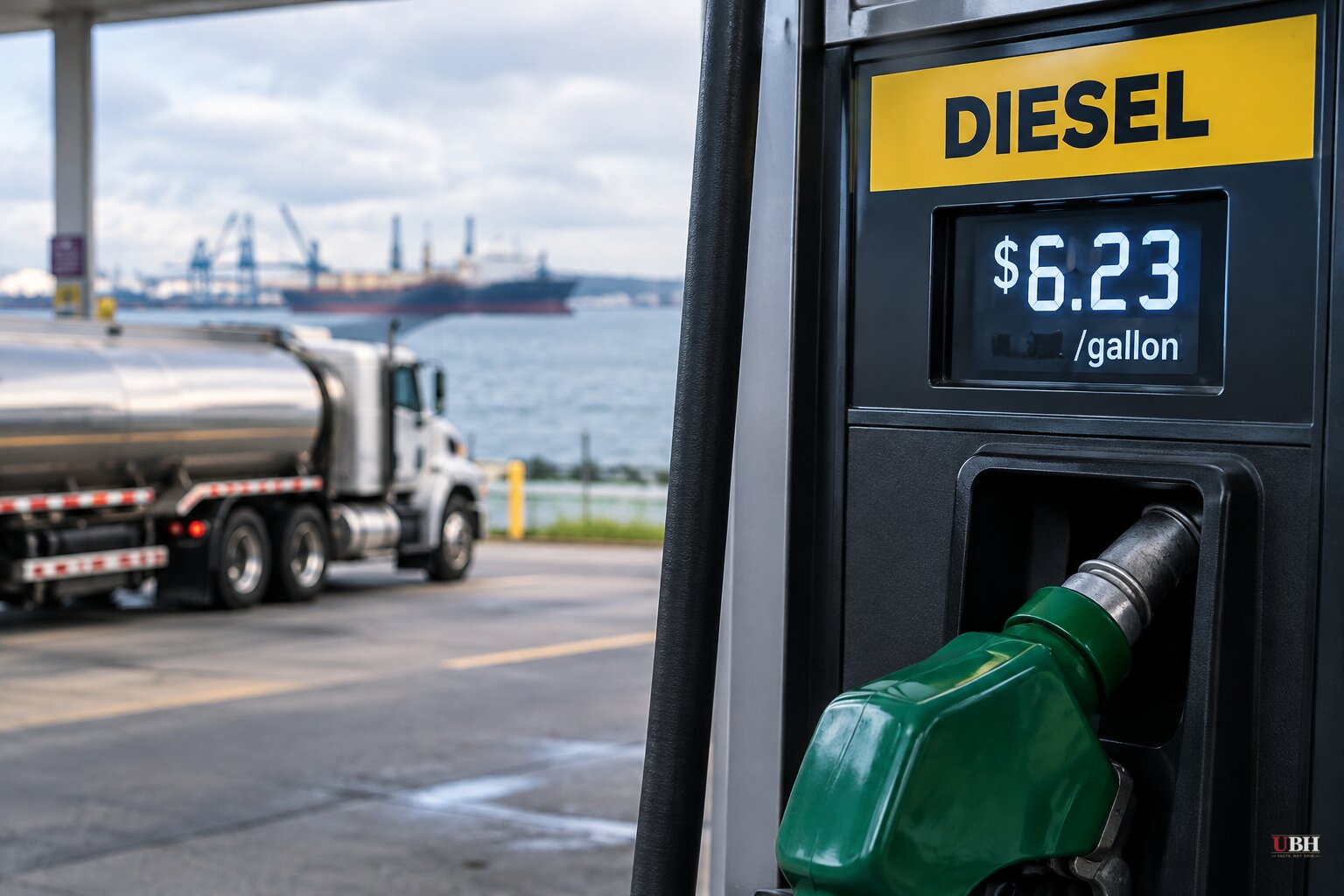
While the CPI headline looked stable, fuel prices did not. The national average price of diesel hit $6.23 a gallon as of Sunday, September 13, up more than 80 cents in a month, according to Epoch Times reporter Tom Ozimek. That follows diesel first crossing the $6 mark on Friday, September 11, according to AAA data cited by Breitbart. President Trump has publicly urged Ukraine to halt drone strikes on Russian oil refineries, a request tied directly to the refined-fuel supply crunch, Epoch Times reported.
The supply picture is getting worse elsewhere too. Saudi Arabia shut a key oil pipeline following multiple attacks, according to engine.online, and Goldman Sachs warned on September 7 that oil could spike to $120 a barrel if attacks on shipping in the Gulf intensify, though prices could fall back toward $80 if exports normalize. Wheat prices are also up 19% in August alone on Black Sea tensions and El Niño weather patterns, according to Andrew Moran's reporting for Epoch Times.
A Divided Fed Heads Into Its Meeting
The Federal Reserve is scheduled to meet Tuesday and Wednesday, September 15-16, and officials are not on the same page. At the Kansas City Fed's Jackson Hole symposium on August 27, Kansas City Fed President Jeffrey Schmid said inflation is "still stubborn and it's still sticky," and questioned whether the current 3.5%-3.75% policy rate is even restrictive: "I don't know what we're restricting currently with the rate policy that we're at today."
Cleveland Fed President Beth Hammack, who dissented at the July meeting in favor of a hike, told CNBC "now is the time to act," and warned that inflation running above target for more than five years risks embedding an "inflationary mindset" in the economy. She told Fox Business she expects inflation to land around 3% this year and only reach "maybe mid-twos at best" next year, well above the Fed's 2% target. Chicago Fed President Austan Goolsbee said his biggest short-run fear remains that inflation is not under control. Fed Chairman Kevin Warsh told the same gathering, "We must be confident that underlying inflation is moving to our objective, clearly and at sufficient speed."
CNN reported the Fed is expected to raise rates this week for the first time since July 2023, with Wall Street pricing in as many as three quarter-point hikes over the coming months. New York Fed President John Williams identified a less obvious threat: the AI data-center buildout. Spending on data centers is running near $800 billion and projected to hit $1.1 trillion by 2030, according to a PricewaterhouseCoopers report cited by CNN, while Gartner estimates total AI-related spending, including software and model development, will reach $2.52 trillion this year. Morgan Stanley's Jim Caron told CNN that hyperscalers "will pay almost any price" for chips, power, and skilled labor to grab early market share, a dynamic several Fed committee members flagged in July's meeting minutes as a risk to "broader effects on prices."
That tension sits awkwardly next to President Trump's own position on AI. He dismissed calls from Anthropic's Dario Amodei, OpenAI's Sam Altman, and Elon Musk to slow AI development, telling reporters "whoever wins AI, wins." The same week, Sam Altman reportedly told OpenAI staff the company is open to slowing its pace, according to Breitbart, even as the president pushes full speed ahead on the buildout the Fed's own vice chair says could keep inflation elevated longer.
The Fair Counterpoint
Fed officials who favor patience, including Schmid's own admission that he needs "a little bit more information" before September, point out that hiking into an energy-price shock driven by a war, rather than domestic demand, risks slowing growth without actually fixing the diesel and refinery problem driving headline pain.
Meanwhile, health insurance premiums are projected to rise by the most in more than 20 years, according to Epoch Times, and Trump's proposed $5,000 dividend, which he described as a reward for enduring "Biden's poor economic policies," would inject fresh federal cash into an economy the Fed is actively trying to cool. No source in this reporting establishes that the dividend proposal has been priced into the Fed's rate decision, but the two policies are pulling in opposite directions at the same moment.
The Fed's decision lands Wednesday. Markets will be watching not just whether it hikes, but whether officials signal more increases are coming if diesel and AI-driven demand keep feeding into prices through the fall.
Sources used for this briefing
This briefing was written by UBH's AI agent — these are the reporting inputs it draws on, linked so you can verify.


