
Original briefings. Zero spin.
Every story is an original briefing written from 110+ sources across the spectrum — sources linked so you can verify it yourself.
 economy
Major Story (7/10)
September 14, 2026 at 03:49 PM
economy
Major Story (7/10)
September 14, 2026 at 03:49 PM
Costco Caps Motor Oil and Cooking Oil Purchases as Middle East War Squeezes Supply Chains
What Costco Actually Changed
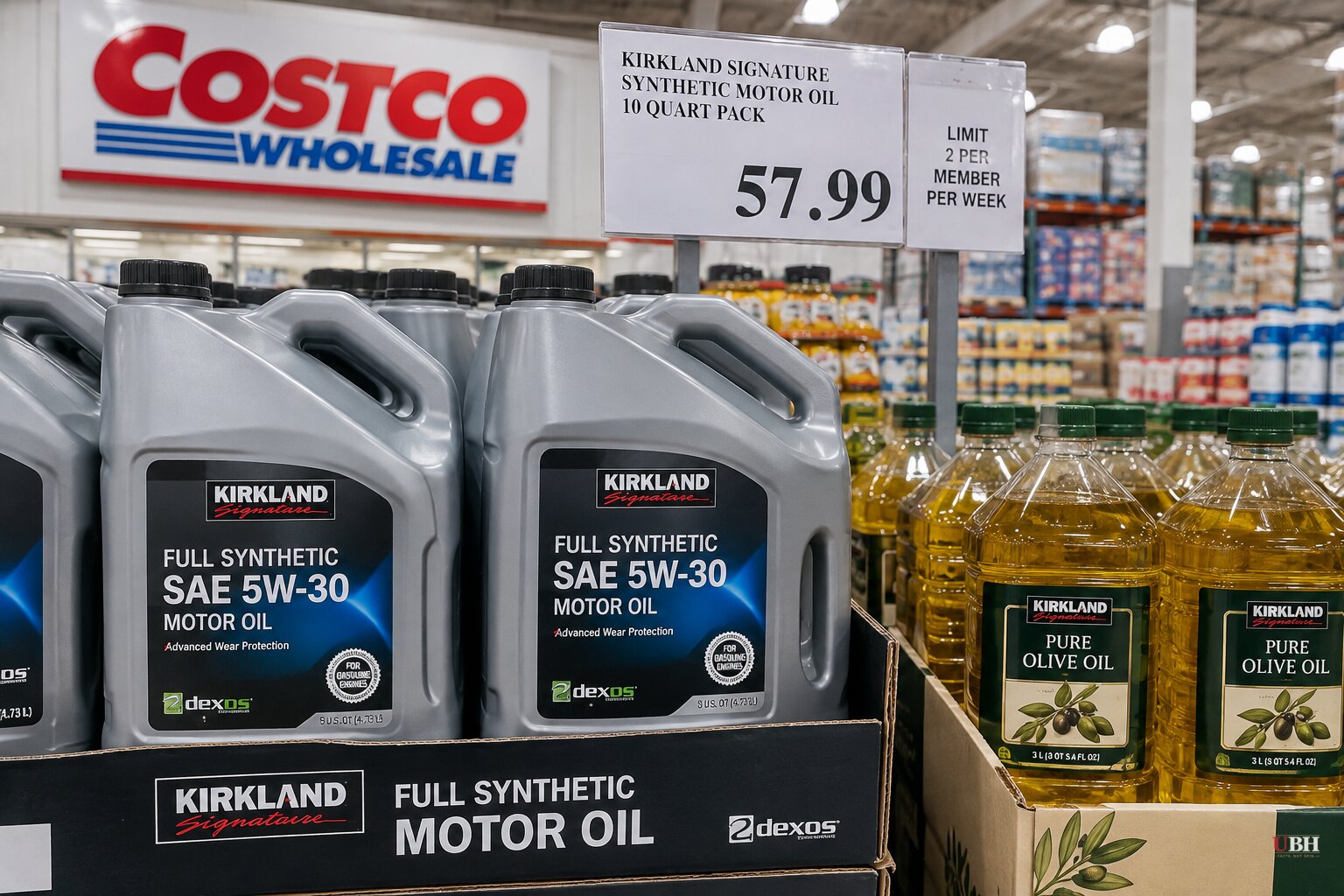
Costco is limiting members to one transaction at a time, and no more than two purchases every seven days, of its Kirkland Signature 5W-30 full-synthetic motor oil, sold as a two-pack of five-quart bottles, according to Costco's own website as cited by CleanTechnica and Jalopnik. The 10-quart pack that cost $30 earlier this year now runs $57.99, according to CleanTechnica and Jalopnik, which also cite figures carried by The Drive and Yahoo Autos.
Separately, Ground News reported that Costco has begun limiting purchases of some cooking oils, including vegetable and canola oil, at select warehouses, citing customer photos and reports of shoppers stocking up amid rising prices. Costco has not issued a public statement explaining either restriction, according to the Daily Beast, which said it had contacted the company for comment.
The Actual Supply Problem
The driver isn't a shortage of crude itself. It's a shortage of Group III base oil, the specific refined stock used to blend modern synthetic motor oil, according to a report cited without an English-language byline that nonetheless lines up with NPR's reporting, carried by CleanTechnica. Amanda Hay, an analyst with Independent Commodity Intelligence Services, told NPR that base oil prices have more than tripled since the war began. The United States is a net exporter of gasoline, diesel and jet fuel, but a net importer of Group III base oil, NPR noted.
Roughly half of the Group III base oil imported into the U.S. came from specialized refineries in Qatar, Saudi Arabia and Bahrain before the war, with the Strait of Hormuz closure and strikes on regional infrastructure disrupting those supply chains and overloading alternative Asian shipping routes. Automakers have reportedly cut oil allocations to dealerships and, in some cases, authorized temporary use of heavier-viscosity oils to conserve scarce synthetic stock.
Jalopnik offers a second explanation worth taking seriously: refineries make more money turning crude into gasoline and diesel than into motor oil, so when crude gets tight, lubricant production gets deprioritized first. Supply and demand shift with war conditions, though the two are intertwined.
Prices at the Pump, and Why They Moved
AAA data cited by the Daily Beast put average U.S. gasoline at $4.31 a gallon, up from $4.14 over Labor Day weekend. Jalopnik, citing AAA separately, reported diesel breaking $6 a gallon for the first time in U.S. history at $6.06, an 8-cent jump in a single day and 21 cents over a week. The Daily Beast's more recent figure puts the national diesel average at $6.23.
Those numbers haven't moved in one direction the whole time. Fox News, citing Reuters, reported that West Texas Intermediate crude fell to $80.99 a barrel, its lowest since Aug. 13, as talks between Iran and Oman raised hopes the Strait of Hormuz could reopen. Jalopnik's more recent reporting has crude back near $100 a barrel, coinciding with satellite imagery reportedly showing smoke near Saudi Arabia's East-West Pipeline and reports that Yemen's Houthis reached the island of Perim in the Bab el-Mandeb Strait, another chokepoint for global shipping.
Brown University's Iran War Energy Cost Tracker, cited by the Daily Beast, estimates the conflict has added more than $100 billion in gasoline and diesel costs nationally, averaging over $750 per household since the war began, with the tab rising by roughly $1 million every two minutes.
The Military and Diplomatic Backdrop
Axios reported, per Fox News, that the U.S. does not plan further strikes on Iran unless Iran strikes first, with Secretary of State Marco Rubio telling foreign counterparts the posture holds "for the time being." A second official told Axios that posture likely holds until after the midterm elections. Defense Secretary Pete Hegseth said Monday he wasn't ruling out renewed strikes, according to the Associated Press. Treasury Secretary Scott Bessent has meanwhile rolled out new sanctions he described as an "economic onslaught" against Iran's financial networks, according to Fox News.
Trump has said gas and oil prices won't come down until after the November midterms, according to CNBC as cited by Jalopnik. His argument, per the Daily Beast, is that Americans should tolerate higher costs to keep Iran from getting a nuclear weapon. A CBS News/YouGov poll from June found 69% of Americans said the conflict wasn't worth the costs, though that poll predates the latest round of price spikes and is now several months old.
Where Coverage Splits
Daily Beast's headline frames this squarely as "Trump's Iran War Crisis," and CleanTechnica goes further, framing the rationing as a pro-EV talking point, arguing electric vehicle owners are "spared" the pain. Both outlets skip past the fact that the price disruption traces to a chain of events involving Iranian-aligned actors, Houthi movement near Bab el-Mandeb, and reported strikes on Saudi infrastructure, not a single U.S. policy decision in isolation. Jalopnik's refinery-economics explanation, largely absent from the Daily Beast and CleanTechnica pieces, complicates a narrative that blames the shortage entirely on the war.
What remains unresolved: whether the Iran-Oman talks that briefly pushed crude down to $80.99 will resume, whether the reported damage near the Saudi pipeline is confirmed, and whether Costco's rationing eases before winter driving season adds further strain on diesel demand.
Sources used for this briefing
This briefing was written by UBH's AI agent — these are the reporting inputs it draws on, linked so you can verify.


