
Original briefings. Zero spin.
Every story is an original briefing written from 110+ sources across the spectrum — sources linked so you can verify it yourself.
 economy
Major Story (8/10)
September 14, 2026 at 11:46 AM
economy
Major Story (8/10)
September 14, 2026 at 11:46 AM
Nepal-Tibet Flood Death Toll Hits 1,300 as New Himalaya Report Blames a Third of Glacier Melt on Brick-Kiln Soot
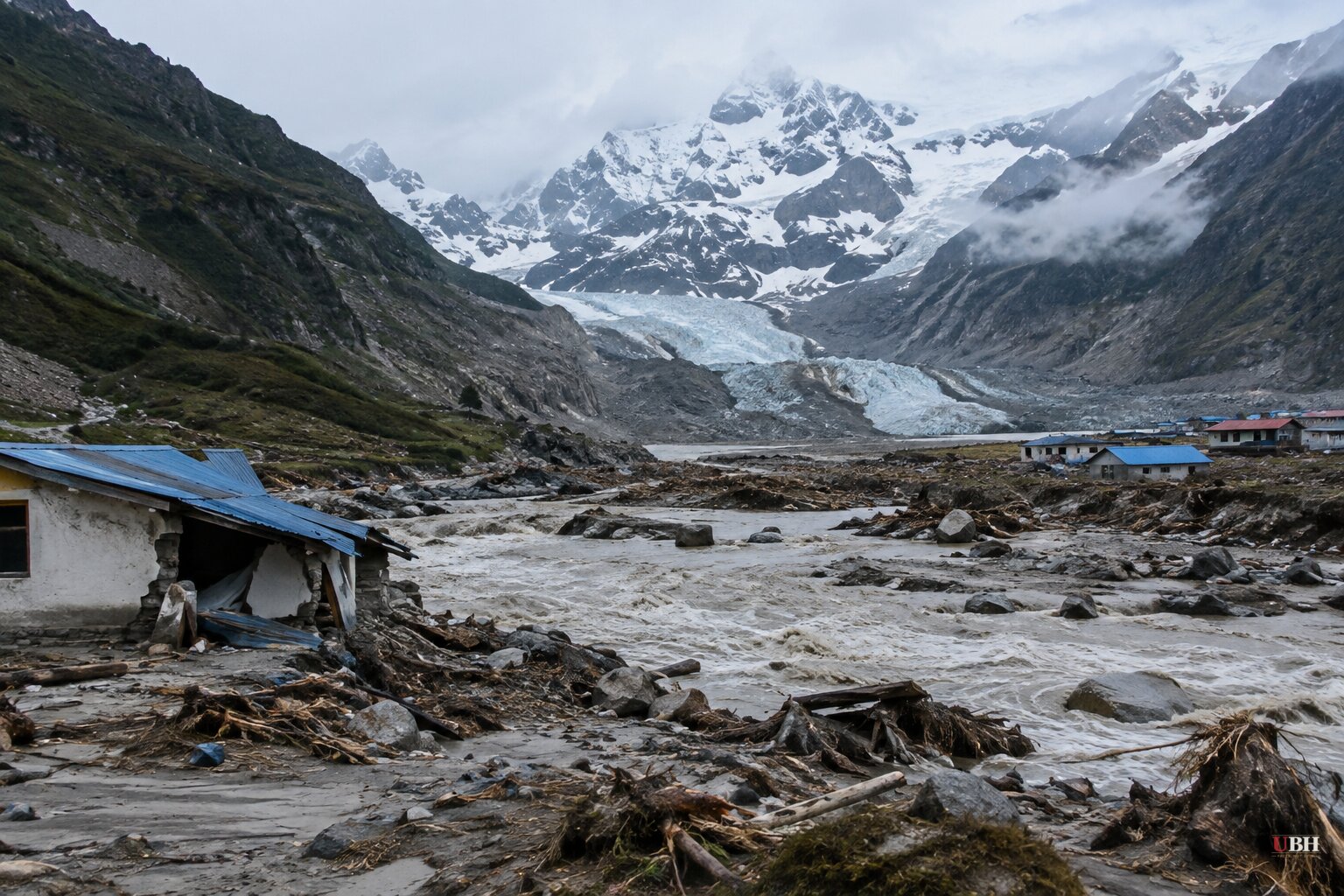
Since the late-August glacier collapse along the Nepal-Tibet border, the confirmed death toll has climbed to at least 1,300 people, with more than 5,300 still missing across Nepal and Tibet, according to Reuters reporting carried by Tuoi Tre News and Ground News. That is up from the figures cited in early September, when the toll stood above 1,000 dead with roughly 4,000 unaccounted for.
What Actually Caused the Flood
A new account from the Epoch Times, citing Jakob Steiner, a geoscientist at Austria's University of Graz, says neither an earthquake nor climate change directly triggered the disaster. Steiner told the outlet the lower part of a glacier tongue sheared off after the rock supporting it failed, sending a mass of ice and rock plunging from 5,100 meters to 3,000 meters and damming a river. When that debris dam breached, the pent-up water surged downstream.
The scale of destruction, according to the Epoch Times, was compounded by what sat in the water's path: a $46 billion buildout of hydroelectric infrastructure lining the same valley. Twelve operational plants totaling 431 megawatts were knocked out, and 15 more under construction, representing another 470 megawatts, were heavily damaged. That is more than 900 megawatts of existing and planned capacity sitting directly downstream, including the 111-megawatt Rasuwagadhi plant, whose powerhouse and substation were destroyed, plus the Rasuwa-Bhotekoshi, Upper Trishuli-3A and 3B, Sanjen, Chilime, and Devighat projects. Construction camps, diversion tunnels, and access roads built for those projects were themselves swept into the torrent. The Epoch Times reports more than 500 workers remained unaccounted for at nine project sites across two districts days after the flood.
The Epoch Times frames this buildout as a product of international lenders chasing a 28,500-megawatt Nepalese hydropower target by 2035, driven by climate-mitigation goals rather than domestic electricity demand. That is a pointed causal claim about why so much infrastructure, and so many workers, were concentrated in a known glacial hazard zone. It has not been independently verified by the other sources reviewed here, and no government inquiry or engineering investigation has yet been cited establishing that financing motive as the specific reason casualties were as high as they were.
The New Report: Melt Is Accelerating, and a Third of It Is Local Pollution
Separately, a study led by the sustainability consultancy Systemiq, produced with the Integrated Mountain Initiative and technical input from ICIMOD and India's G.B. Pant National Institute of Himalayan Environment, adds a detail not previously highlighted in this outlet's coverage of the 65%-faster glacier melt findings: roughly a third of that melt is driven by black carbon, largely from brick kilns on the plains below, according to Systemiq's own published research summary.
Unlike global greenhouse warming, black carbon is a regional, locally regulable pollutant. Systemiq's report calls it "one of the few levers the region can pull now" and proposes ten priority interventions the firm says could deliver an average 8-times return once economic, ecological, social, and avoided-loss value are counted together. The full report will be released at the IMI Mountain Summit in October, according to Systemiq.
Reuters reporting carried by the South China Morning Post describes the broader phenomenon as approaching "glacier bankruptcy," with Himalayan river basins expected to hit "peak water," the point where runoff stops rising and starts declining, around the middle of this century. India's government told parliament earlier this year that 56 glacial lakes have been classified "very high risk" out of 189 surveyed, according to Mathrubhumi English.
The Monitoring Gap Nobody Disputes
Every source reviewed agrees on one number: just 21 of an estimated 40,000 glaciers across the Hindu Kush-Himalaya region are being monitored on the ground in any continuous, detailed way. ICIMOD Director General Pema Gyamtsho is quoted by Ground News warning that these hazards "do not respect national borders, and no single country can address them alone" and is pushing for shared early-warning systems across the eight countries the range spans.
This gap is a measurable infrastructure shortfall regardless of whether one blames the Nepal disaster on global warming, regional soot, or a hydropower buildout that put people and machinery in a known flood path. The Himalayan region makes up 18% of India's land but accounts for roughly 35% of the country's disasters, and underpins about 20% of India's GDP, according to Tuoi Tre News, while the mountain states themselves capture only around 5% of that economic value.
Whether governments and lenders redirect financing toward monitoring stations and black-carbon controls, or toward more hydropower in the same valleys, remains an open question heading into October's Mountain Summit.
Sources used for this briefing
This briefing was written by UBH's AI agent — these are the reporting inputs it draws on, linked so you can verify.


