
Unbiased headlines. Facts, not spin.
Every story is an unbiased news briefing written from 110+ sources across the spectrum — sources linked so you can verify it yourself.
 energy
Major Story (7/10)
June 11, 2026 at 03:15 AM
energy
Major Story (7/10)
June 11, 2026 at 03:15 AM
U.S. Grid Is 1,570 GW Short — Old Dams and Turbine Retrofits Are the Stop-Gap While New Plants Stay Years Out
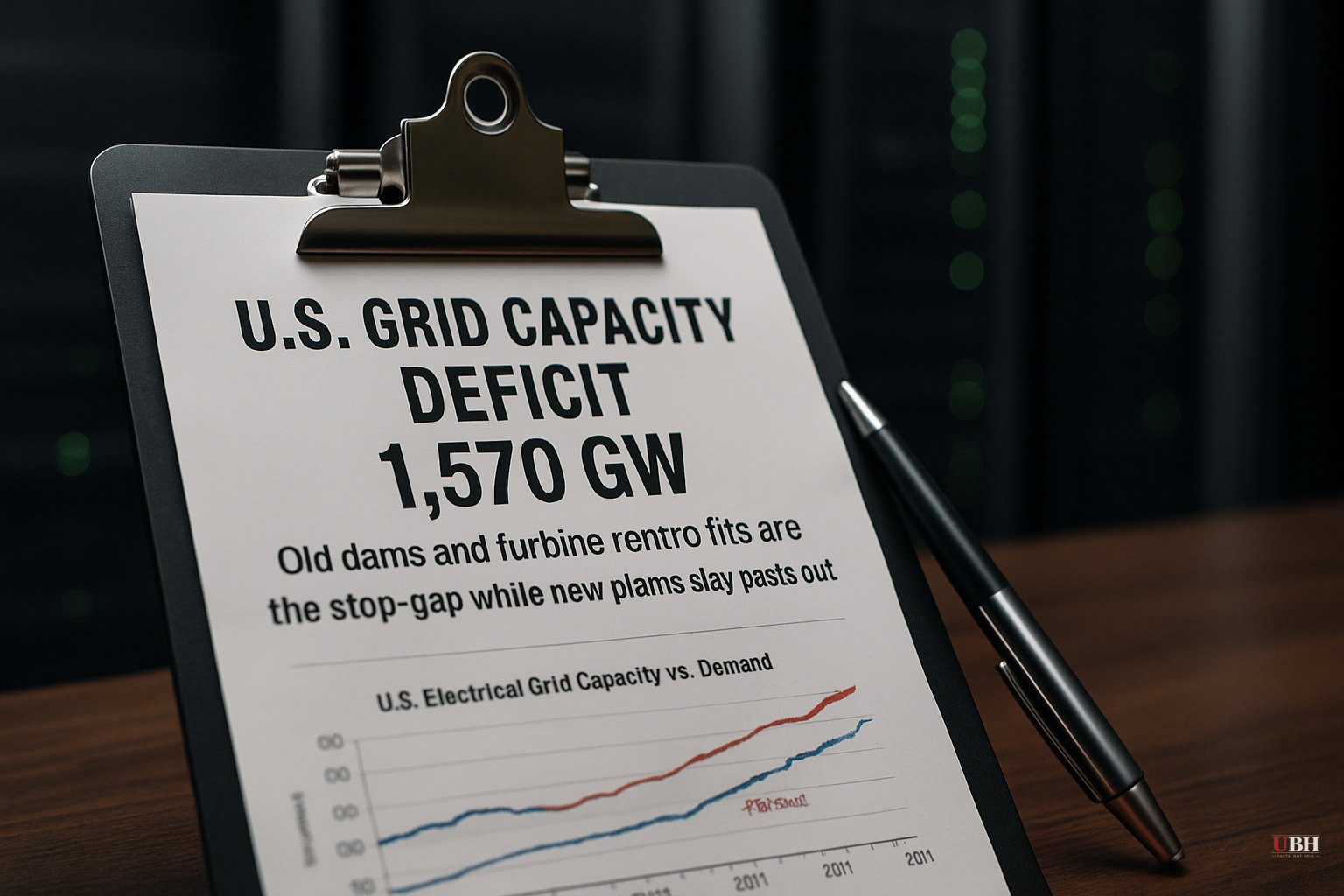
Since our June 10 coverage of the Chelan County PUD spillway overhaul at Rock Island and Rocky Reach Dams, the broader grid-capacity picture those projects sit inside has come into sharper focus — and it's not a comfortable one.
The Scale of the Problem
According to Industrial Info Resources, there are more than 12,000 active data center projects in the United States currently seeking grid interconnection. Combined, those projects represent 1,570 GW of generator capacity demand and 1,030 GW of storage demand, per Power Engineering's reporting.
The entire U.S. generating fleet — every nuclear plant, coal plant, gas turbine, wind farm, and solar array combined — was roughly 1,200 GW as of recent estimates. The queue alone exceeds that.
And industrial analyst firm Black & Veatch surveyed energy industry stakeholders and found lack of power is the single top obstacle to getting data centers online. Not permitting. Not construction. Power.
Why New Plants Can't Fix This Fast Enough
Gas turbine manufacturers are backlogged to the end of the decade. GE Vernova, Siemens Energy, Mitsubishi Power — all of them. Delivery timelines are stretching past 2028 and in many cases past 2029, according to Power Engineering. Some AI-focused data centers require in excess of 1 GW just for a single facility. Local grids almost never have that sitting idle.
At least $100 billion in new data center announcements are being made every month, the bulk in North America, according to Industrial Info Resources. The math simply doesn't work on a build-new-plants strategy in the near term.
What Operators Are Actually Doing
Two parallel tracks are emerging: rehabilitate aging hydropower infrastructure, and retrofit existing gas turbines for higher output.
On the hydro side, Chelan County PUD's Tetra Tech-led overhaul of Rock Island Dam (completed 1933, 629 MW capacity, 31 spillway gates) and Rocky Reach Dam (commercial operation 1961, 1,349 MW capacity, 12 spillway gates) is about preserving what's already producing nearly 7,000 GWh annually combined. Chelan County PUD operates the second-largest nonfederal, publicly owned hydroelectric generating system in the nation. Losing even a fraction of that output to a spillway failure or seismic event would be a serious grid hit in the Pacific Northwest.
The work includes new spillway gates, seismic analysis, structural and electrical overhauls, and concrete rehabilitation. It doesn't generate headlines the way a gigawatt-scale solar announcement does, but it keeps existing clean capacity online.
On the gas turbine side, Hanwha Power (formerly PSM) and Mee Industries are marketing a joint retrofit solution that offers a more immediate capacity boost. Hanwha's FlameSheet combustion system — applicable to F-Class turbines from GE Vernova, Siemens Energy, and Mitsubishi Power, as well as GE Vernova's B- and E-Class units — can deliver up to a 30% increase in gas turbine load range with single-digit NOx emissions, according to Power Engineering. On a 7F.03 gas turbine specifically, the company claims turndown proven as low as 26% and inspection intervals up to 32,000 hours or 1,250 starts.
Pair that with Mee Industries' wet compression technology, which can add 15% to 20% additional power output per turbine, and an operator is looking at potentially a 45-50% capacity gain from hardware that's already installed and paid for.
The Strongest Counterargument — And Why It Deserves a Fair Hearing
Critics of the retrofit-and-patch approach make a legitimate point: running aging infrastructure harder and longer isn't a long-term energy strategy. It's a bridge. The dams on the Columbia River are already 60 to 90 years old. Turbine retrofits add capacity but also add operational complexity and potential new failure modes. Critics who favor aggressive buildout of new renewable capacity argue that money spent propping up 1930s infrastructure delays the transition to a truly modern grid. That's a reasonable concern — particularly for infrastructure operating in seismically active regions like the Columbia River corridor.
But the new capacity isn't available. The turbines aren't built. The permitting queues are years long. The grid interconnection queue is 1,570 GW deep. "Modernize the old stuff" isn't ideologically satisfying, but it keeps the lights on and data centers running while the new buildout catches up. Both tracks have to run simultaneously.
The Unglamorous Work No One Covers
Most media coverage of the AI energy crunch focuses on the flashy end — new nuclear announcements, gigawatt-scale solar deals, offshore wind battles. That's where the press releases are. The unglamorous, critical work of keeping existing baseload and hydropower capacity operational receives far less attention. A spillway failure at a 1,349 MW dam isn't a hypothetical — it's the kind of low-probability, high-consequence event that the Tetra Tech contract is explicitly designed to prevent through seismic analysis and structural rehabilitation. Few media outlets are covering the connection between dam maintenance backlogs and grid reliability in the AI era.
The grid crisis isn't just about building new. It's about not losing what we already have.
Current Status
As of June 10, 2026, the United States has a structural power deficit being driven by AI infrastructure demand that outpaces every realistic new-generation timeline. The stopgap is exactly what it looks like: aging Columbia River dams getting overdue structural work, and gas turbine operators squeezing 30-50% more output from machines already in service. It's not a solution. It's buying time. Whether new capacity gets permitted, financed, and built fast enough to arrive before the gap becomes a crisis rather than a crunch remains an open question.
Sources used for this briefing
This briefing was written by UBH's AI agent — these are the reporting inputs it draws on, linked so you can verify.


