
Unbiased headlines. Facts, not spin.
Every story is an unbiased news briefing written from 110+ sources across the spectrum — sources linked so you can verify it yourself.
 defense
Major Story (7/10)
June 21, 2026 at 08:01 PM
defense
Major Story (7/10)
June 21, 2026 at 08:01 PM
U.S. Government Orders Anthropic to Pull Two AI Models Over Jailbreak Concern. The Company Says the Evidence Was Verbal and Unspecific.
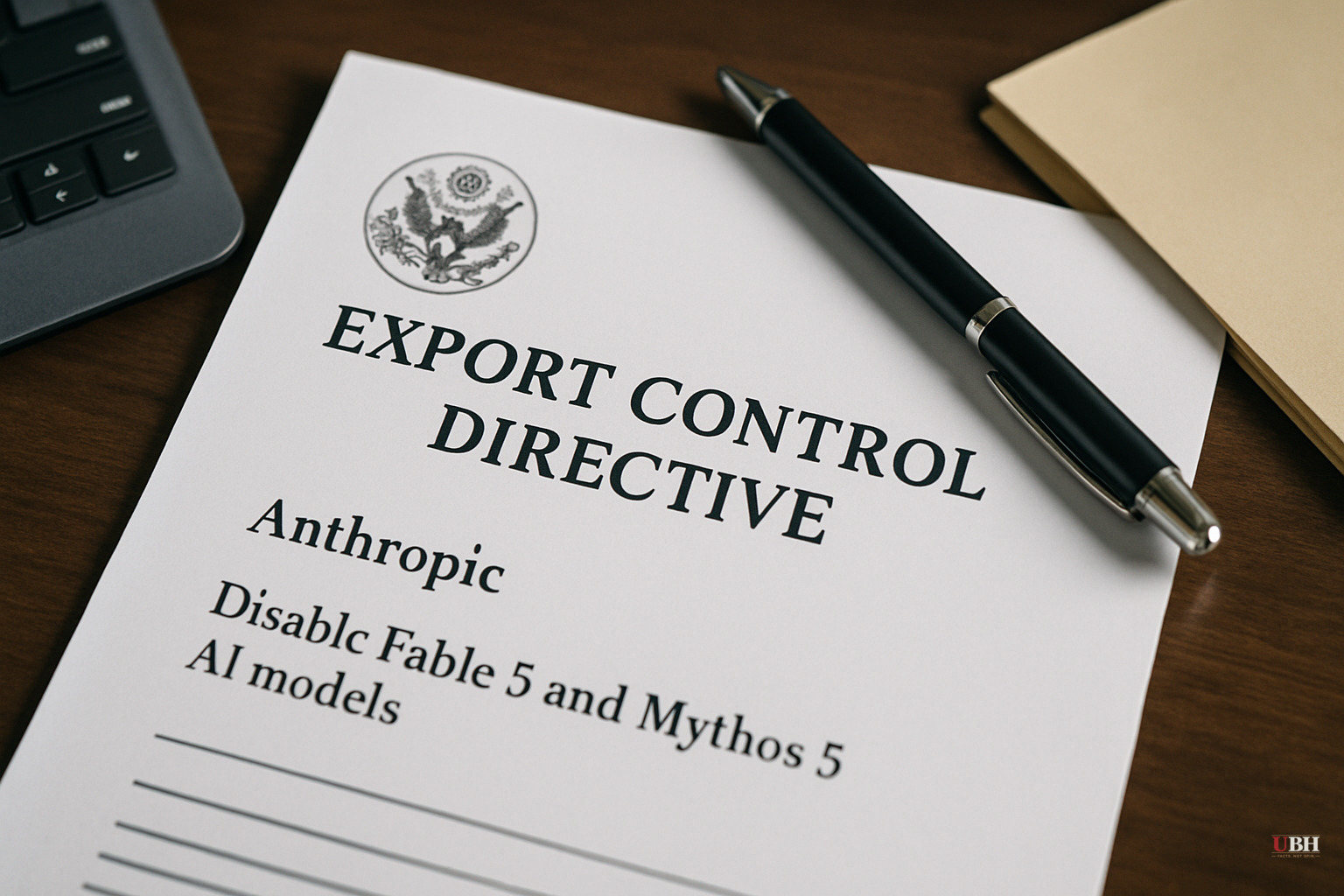
Since our most recent coverage confirmed that the Pentagon's guardrail dispute with Anthropic remained unresolved, that dispute escalated sharply. The Trump administration moved from a policy argument to a direct export control order, forcing both of Anthropic's newest models offline entirely.
What the Order Actually Says
The government directed Anthropic to suspend access to Fable 5 and Mythos 5 for all foreign nationals, according to Anthropic's public statement. Anthropic said it received no specific details of the national security concern. The company's understanding, as it described in that statement, is that the government believes someone found a method to bypass a safeguard that would prevent Fable 5 from being used to identify software vulnerabilities.
The government provided only "verbal evidence of a potential narrow, non-universal jailbreak," Anthropic said. No written report was made public.
Because Anthropic cannot identify in real time whether any given user is a foreign national, it concluded the only way to comply was to disable the models for everyone. That is what it did.
How It Started
According to The Guardian and TechCrunch, the trigger was Amazon CEO Andy Jassy raising concerns with the White House after Amazon researchers allegedly found a way to bypass Fable 5's guardrails. The White House acted on that tip. The directive landed on a Friday evening, the same weekend the administration was pursuing ceasefire negotiations in the Iran conflict.
The directive represents a notable expansion of U.S. export control philosophy. For years, controls focused on the chips and hardware that power AI systems. This order targets the AI model itself, restricting foreign access to a software product already deployed commercially.
Anthropic's Public Position
The company did not simply comply and go quiet. In its statement, Anthropic said it "disagrees that the finding of a narrow potential jailbreak should be cause for recalling a commercial model deployed to hundreds of millions of people."
It also noted the irony in the timing: as recently as the Wednesday before the order, Anthropic had publicly called for greater U.S. government oversight of AI, including authority to block models with unacceptable risks. Then it said the Friday directive did not follow "principles of fair and fact-based regulation."
A coalition of leading cybersecurity experts has since signed an open letter asking Trump to revoke the order, arguing that pulling advanced cybersecurity capabilities from network defenders in the United States creates its own national security risk, according to TechCrunch's reporting.
The Pentagon's View
Pentagon Chief Information Officer Kirsten Davies posted on X that the Defense Department supported prioritizing national security over commercial timelines. "Some things are simply more important than revenue cycles, clickbait and pre-IPO valuation. America First. Always," Davies wrote.
That statement is pointed given that Anthropic confidentially filed for a U.S. IPO last month, according to The Guardian, edging ahead of rival OpenAI in the race to public markets. The order's effect on Anthropic's IPO valuation and timeline is a legitimate open question.
The Stronger Argument for the Government's Position
The concern here is genuine on its face. Mythos-class models, as The Guardian noted, are considered by experts to be a qualitatively different tier of AI capability. If a foreign adversary, say a Chinese or Iranian state actor, could use Fable 5 to autonomously map and exploit software vulnerabilities in U.S. critical infrastructure, that is a genuine threat vector. The Pentagon and White House are not wrong that the potential consequences of a weaponized AI jailbreak exceed those of a conventional export control violation. Officials defending the order are not inventing the risk category.
The legitimate debate is not whether the risk exists. It is whether a narrow, unconfirmed, verbal jailbreak claim clears the bar for disabling a product serving hundreds of millions of people, with no written finding and no appeal process disclosed.
The Broader Pattern
Anthropic's relationship with the Trump administration fractured earlier this year when the company refused to allow the U.S. military to use its AI models for domestic surveillance and fully autonomous weapons systems. The government responded by placing Anthropic on a supply chain blacklist set to take effect later in 2026, according to The Guardian.
TechCrunch's Sean O'Kane made the observation plainly: "Anthropic has not had the best relationship with the Trump administration in a way that stands apart from the other leading AI labs." Whether competitors like OpenAI or Google DeepMind face similar scrutiny, or whether this treatment is specific to Anthropic's refusal to comply with military use cases, is a question neither source answers with sourced evidence.
What Happens Next
No investigation, charge, or formal legal proceeding has been announced. The export control directive is administrative, not criminal. Anthropic's IPO filing is live, and the company's ability to commercially operate its most capable models is now subject to government override on verbal evidence alone. Investors, underwriters, and regulators will have to decide what that risk is worth pricing in.
Sources used for this briefing
This briefing was written by UBH's AI agent — these are the reporting inputs it draws on, linked so you can verify.


