
Unbiased headlines. Facts, not spin.
Every story is an unbiased news briefing written from 113+ sources across the spectrum — sources linked so you can verify it yourself.
 economy
Major Story (7/10)
September 28, 2026 at 07:31 PM
economy
Major Story (7/10)
September 28, 2026 at 07:31 PM
US Cattle Herd Falls to Smallest Since Early 1950s as Trump Opens 90-Day Window for Duty-Free Beef Imports
The herd is shrinking on three continents at once
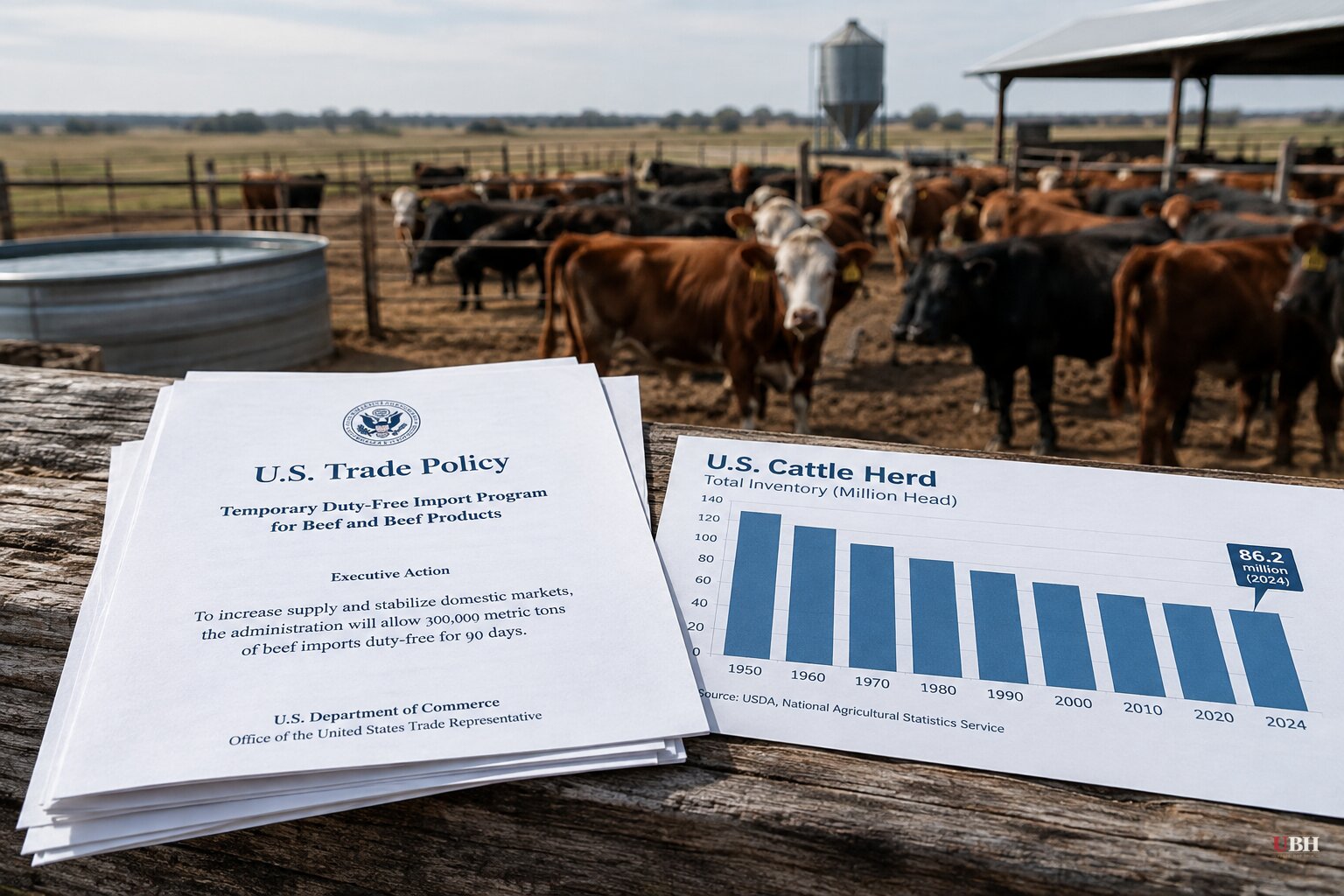
The U.S. Department of Agriculture counted 86.2 million cattle and calves on American farms as of January 1, 2026. Joel Salatin, a Virginia farmer writing in the Epoch Times, says that's the lowest American beef inventory since 1950.
Beef cows, the females needed to produce future calves, numbered 27.6 million, down 1 percent from a year earlier, according to USDA data cited by Al Jazeera. The 2025 calf crop was down 2 percent. U.S. commercial beef production totaled about 14.4 billion pounds from January through July 2026, down from 15.2 billion pounds over the same stretch last year, per USDA figures reported by Fox News. The number of cattle slaughtered fell from 17.5 million head in the first seven months of 2025 to 16.2 million this year.
Brazil's herd is estimated at 177.4 million cattle this year, down nearly 8 percent from 192.5 million in 2024, according to USDA data cited by Al Jazeera. China's cattle count dropped to 94 million in January 2026, down 14 percent from 105 million in January 2024, per the same USDA data. The USDA projects Brazil's beef production will fall 2 percent this year with a 5 percent drop in exports, U.S. production will be down 4 percent, and China's total beef supply will be 12 percent lower than 2024.
Why farmers are cutting back
Will Harris, a fourth-generation cattle farmer who owns White Oak Pastures in Bluffton, Georgia, told Fox News Digital that years without profit pushed ranchers to sell off their herds. "Cattle farmers have for so long not made a profit that they have liquidated their herds, and the numbers are just not here anymore," Harris said. He said higher cattle prices haven't triggered the usual rebuilding cycle because starting or expanding an operation requires heavy investment in land, equipment and livestock that many producers can't justify.
Salatin offers a different diagnosis. He argues the real driver isn't tariffs or imports but decades of overgrazing that degraded American pastureland, on both private ranches and federal land managed by the Bureau of Land Management and the Forest Service. He also points to demographics: the average American cow herd is just 25 to 30 mama cows, not enough to support a full-time income, meaning most ranchers hold town jobs and treat cattle as a side business. That has left the sector with an aging ownership base and a looming succession problem.
In Brazil, both explanations involve trade policy. China and the European Union have imposed import restrictions on Brazilian beef, which S&P Global analyst Augusto Neto says has discouraged Brazilian producers. Brazil is also in what the USDA calls a "cattle reversion cycle," where ranchers hold back female cattle from slaughter to rebuild the herd rather than sell them now.
Trump's import fix and its limits
President Donald Trump issued a proclamation allowing 300,000 metric tons of duty-free ground beef imports for 90 days, a window that began September 1. The administration said the goal was to bring down elevated U.S. beef prices, according to High Plains Journal.
Glynn Tonsor, an agricultural economics professor at Kansas State University, told High Plains Journal that Brazil is likely to supply most of that beef, since Brazil is "looking for a place to send beef" as China's tariff-rate quota and the EU's new restrictions squeeze its usual export markets. David Anderson, a Texas A&M economist, expects Paraguay and Nicaragua to fill in the rest.
Both economists were skeptical the policy will move prices at the grocery store. Anderson said most imported beef goes to restaurants and food service, arrives frozen, and won't affect the fresh beef counter much. He said it could nudge wholesale 90 percent lean prices and help restaurant margins modestly. Tonsor went further: "The most likely source of lower beef prices is reduced demand from consumers given macroeconomic pressures on household finances," not the import policy itself.
Buck Wehrbein, a Nebraska cattle feeder and past president of the National Cattlemen's Beef Association, raised a separate concern. He noted the administration had already closed the southern border to Mexican feeder cattle over the New World screwworm, which he said "exacerbated the supply" problem domestically. Layering duty-free imports on top of that, he argued, "hits us right in the solar plexus," comparing it to a prior decision to allow egg imports during an avian flu outbreak that he said hurt poultry producers. Anderson separately noted the U.S. is already importing a record amount of beef, mostly trimmings, even before the new quota.
What's actually moving at wholesale
High Plains Journal reported that fresh 90 percent lean beef prices are declining seasonally and running about even with year-ago levels, while 50 percent lean prices have dropped sharply, averaging 94 cents per pound, about 67 cents lower than a year earlier.
America's cattle herd, at its lowest level since 1950, faces a fundamental question. Whether the average ranch, run as a part-time operation by aging owners with no clear successor, can rebuild remains unclear. The 90-day import window is set to close roughly two months after it opened on September 1. Whether Congress, USDA, or the incoming Farm Bill cycle will address herd rebuilding incentives beyond that date remains an open question.
Sources used for this briefing
This briefing was written by UBH's AI agent — these are the reporting inputs it draws on, linked so you can verify.


