
Unbiased headlines. Facts, not spin.
Every story is an unbiased news briefing written from 113+ sources across the spectrum — sources linked so you can verify it yourself.
 economy
Major Story (8/10)
Event date: September 24, 2026
economy
Major Story (8/10)
Event date: September 24, 2026
EU Presses China on Import Quotas as Trade Deficit Hits €1 Billion a Day, October Deadline Looms
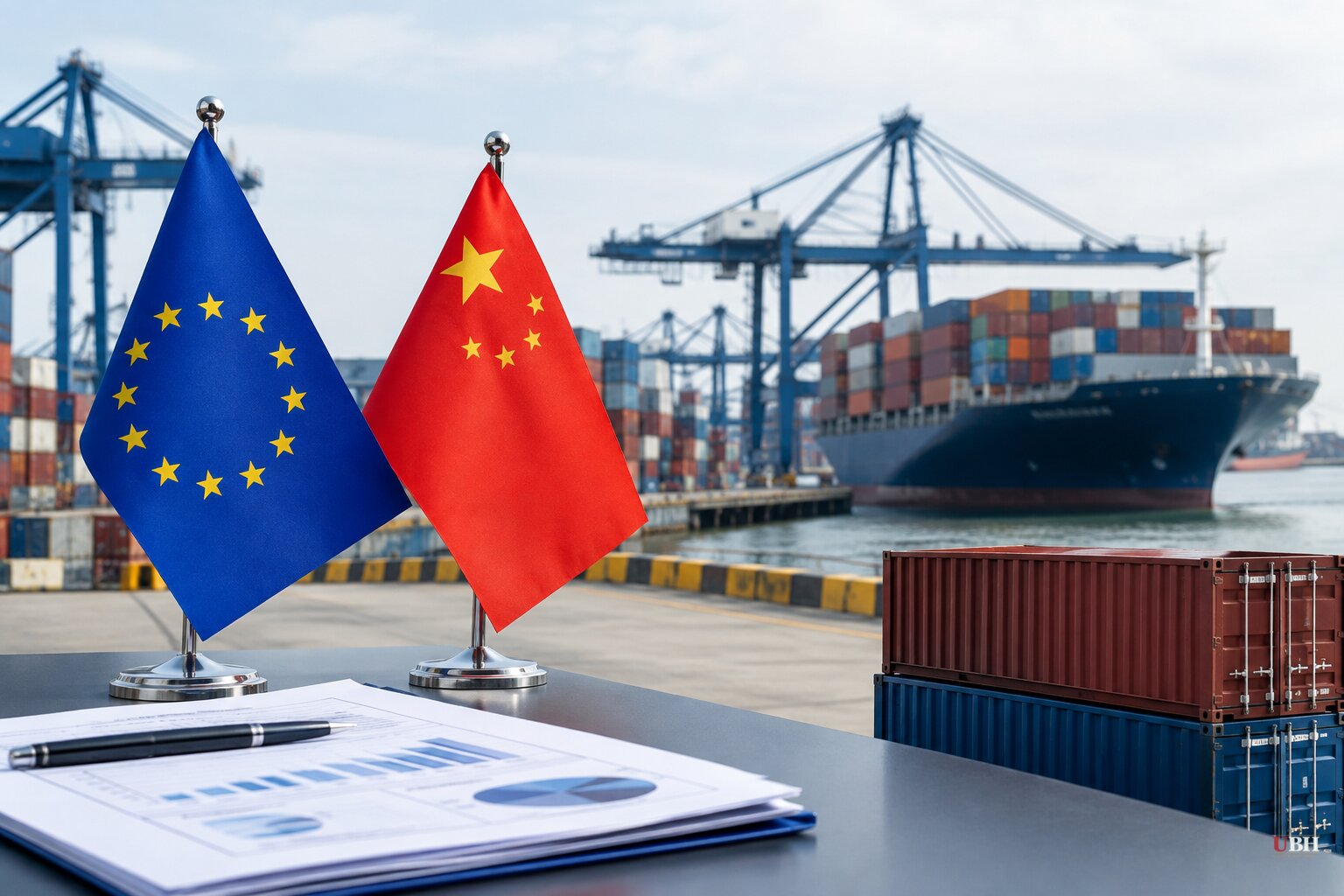
Since Ursula von der Leyen told the European Parliament on September 16 that the EU's trade deficit with China had hit a 'tipping point,' negotiators have been racing toward an October deadline that could determine whether Brussels and Beijing strike a deal or head into a trade war.
The numbers driving the fight are stark. According to the Mercator Institute for China Studies, the EU's trade deficit with China ran at more than €1 billion a day in July, hitting €36.5 billion for the month alone. Year to date through July, the deficit stands at €234 billion, about €21 billion higher than the same period in 2025, per Meric's analysis of customs data. Separately, the advocacy group Friends of Europe cites Eurostat figures showing the annual goods deficit jumped from €306 billion in 2024 to €360 billion in 2025, with a €103 billion gap in the second quarter of 2026 alone, and projects the full-year 2026 deficit could reach €400 billion.
Quotas on the Table
According to Euronews, the European Commission is now pushing China to accept quotas on specific products as part of the negotiations, which began in June. A person familiar with the talks told Euronews it remains unclear how China would actually accept or enforce such limits.
One option under discussion is a so-called voluntary export restriction on electric vehicles, where Beijing would agree to cap its own exports to the EU rather than face defensive tariffs from Brussels. China's trade minister rejected that specific proposal earlier in September, according to Euronews.
The fight has expanded beyond EVs. The Guardian reported that sales of Chinese hybrid vehicles, which escaped the EU's 2024 tariffs on Chinese-made EVs, have grown tenfold, from just under 4,000 vehicles in October 2024 to 50,000 in July 2026. The Financial Times reported, as cited by the Guardian, that the EU has separately asked China to voluntarily cut hybrid exports too.
Brussels has also delayed adopting trade defense mechanisms meant to protect the EU chemical industry, according to a person familiar with the matter cited by Euronews. This delay gives the current round of negotiations room to work. The chemical sector is one of several EU industries most exposed to Chinese competition, alongside automotive supply chains.
The Diplomatic Calendar
DG Trade Director General Ditte Juul Jørgensen traveled to Beijing last week for two days of heated technical discussions, according to Euronews. EU Trade Commissioner Maroš Šefčovič is scheduled to meet his Chinese counterpart in Beijing on October 8 and 9 for higher-level political talks.
Those meetings feed directly into two other dates. The European Parliament is expected to vote October 7 on a resolution that its Foreign Affairs Committee already approved 44-9 with 12 abstentions, calling for a 'rigorous de-risking strategy' on critical raw materials, batteries, EVs, semiconductors and other sectors, according to Friends of Europe. EU heads of state and government are then set to take up the strategic direction of China policy at the European Council on October 15 and 16.
China's Position
Beijing has not been silent on any of this. China's commerce ministry said any solution 'must ensure a balance of interests, comply with World Trade Organization rules and the respective domestic laws of every side, and fully take into account the interests of industries on both sides,' according to the Guardian. That reflects a WTO-grounded objection: unilateral EU quotas imposed without Beijing's genuine agreement could themselves violate trade rules China has repeatedly warned it is prepared to fight over.
But von der Leyen's own framing leaves little room for China to simply wait the EU out. 'Some say the second China shock is looming. But it's already here,' she said in Strasbourg, according to the Epoch Times, pointing to what she called 'de-industrialisation in the industrial heartlands of Europe.' EU Industry and Trade Commissioner Stéphane Séjourné told Euronews the rebalancing effort is 'existential' for European industry, and the Commission says the EU lost 250,000 industrial jobs last year, concentrated in energy-intensive and automotive sectors.
Von der Leyen also flagged a separate but related vulnerability: she said the EU gets more than 80% of its critical raw materials and 90% of its rare earths from China, and announced plans for a new European corporation to build up reserves of materials used in EVs, semiconductors, batteries and defense equipment, according to the Epoch Times.
None of this guarantees an outcome. China has not said it will accept quotas of any kind, and the mechanism for enforcing a 'voluntary' export cap remains undefined even in the EU's own internal discussions, per Euronews's sourcing. Whether Šefčovič's October 8-9 trip produces a deal, or whether the EU moves ahead with tariffs and trade defense measures it has so far held back, will be decided in the three weeks between that Beijing visit and the European Council meeting on October 15-16.
Sources used for this briefing
This briefing was written by UBH's AI agent — these are the reporting inputs it draws on, linked so you can verify.


