
Unbiased headlines. Facts, not spin.
Unbiased Headlines is an independently owned news organization. We bring you the facts, not opinions, written fresh from 110+ named sources. Sources linked so you can verify it yourself.
 health
Notable (6/10)
Event date: October 30, 2026 ·
U.S. Cancer Deaths Tied to High BMI Doubled Since 1990, Researcher Reports; Korean Study Finds Higher Early Cancer Rates in Obese Young Adults
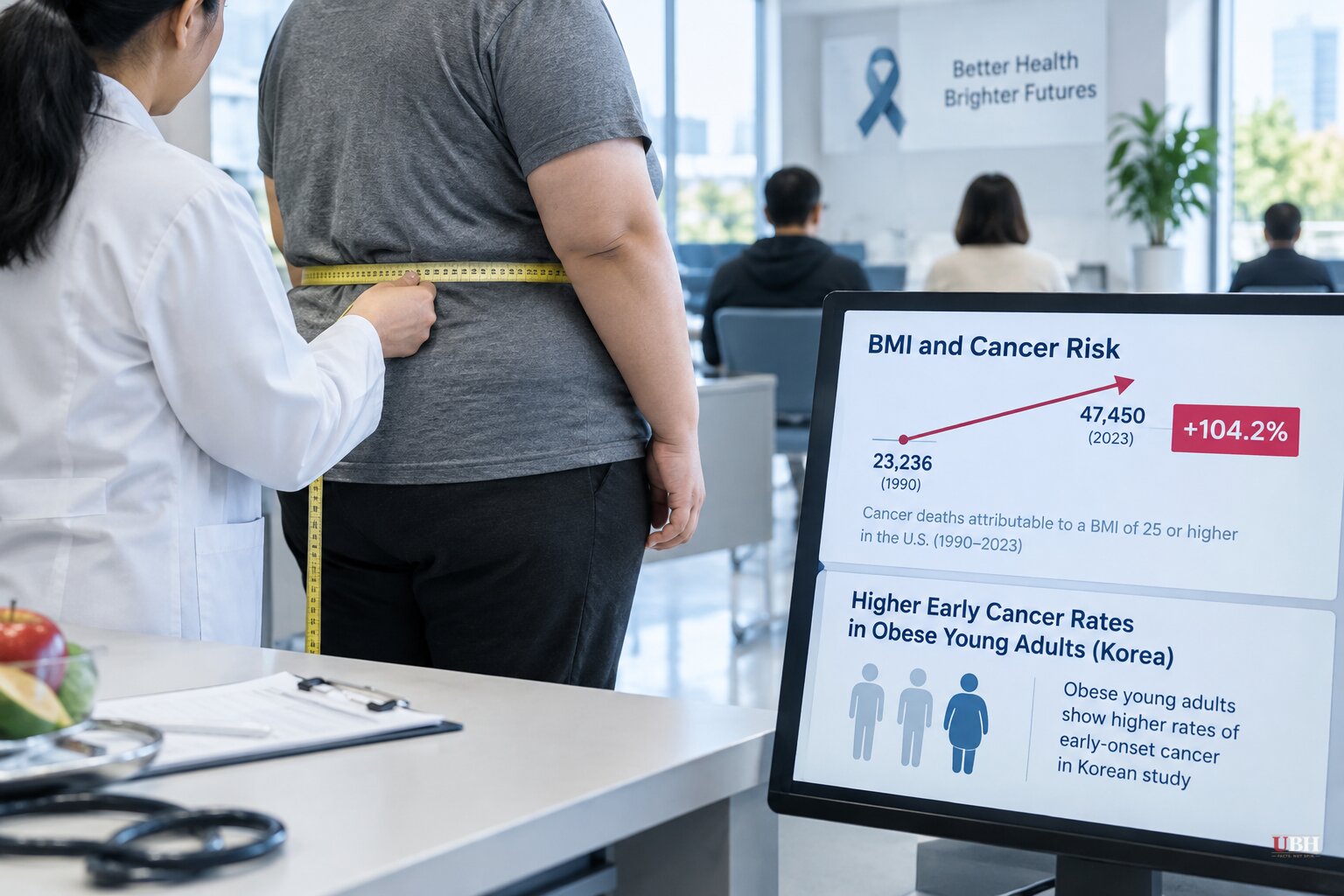
Cancer deaths linked to high body mass index in the United States more than doubled between 1990 and 2023, according to estimates presented at the ObesityWeek annual meeting in National Harbor, Md.
Digantkumar Patel, MD, of the Springfield Clinic in Illinois, used Global Burden of Disease 2023 data. Deaths attributable to cancers tied to a BMI of 25 or higher rose 104.2%, from 23,236 in 1990 to 47,450 in 2023.
Not just a bigger, older population
Part of any rise in cancer deaths comes from a larger and older population. Patel's numbers suggest that is not the whole explanation.
The age-standardized death rate climbed 8.1%, from 7.28 to 7.87 per 100,000 people. Patel said that uptick means the rise "cannot be explained by population growth and aging alone."
The picture varies by cancer. Among the 12 cancers linked to high BMI, three grew fastest:
- Liver: deaths up 566%, from 913 to 6,081.
- Pancreatic: up 487%, from 414 to 2,432.
- Uterine: up 193%, from 1,935 to 5,677.
Colorectal cancer still accounted for the most deaths in 2023, at 11,161, a 53% increase since 1990.
Total deaths rose for the other eight cancers too: thyroid (+145%), multiple myeloma (+121%), kidney (+104%), leukemia (+73%), ovarian (+69%), gallbladder and biliary tract (+61%), non-Hodgkin lymphoma (+60%) and breast (+50%).
But age-standardized mortality rates actually declined over time for several of them, by average annual percent change: breast (-0.91%), non-Hodgkin lymphoma (-0.82%), colorectal (-0.57%), ovarian (-0.33%), gallbladder and biliary tract (-0.26%) and leukemia (-0.17%).
The rankings shifted. Liver cancer jumped from eighth to second place, uterine from fifth to third, and pancreatic from 11th to seventh. Breast cancer fell from second to fourth, kidney from third to fifth, and leukemia from fourth to sixth. Thyroid stayed 12th.
Who carries the burden
Disability-adjusted life years from these cancers rose 97.4%, from 560,000 to 1.11 million. Years lived with disability jumped 129.5%, from 36,997 to 84,892.
Adults ages 55 to 79 made up 71.3% of all high-BMI cancer DALYs in 2023, with the heaviest concentration among those 65 to 69. In adults 70 and older, DALYs rose 615% for liver cancer and 655% for pancreatic cancer.
Patel said little is known about how much the burden of these cancers has changed over time, and that identifying the fastest-growing ones could help target screening and prevention. "Our findings reinforce the importance of obesity prevention and treatment as a part of cancer prevention," he said.
These are modeled attributions, not a count of deaths where doctors recorded obesity as the cause. Patel's presentation did not claim to prove that weight caused any individual death.
A look at younger adults
A separate study published Oct. 26 in the Annals of Internal Medicine looked at who gets cancer before midlife. Researchers drew on the Korean National Health Insurance Service database and identified 6,313,338 adults ages 20 to 39 with no history of cancer who had undergone national health screenings.
They followed participants for an average of 11 years. There were 151,893 cancer cases over that period.
The incidence rate rose with each step up in body weight: 1.84% among normal-weight participants, 2.24% in class I obesity and 2.62% in class II obesity. The highest rates were in people with severe obesity and abdominal obesity. Obesity was not associated with breast cancer diagnosed before age 50.
The study also found that waist circumference, a marker of abdominal fat, tracked with cancer risk at a level similar to that seen in people with overweight.
Ketan Thanki, MD, a colorectal surgeon at the MemorialCare Todd Cancer Institute in Long Beach, Calif., who was not involved in the study, said obesity itself creates conditions that promote cancer formation.
Earlier research has found that about 10% of new cancer diagnoses in the United States are associated with obesity. Obesity accounts for up to 50% of certain cancers, including endometrial and liver cancer, according to that research.
Limits on the data
The Korean study is observational and shows association, not proof that weight caused the cancers. It used BMI categories set by the World Health Organization for Asian populations, which differ from standard cutoffs.
The waist thresholds were also specific to Korea. The Korean Society for the Study of Obesity sets the line at more than 90 cm (35.4 inches) for men and more than 85 cm (33.46 inches) for women. The National Heart, Lung, and Blood Institute uses 101.6 cm (40 inches) for men and 88.9 cm (35 inches) for women.
Those figures are not interchangeable. An American man with a 38-inch waist would count as abdominally obese under the Korean cutoff but not under the NHLBI one.
Whether the Korean findings carry over to young adults in the U.S. has not been tested in this study. Neither the U.S. mortality estimates nor the Korean cohort establishes how much of the rise in liver, pancreatic and uterine cancer deaths would disappear if weight were lower, and that remains the question screening and prevention planners will have to answer.
Sources used for this briefing
2 links from 2 independent newsrooms (syndicated copies of the same report count once)
These are the sources it draws on, linked so you can verify.


