
Unbiased headlines. Facts, not spin.
Unbiased Headlines is an independently owned news organization. We bring you the facts, not opinions, written fresh from 110+ named sources. Sources linked so you can verify it yourself.
 health
Notable (6/10)
Event date: November 16, 2026 ·
Shanghai Probe Fires Two Researchers After 6-Year-Old Girl Dies in Gene-Editing Trial
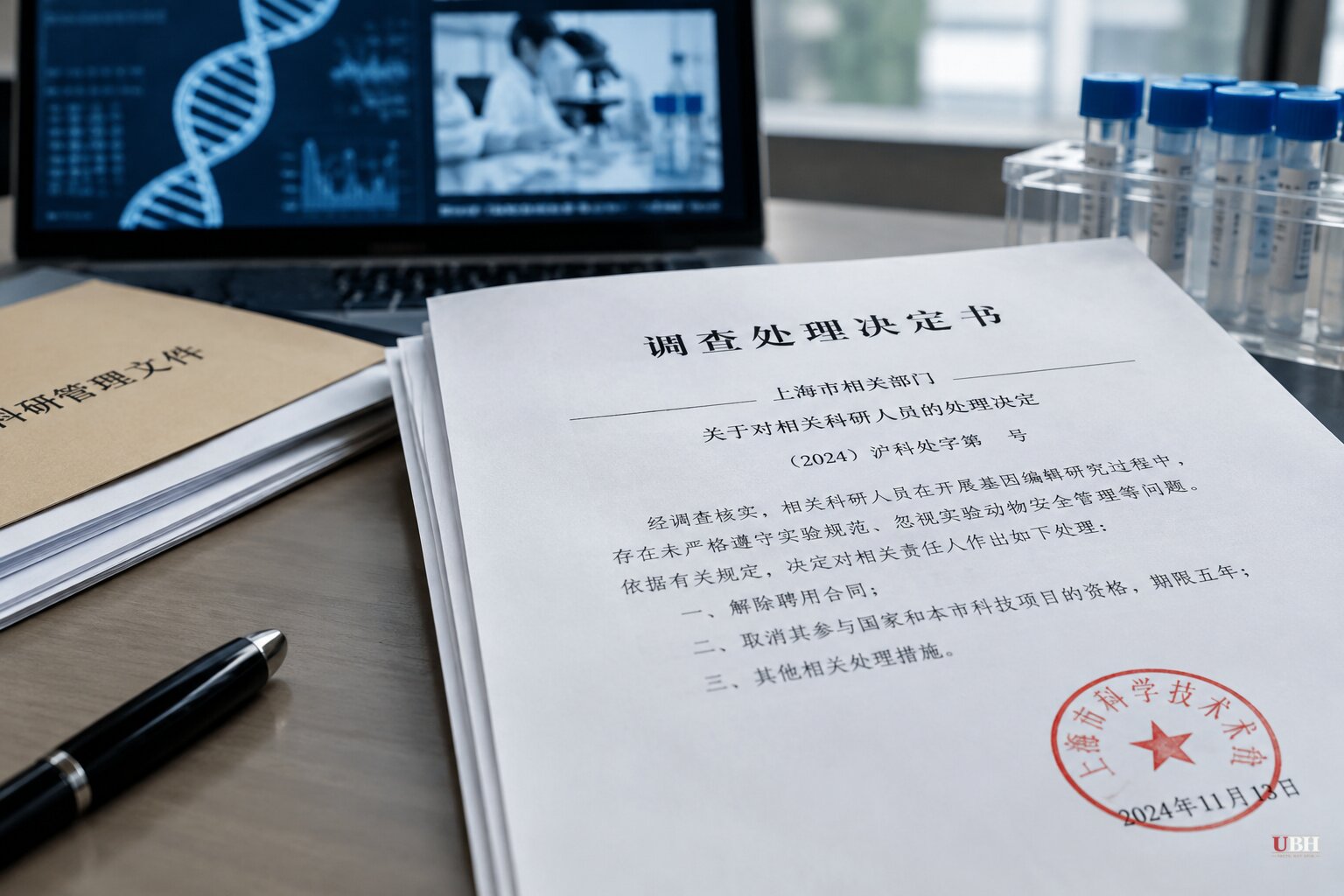
A 6-year-old girl died in March 2025 after an experimental gene-editing treatment at Xinhua Hospital in Shanghai. On Friday, Nov. 13, the Shanghai municipal government said it had fired the scientist who led the work.
The statement, carried by state broadcaster CCTV, named Qiu as the main person responsible. Zilong Qiu was deputy director of the Songjiang Research Institute at Shanghai Jiao Tong University School of Medicine. A second researcher, a deputy researcher at Xinhua Hospital, was also dismissed.
Both are barred for five years from leading or taking part in government science projects. Both were entered in a national database of serious research integrity breaches. Five other people received punishments ranging from demotions to administrative warnings.
What the investigators found
The girl had Snijders Blok-Campeau syndrome, a rare neurodevelopmental disorder. It is not life-threatening. The therapy was a base-editing treatment delivered by a viral vector injected into her spine, which carried it to her brain.
Shanghai investigators found that Qiu's team failed to promptly tell the hospital's clinical study leader about safety problems seen in earlier primate tests, so the early warning signal in the safety report was not given high attention. Science and Retraction Watch reported in July that Qiu's team learned about a month before the girl's dosing that monkeys had sustained liver damage from the same editing.
The probe also found that:
- The hospital did not conduct an adequate scientific review of the protocol.
- Required ethical review was not properly performed. The hospital's ethics committee asked the research team for extra materials when safety evidence was lacking, but approved the trial without receiving them.
- The consent form did not clearly warn the family of the risk of death.
- The team's Nature paper, published Feb. 18, did not disclose the clinical treatment or the girl's death.
The hospital's ethics committee had approved the trial in January 2025. It terminated the study after the girl died in March.
Money and gifts
Investigators also cited undisclosed conflicts of interest. According to CCTV, families gave the researchers money and gifts worth about 1.1 million yuan (roughly $160,000), including high-end liquor and electronics. None of it was disclosed in the research paper.
That is separate from the funding the girl's parents provided. Science reported in July that the parents paid more than $800,000 toward the experiment.
The girl's father told Science that learning of the missing safeguards had "fundamentally changed how we now view the entire project." He added: "We did not realize how unusual and dangerous many of the arrangements were."
AFP has asked Qiu for comment.
A pathway that skipped national regulators
The trial ran under China's investigator-initiated trial pathway, known as IITs. It lets researchers test therapies in hospitals without supervision from national regulators. Science reported that the hospital allowed the treatment under a provision that did not require national approval. After the girl's death, the hospital paid what Science called a modest fine to a local health authority, and Qiu was not publicly sanctioned at that point.
The pathway has let drug candidates reach early clinical development quickly. It has also raised questions about oversight and safety reporting. The government tightened IIT rules in May, including limits on which sites can run them.
Jiayou Shi, a lawyer at the National Research Center for Civil and Commercial Law at Renmin University of China, told Nature he expects the action "to send a big warning to research institutes and hospitals across the country." He said the May rules should prevent similar cases.
Lizzi Lee, who studies China's technology policy at the Asia Society Policy Institute in New York, called the trial "a cautionary tale" for China's fast-growing biotech industry. Clinical oversight "hasn't always kept pace" with that growth, she said. She described the investigation as "quite candid about what went wrong."
The wider stakes
The case lands as Beijing tries to rival the United States as a biotech power. It echoes the 2018 case of He Jiankui, the biophysicist who secretly produced gene-edited babies and was sentenced to three years in prison.
This case differs in one respect. The treatment went through a hospital ethics committee and an approved pathway. The probe found the review and consent steps were flawed, so the paperwork existed but the safeguards did not work.
Shanghai Jiao Tong University School of Medicine and Xinhua Hospital were reprimanded. Multiple organizations must now submit written self-examinations and correct the failures the investigation identified, according to CCTV. Authorities also said they will strengthen oversight of clinical trials involving new biomedical technologies such as gene editing.
Sources used for this briefing
7 links from 7 independent newsrooms (syndicated copies of the same report count once)
These are the sources it draws on, linked so you can verify.


