
Unbiased headlines. Facts, not spin.
Unbiased Headlines is an independently owned news organization. We bring you the facts, not opinions, written fresh from 110+ named sources. Sources linked so you can verify it yourself.
 health
Notable (5/10)
Event date: November 15, 2026 ·
FDA Lifts Restrictions on Six Peptides After Advisory Committee Overrides Agency Reviewers
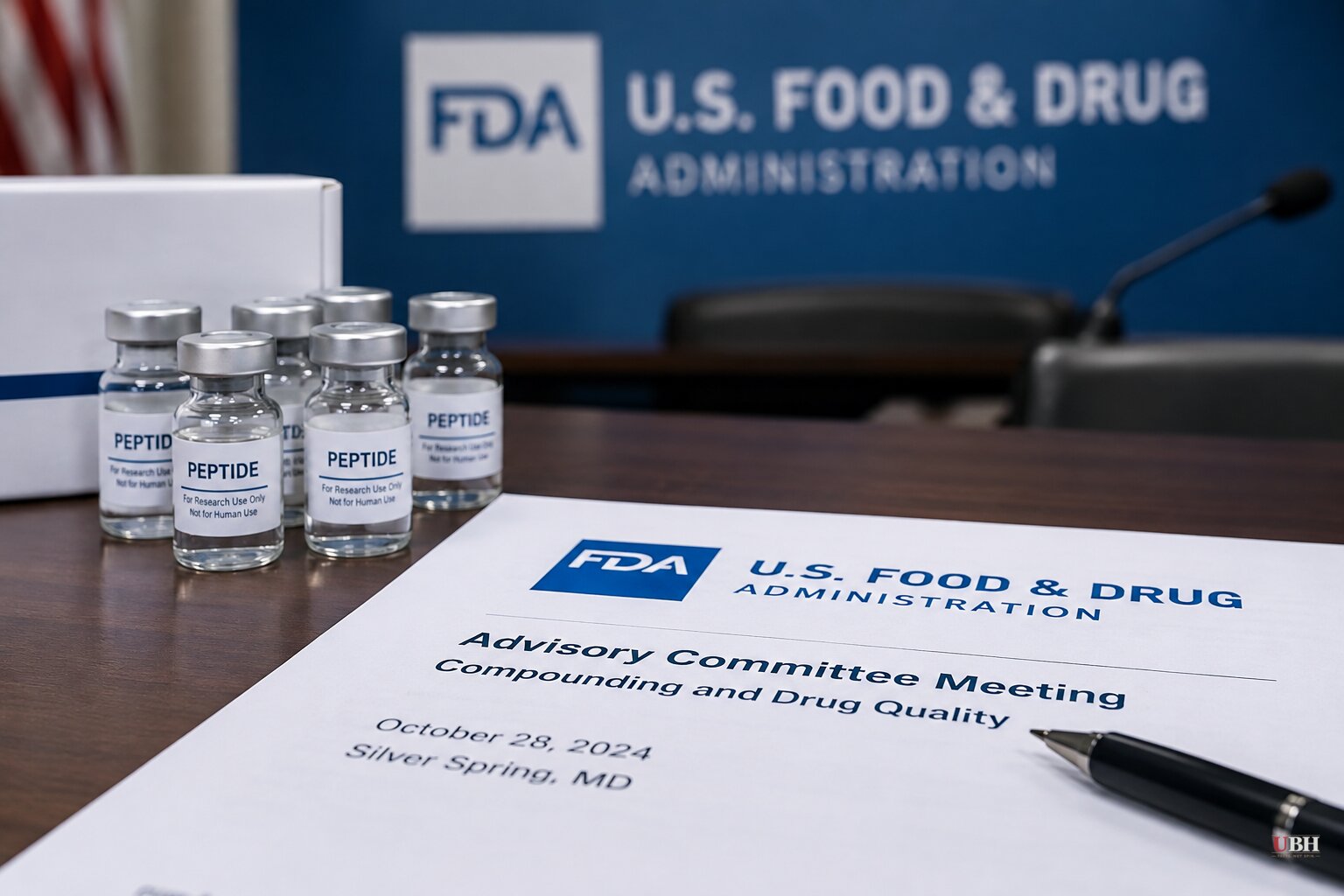
On Oct. 28, the Food and Drug Administration reversed a three-year restriction on six peptides: BPC-157, Epitalon, TB-500, MOTS-c, Semax and KPV. Licensed compounding pharmacies can dispense them again.
The agency's own reviewers recommended against it. They cited a lack of safety data and human trials, plus the potential for products to degrade or become contaminated. The pharmacy compounding advisory committee that made the final call set that recommendation aside.
The peptide reversal
Three years ago the FDA restricted 19 peptides, citing a lack of safety evidence and human trials. Six came off that list.
Dr. Matt Cook prescribed peptides for a decade, for pain, complex diseases and anti-aging protocols, until the restrictions forced him to stop. He told The Epoch Times that peptides work through multiple mechanisms, unlike traditional drugs that block a single pathway. "A lot of times if you try to block a pathway, the body finds another way around it," Cook said.
Many patients did not stop treatment. They bought from illicit suppliers, according to the Epoch Times account of the period. That is the practical argument for moving the products back into licensed pharmacies.
The counterargument comes from the FDA reviewers themselves. The six compounds have not undergone the rigorous safety and human trials that GLP-1 drugs underwent, and the human research needed to determine whether they are safe still doesn't exist. Patients may also not realize the peptides are on a new regulatory path, one that doesn't include the same scrutiny earlier peptides such as insulin and GLP-1 drugs faced.
John G. Rizk, a pharmacoepidemiologist at Johns Hopkins Bloomberg School of Public Health, put the gap bluntly on one of the six, BPC-157. There is a theoretical concern about how it promotes new blood vessel growth, which cancer also uses to spread. "Nobody has shown it causes cancer, and nobody has shown it doesn't either because the long-term human studies don't exist," Rizk said.
Kratom: a market ahead of the rules
Kratom shows how this plays out when a product sits between supplement and drug. Dr. Eliza Hutchinson, director of addiction services at Packard Health, told a Michigan Academy of Family Physicians panel the answer to "good or bad" is "more complex."
She distinguishes natural leaf kratom, which she has seen some patients use responsibly for chronic pain, from concentrated products such as 7-OH. Those, she said, bring seizures, liver failure, overdose and, "often in my practice, addiction."
Some synthetic kratom products were recently recategorized as Schedule I drugs at the federal level. Leaf kratom remains unregulated federally and has not been approved by the FDA for medical or any other use. A University of Michigan and Texas State University study found more than 5 million Americans have tried it, and most people who used it also had substance use disorders associated with it or another drug.
Kratom is not regulated in Michigan, and products not banned federally can be bought at smoke shops or gas stations. The state House passed a bill banning growing, synthesizing or selling it; the state Senate has not yet considered it. Jennifer Morse, who directs the central and mid-Michigan district health departments, said the stories of deaths are devastating.
AI in hospitals, with no federal rules
At the Association of Health Care Journalists' fall summit in Los Angeles, panelists said health care organizations are deploying AI tools within a federal regulatory vacuum.
Dr. Sukhbir Singh, a hospitalist and board member of the Union of American Physicians and Dentists, said "home for dinner" is the phrase used in trainings for AI note-taking tools. In practice, he said, clinicians must review, correct and sign the notes, which leaves full legal liability with the physician while adding cognitive work. He said administrators then treat the notes as efficiency gains and use the metrics to assign larger patient panels and cut support staff.
Mishal Khan of the UC Berkeley Labor Center said nurses face harms from untested and unregulated algorithms, including staffing platforms where nurses bid for shifts and algorithms adjust pay based on worker data. "Even if we do not lose a single job to AI, that does not mean that there will be no harms to workers," she said. The California legislature recently passed a law prohibiting employers from making employment decisions without human oversight, and some nursing groups are establishing their own bill of rights for workplace AI.
Hospitals as contested ground
In San Francisco, resident physicians and nurses rallied outside a University of California Board of Regents meeting to demand ICE be kept out of UC hospitals. The email action behind the rally is cosponsored by CIR/SEIU, the California Immigrant Policy Center, the California Nurses Association and UAW 4811.
They want clear, systemwide protocols for patients in immigration custody, and at a minimum adoption of the updated California attorney general guidelines. Jamile Cabacungan, an RN at UCSF Stanyan Hospital, called the deportation program "cruel and unnecessary." The coalition argues enforcement presence can interfere with medical examinations and treatment and compromise patient confidentiality. The coalition's announcement did not include a response from UC leadership.
In Wyoming, a bill to protect healthcare workers from assault and threats of violence advanced Friday from the Legislature's Joint Labor, Health and Social Services Committee. Perpetrators could face a minimum of two days in jail and/or a $1,000 fine. A second conviction could bring a prison sentence not exceeding three years and/or a $5,000 fine. The bill would also include mandatory reporting requirements to law enforcement when a healthcare worker suffers an assault, battery or threat of violence.
Sen. Lynn Hutchings, R-Cheyenne, questioned the need, noting existing assault statutes. "We shouldn't assault people," she said. Toni Decklever of the Wyoming Nurses Association said similar legislation has been discussed for a decade and that Wyoming is one of two states with no law specific to healthcare professionals.
Rep. Ken Clouston, R-Gillette, proposed covering all employees who work in healthcare institutions, not just providers. He cited a case in North Dakota where a patient choked a receptionist and punched a janitor. The bill now progresses to the general session.
Haiti: what happens with no regulator at all
The contrast with Haiti is stark. Writing for Global Voices on Nov. 17, Jude Pierre Louis described vendors selling medicine out of buckets and bags on sidewalks and in public markets, with no professional medical training. Gangs from the Viv Ansanm criminal coalition have looted and burned health facilities, and most Haitians cannot afford private care.
Dr. Wellington Derameau, working with the University of Colorado and the Faculty of Medicine at the State University of Haiti, has tested drug quality there. A 2020 paper sampled roughly 258 boxes of antibiotics across 28 open-air markets in Port-au-Prince. Louis wrote that no Haitian government has fought the problem effectively.
The peptide market is a very different case, but the question it raises is the same. The six compounds are back in pharmacies, and the human trial data that would show whether the agency's reviewers were right does not exist yet.
Sources used for this briefing
6 links from 6 independent newsrooms (syndicated copies of the same report count once)
These are the sources it draws on, linked so you can verify.


