
Unbiased headlines. Facts, not spin.
Unbiased Headlines is an independently owned news organization. We bring you the facts, not opinions, written fresh from 110+ named sources. Sources linked so you can verify it yourself.
 health
Notable (5/10)
FDA Moves to Withdraw Liquid Statin FloLipid Over Missing Annual Reports
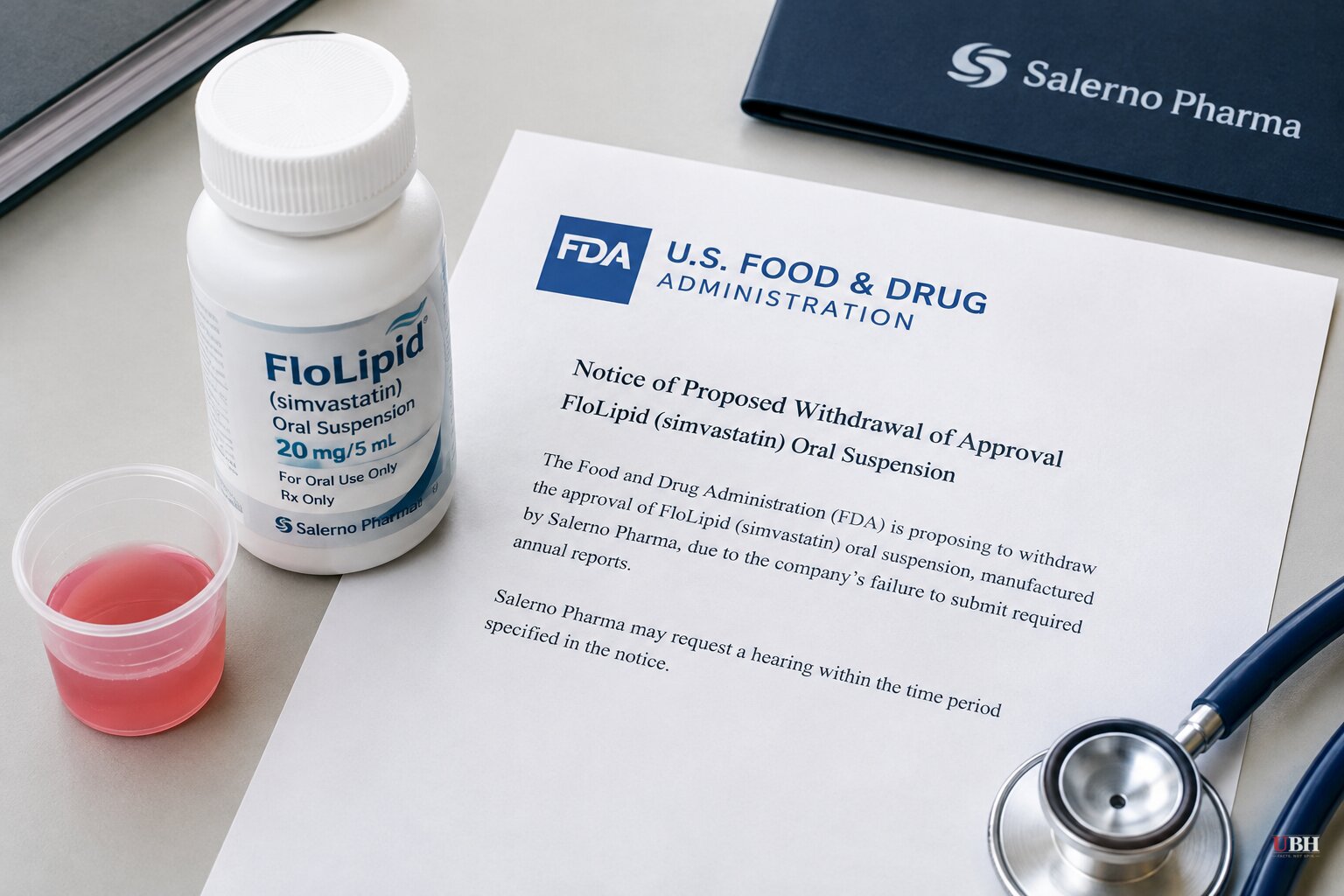
Statins have dominated the drug-safety calendar for weeks: an Oct. 29 FDA enforcement report on a Class II atorvastatin recall, a Nov. 7 trial on stopping the drugs in older patients, and now a Federal Register notice proposing to withdraw approval of a liquid simvastatin. The three stories are separate. Nothing in the reporting links them.
The FDA's case against FloLipid
The notice, signed by Michael Davis, MD, PhD, the FDA's top drug regulator, says approval of simvastatin oral suspension (FloLipid) is at risk because Salerno Pharma "has repeatedly failed to file required annual reports."
Those reports are routine. Under FDA policy they carry labeling information and technical details, including a current list of approved chemistry, manufacturing and control information.
The notice cites missing paperwork as the reason. It does not describe a new safety finding.
Salerno is being offered the chance to request a hearing to argue why the approval should not be withdrawn. Withdrawal is not final.
FloLipid was approved in 2016 and is marketed as the first LDL cholesterol medication in liquid form for U.S. patients. It was developed for people who have trouble swallowing pills. The usual starting dose is 10 mg or 20 mg once a day in the evening on an empty stomach.
The label already carries warnings. An increased risk of myopathy, including rhabdomyolysis, has been seen at the 80-mg dose. Patients who cannot reach their LDL goal on 40 mg are advised to start alternative treatments. A 2020 label update added a warning about rare reports of immune-mediated necrotizing myopathy with statin use.
The product was previously manufactured for Rosemont Pharmaceuticals, a Perrigo company. Another liquid statin, atorvastatin oral suspension (Atorvaliq), remains on the market.
A recall of 13,296 bottles of generic Lipitor
Separately, the FDA's Oct. 29 enforcement report listed a Class II recall of prescription atorvastatin calcium tablets, the generic version of Lipitor. The stated reason is "Presence of Foreign Tablets/Capsules." The report does not say what the foreign tablets or capsules are.
Novadoz Pharmaceuticals distributed the product nationwide. India-based MSL Laboratories Private Limited manufactured it. The recall covers 13,296 bottles of 1,000 tablets each.
A Class II designation means the drug might cause temporary health problems, but the FDA has judged the probability of a serious health consequence to be remote.
The trial on stopping statins
The most consequential news for patients is clinical. A randomized trial presented Nov. 7 at the American Heart Association Scientific Sessions in Chicago, and published in The New England Journal of Medicine, tested what happens when older adults quit.
Researchers from the University of Bern, the University of California, San Francisco and other institutions enrolled 1,880 adults aged 70 and older. All were taking statins to prevent a first heart attack or stroke. All had at least two chronic medical conditions and no established cardiovascular disease. Half stopped. Half continued.
After two years, the added risk from stopping fell within the limits the researchers set in advance. The study authors' framework treats that as acceptable. It does not mean stopping carried no added risk.
Over the full follow-up, about two years for the typical participant and up to four for some, about 13% of those assigned to stop had a heart attack, an ischemic stroke or died from any cause. In the continue group the figure was about 9%.
The trial's safety monitoring board recommended that participants assigned to stop statins discuss restarting with their healthcare team, according to the American College of Cardiology.
On the other outcomes, the researchers found no meaningful differences between groups in quality of life, muscle pain, falls, or loss of muscle mass and strength.
Dr. Christopher Kelly, a UNC Health cardiologist, stressed that continuing statins did not worsen reported muscle pain or quality of life in the trial. He said the decision should be individualized, based on overall health and expected lifespan.
That leaves two readings of the same data. One is that a short break looks low-risk over two years. The other, which the monitoring board's recommendation and the longer follow-up point toward, is that the gap widens with time.
What comes next
The FloLipid outcome now turns on whether Salerno requests a hearing and what it files. If the company does not, or cannot show the approval should stand, the FDA can proceed with withdrawal. Patients who rely on a liquid form would then be left with Atorvaliq as the remaining liquid statin named in the notice coverage.
The notice does not say how many patients use FloLipid or when the FDA will act after the hearing window closes.
Sources used for this briefing
3 links from 3 independent newsrooms (syndicated copies of the same report count once)
These are the sources it draws on, linked so you can verify.


