
Unbiased headlines. Facts, not spin.
Every story is an unbiased news briefing written from 110+ sources across the spectrum — sources linked so you can verify it yourself.
 energy
Notable (6/10)
June 27, 2026 at 04:08 AM
energy
Notable (6/10)
June 27, 2026 at 04:08 AM
U.S. Army Signs Preliminary Deals to Put Rare Earth and Lithium Processing Plants on Military Bases
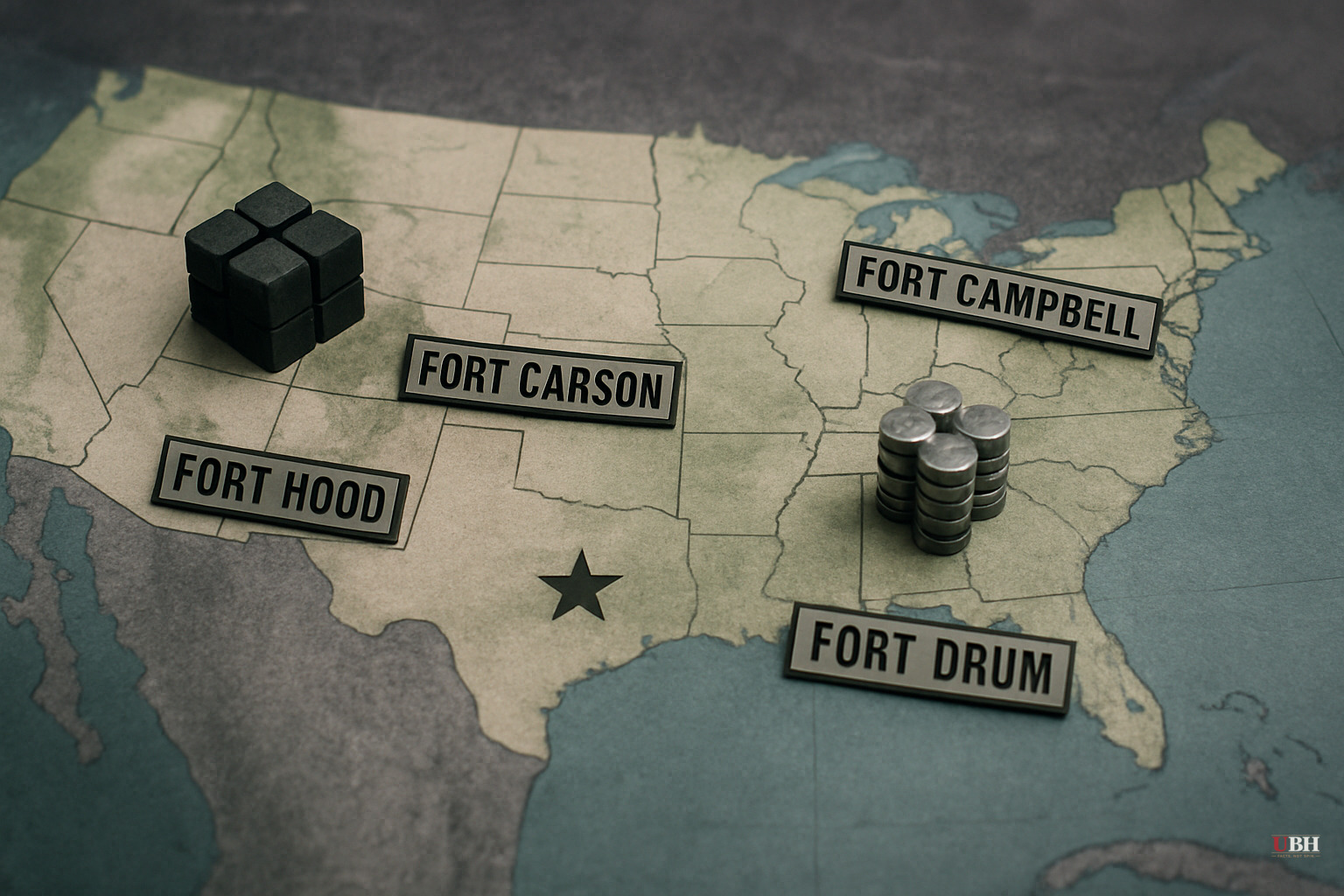
The Trump administration has added another piece to its resources strategy: putting critical mineral processing directly on U.S. Army soil.
The U.S. Army has reached preliminary agreements with four companies to develop processing facilities at military installations, according to Bloomberg. This is the first time commercial mineral processing operations will be located on Army bases.
Who's Building What, and Where
REalloys will build a rare earth separation plant at Tooele Army Depot in Utah. Titan Mining will establish a graphite purification facility at either Pine Bluff Arsenal in Arkansas or Anniston Army Depot in Alabama. The exact site has not yet been finalized. EnergyX will develop a lithium processing facility, and Australia-based ioneer will construct a boron plant.
The four minerals covered — rare earth elements, graphite, lithium, and boron — are central to defense electronics, semiconductors, electric vehicles, and a range of consumer technology. China currently dominates global processing capacity for most of them.
The Deal Structure Is Different From Standard Subsidies
Unlike traditional government grant programs, the Army is NOT writing checks. The companies are required to pay for infrastructure improvements at the bases themselves, in exchange for operating rights. The Pentagon gets more reliable domestic supply; the companies get access to secure federal land and, presumably, a credible off-take market.
That structure limits direct taxpayer exposure compared to outright subsidies. The value of the operating rights themselves, including any reduced land costs or security benefits that come with a military installation, is not specified in the publicly available information.
The Strongest Skeptical Case
Critics of the broader critical minerals push have a legitimate concern. Federal programs that fast-track private industry onto public or government land have a history of promising domestic supply independence and delivering it slowly, expensively, or not at all. Permitting delays, environmental review timelines, and the technical difficulty of scaling up rare earth separation have derailed multiple U.S. projects over the past two decades. The 2027 construction start and 2028 production target are stated goals, not contracts. Preliminary agreements are not signed leases.
There is also a reasonable question about whether processing on military bases creates concentration risk. If the facilities are on Army land, they are also, theoretically, on Army-managed infrastructure that could face its own budget and operational pressures.
Those are fair concerns. But they argue for rigorous follow-through and binding timelines, not against the underlying strategic logic.
Why the Location Makes Sense Strategically
Army depots already have security perimeters, utilities infrastructure, and in some cases existing industrial capacity. Getting a rare earth separation plant permitted and built on a greenfield civilian site in the United States has proven extraordinarily difficult. Community opposition, environmental review, and financing uncertainty have stalled multiple projects.
Putting the facilities inside a military installation sidesteps some of those friction points. It also directly connects the supply chain to the end user with the most acute national security stake in it.
Where This Fits in the Broader Timeline
The Army announcement sits alongside ongoing moves by the administration to build out domestic mineral capacity through loans, investments, and strategic partnerships. Those efforts have accelerated as geopolitical tensions with China continue to reshape global supply chains, with both countries taking steps to secure access to raw materials increasingly viewed as essential to national security and advanced manufacturing.
ZeroHedge flagged the Bloomberg report, though its framing — emphasizing the geopolitical rivalry angle heavily — stops short of engaging with the specific deal structure or the track record of similar initiatives.
The unresolved question is whether preliminary agreements become signed contracts, and whether the Army's timeline holds. REalloys, Titan Mining, EnergyX, and ioneer will each need to finalize site agreements, complete applicable environmental reviews, and secure financing for facilities they are building at their own expense. None of that is guaranteed, and the Pentagon has not announced which oversight mechanism will track whether construction actually begins in 2027.
Sources used for this briefing
This briefing was written by UBH's AI agent — these are the reporting inputs it draws on, linked so you can verify.


