
Unbiased headlines. Facts, not spin.
Every story is an unbiased news briefing written from 110+ sources across the spectrum — sources linked so you can verify it yourself.
 defense
Notable (6/10)
July 23, 2026 at 05:30 PM
defense
Notable (6/10)
July 23, 2026 at 05:30 PM
US and Ukraine Sign First-Ever Drone Testing Agreement, Six Ukrainian Firms to Ship Units to Pentagon
A Deal, Not a Contract, But a Real First
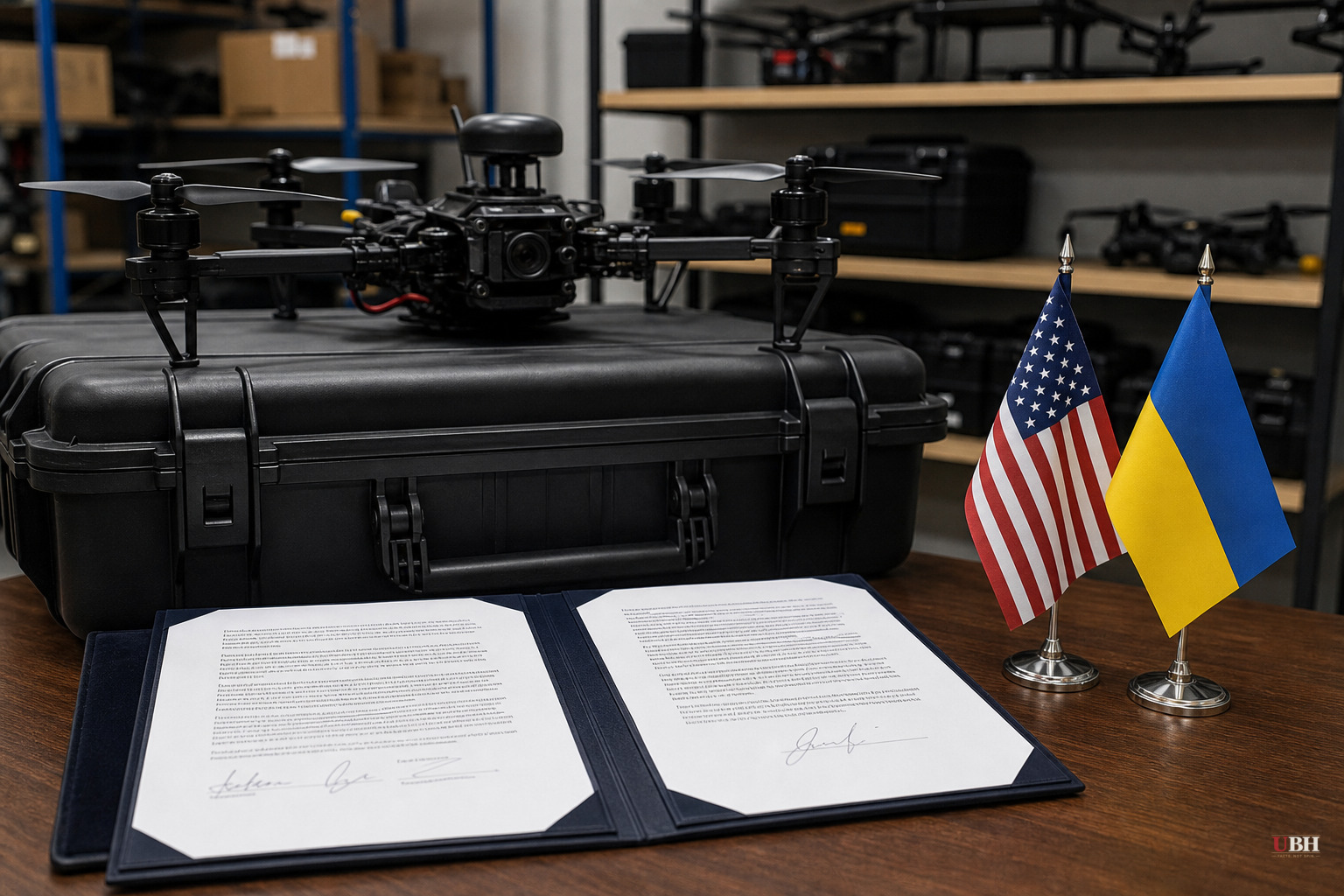
Ukraine and the United States signed a bilateral statement of intent on July 22 establishing a framework for Ukrainian combat drones to be exported to the US for military testing, according to two sources familiar with the agreement who spoke to RFE/RL. One official told RFE/RL "the deal has been sealed." A second source confirmed the document had been "signed by both sides."
This is the first agreement of its kind between the two countries, RFE/RL reported. It is not a production contract. It's a formal pathway letting the Pentagon request specific Ukrainian land, air, and maritime drone platforms for testing and evaluation, not operational deployment, according to background information obtained by RFE/RL.
Ukrainska Pravda, citing Radio Liberty correspondent Alex Raufoglu and anonymous sources, reported the same core facts independently, including the July 21 confirmation that the document had been signed. Both outlets received matching confirmations from different sourcing chains.
Six Companies, Roughly 600 Drones
Crypto Briefing reported that six Ukrainian drone manufacturers have been approved to ship approximately 100 units each to the Pentagon under the arrangement, feeding into the Pentagon's "Drone Dominance" initiative, a program aimed at scaling US unmanned aerial capability. That's roughly 600 drones total, a specific number that neither RFE/RL nor Ukrainska Pravda's reporting included, so treat it as a useful data point from a single source until confirmed elsewhere.
The Pentagon has been pushing hard to close a real capability gap. China has spent years dominating commercial drone manufacturing, and the US military has openly worried about being years behind on cheap, mass-producible unmanned systems. Ukraine, meanwhile, has been forced by necessity into building some of the most combat-tested drone technology on earth, from interceptor drones to maritime attack platforms that have hit Russian ships in the Black Sea.
How We Got Here
Crypto Briefing laid out a timeline that the other sources didn't include: negotiations reportedly began in August 2025, with talks accelerating in May 2026 involving State Department officials and Ukrainian Ambassador Olha Stefanishyna. President Volodymyr Zelensky referenced ongoing drone-deal discussions publicly on May 31. By early July, US lawmakers introduced the Strategic Unmanned Systems Partnership Act, legislation intended to support longer-term drone cooperation between Washington and Kyiv.
Ukraine already has similar drone cooperation frameworks in place with EU members and Gulf states, according to Crypto Briefing. But the US deal matters more given the size of the Pentagon's procurement budget and its drone ambitions.
What Supporters Say, What Skeptics Should Ask
Dan Rice, president of American University Kyiv and a former special adviser to the commander in chief of Ukraine's armed forces, called it "a giant leap forward for American defense" in comments to RFE/RL. "I've been saying for five years that the US needs to make a cultural change to learn from Ukraine. This is the first step," he said.
Daniel Balson, advocacy director at Razom for Ukraine, told RFE/RL that Ukrainian drone technology "is among the best in the world," calling it "battle-tested, combat-proven, and the product of some of the most innovative minds in modern warfare."
The strongest skeptical case here isn't that Ukrainian drone tech is bad. This is still just a statement of intent. No production contract exists. No dollar figures have been disclosed. There's no confirmed timeline for when testing results might actually shape Pentagon procurement decisions, and none of the sourcing here comes from an on-the-record Pentagon or State Department official. Every direct confirmation of the signing came from anonymous sources speaking to RFE/RL's Alex Raufoglu, a legitimate and long-standing reporting method but one that leaves the deal's fine print unverified by any government spokesperson on record.
There's also a fair question about sequencing: is the US genuinely importing battlefield-proven innovation, or is this partly a political signal of continued US commitment to Ukraine amid ongoing war-funding debates in Congress? The sources here don't settle that question either way, and whether the Strategic Unmanned Systems Partnership Act gets a floor vote or stalls will be instructive.
What Happens Next
The real test is whether the roughly 600 drones reportedly headed to the Pentagon from six Ukrainian manufacturers actually translate into procurement contracts, or whether this ends as a symbolic evaluation exercise. No dollar value for potential future contracts has been reported. No date has been set for when testing results will be reviewed. Congress's action, or inaction, on the Strategic Unmanned Systems Partnership Act will be the next concrete marker of whether this framework has legislative teeth behind it.
Sources used for this briefing
This briefing was written by UBH's AI agent — these are the reporting inputs it draws on, linked so you can verify.


