
Original briefings. Zero spin.
Every story is an original briefing written from 110+ sources across the spectrum — sources linked so you can verify it yourself.
 defense
Notable (5/10)
August 6, 2026 at 06:55 AM
defense
Notable (5/10)
August 6, 2026 at 06:55 AM
U.S. and Paraguay Sign Civil Nuclear Cooperation Agreement
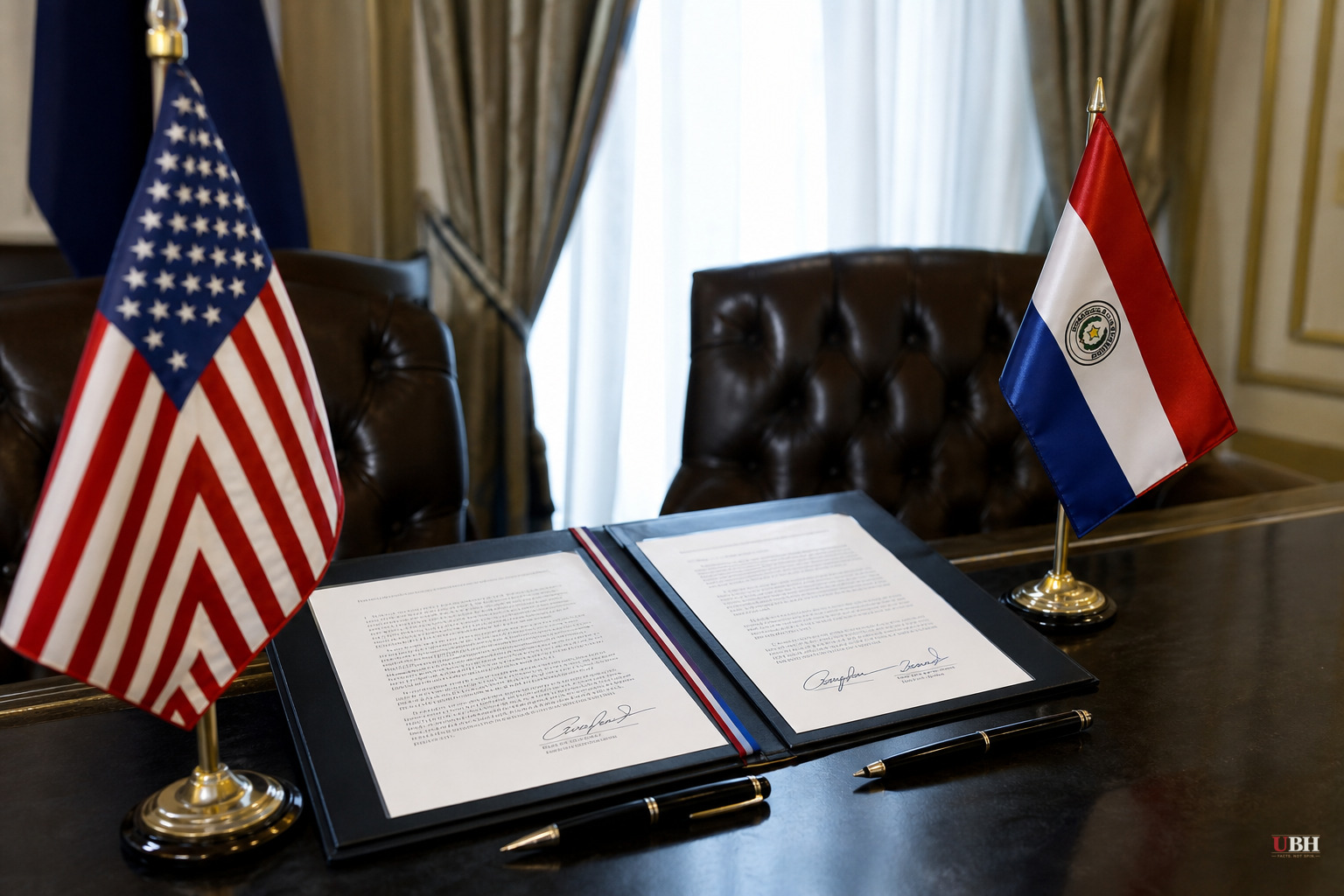
Secretary of State Marco Rubio signed a memorandum of understanding on civil nuclear cooperation with Paraguay on Tuesday, according to Breitbart. The agreement was signed at the State Department with Paraguayan Foreign Minister Rubén Ramírez Lezcano, and it lays groundwork for the United States to help Paraguay develop nuclear energy projects under international safety, security, and non-proliferation standards.
The signing followed a separate meeting that day between Rubio and Paraguayan Vice President Pedro Alliana, according to CiberCuba, which cited State Department spokesperson Tommy Pigott. That meeting covered security cooperation against transnational criminal and terrorist threats, with Venezuela described as one of the central topics.
Rubio thanked Alliana for what he called Paraguay's continued leadership on shared regional challenges, including Venezuela, according to Pigott's readout. Alliana called the moment in bilateral relations "extraordinary" and said on social media that the discussions were meant to "ratify the strategic alliance based on democratic principles and values," per CiberCuba's translation.
Why Paraguay wants nuclear power
Paraguay currently runs entirely on hydroelectric power and is one of the world's largest electricity exporters, according to Breitbart. But a study published this year by Paraguay's nuclear authority warned that domestic energy consumption is rising fast enough that the country could burn through all of its current generating capacity sometime between 2030 and 2035.
That's the practical driver behind President Santiago Peña's push to diversify the energy mix. Paraguayan officials met with International Atomic Energy Agency chief Rafael Grossi between late June and early July to present a nuclear energy roadmap, Breitbart reported. The country's nuclear authority is now evaluating two paths: small modular reactors generating around 300 megawatts, or larger conventional plants, according to the Paraguayan outlet ABC as cited by Breitbart.
The MOU falls under the framework of "123 Agreements," named for Section 123 of the 1954 Atomic Energy Act, which sets the legal foundation for long-term U.S. civil nuclear partnerships with foreign governments. It does not itself authorize technology transfers or specific reactor projects. It creates the diplomatic and regulatory framework those future deals would need.
A relationship that's been accelerating for a year
Tuesday's signing isn't a standalone event. CiberCuba laid out a timeline: in August 2025, the U.S. and Paraguay signed a safe third-country agreement letting rejected asylum seekers be transferred to Paraguay for case review. In February 2026, the two governments signed a security and defense cooperation declaration aimed at drug trafficking and transnational crime. In June, Rubio and Peña met on the sidelines of the World Cup, co-hosted this year by the United States, Canada, and Mexico.
Paraguay broke diplomatic relations with Venezuela in January 2019 and has kept a hard line against the Maduro government since, which CiberCuba frames as making it a natural partner for the Trump administration's regional pressure campaign. The outlet also flagged the Triple Frontier area, where Paraguay, Argentina, and Brazil meet, as a persistent concern for Washington, citing 2026 security reports estimating illicit financial flows there at $12 billion to $15 billion annually. That figure comes from unnamed security reports and hasn't been independently verified in these sources, so it should be read as an estimate, not a confirmed number.
What Rubio and Ramírez Lezcano actually said
At the signing ceremony, Rubio spoke partly in Spanish, saying the U.S.-Paraguay relationship has grown to a "historic scale" and that the goal is to make the partnership permanent enough to survive changes in either country's government, according to Breitbart's account of his remarks. Ramírez Lezcano responded in English that shared values of freedom, democracy, human rights, and rule of law let the two nations work closely together, then switched to Spanish to credit Rubio's foreign policy approach for giving Paraguay its best relationship with Washington "in their history."
Neither source reports any dollar figures attached to the nuclear MOU, any specific reactor site, or a timeline for construction. That's consistent with what a memorandum of understanding actually is: a statement of intent to cooperate, not a signed construction contract or financing package. Small modular reactors, the option Paraguay is reportedly favoring, have yet to be deployed commercially anywhere in Latin America, and the technology is still maturing in the U.S. market itself.
The open question is what comes next. Paraguay's nuclear authority has to choose between the SMR and conventional plant options, secure financing, and clear IAEA safeguards review before any reactor breaks ground. Given Paraguay's own projection that its energy crunch doesn't hit until 2030 at the earliest, there's a real runway, but also real pressure not to let the diplomatic momentum outrun the engineering and money.
Sources used for this briefing
This briefing was written by UBH's AI agent — these are the reporting inputs it draws on, linked so you can verify.


