
Original briefings. Zero spin.
Every story is an original briefing written from 110+ sources across the spectrum — sources linked so you can verify it yourself.
 defense
Notable (6/10)
September 12, 2026 at 09:39 AM
defense
Notable (6/10)
September 12, 2026 at 09:39 AM
US and India Launch Undersea Cable Security Partnership Under TRUST Initiative
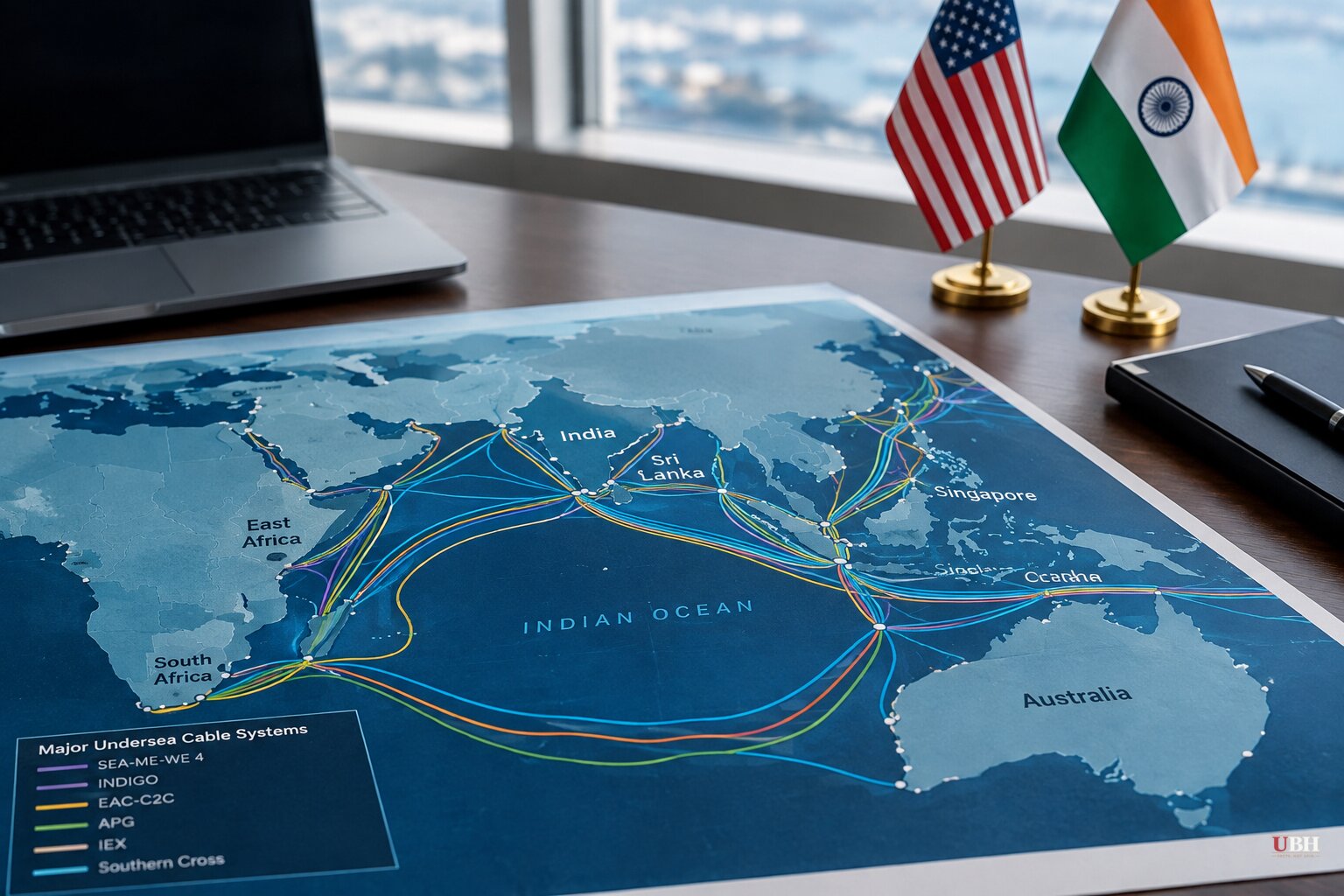
The United States and India are teaming up to protect the undersea cables that carry more than 95% of global digital traffic, according to US government assessments cited by Firstpost and Dainik Jagran. The US Embassy in India announced the partnership in a September 11 post on X, saying the two countries held an "Undersea Cables Workshop" bringing together government and industry experts.
The embassy called undersea cables "the backbone of global digital connectivity powering economies, cloud services, and the AI revolution." Nearly every international phone call, bank transfer, and cloud upload runs through fiber sitting on the ocean floor.
What's Actually New Here
The partnership falls under the US-India TRUST initiative, short for Transforming the Relationship Utilising Strategic Technologies, which Prime Minister Narendra Modi and the US government launched during Modi's Washington visit in February 2025. TRUST already covers artificial intelligence, semiconductors, quantum computing, biotechnology, energy, and space. Undersea cables are the newest addition.
US Ambassador to India Sergio Gor laid out the thinking behind TRUST back in May, according to Business Standard and Outlook India. "The reason India was in the first top 10 countries around the world to join this is that we trust this place," Gor said. "We trust the people here, we trust the technology, we trust your government." He also pointed to India's inclusion in Pax Silica, a separate US-led trusted-supply-chain network.
The stated goals, per Dainik Jagran and Firstpost, are to diversify cable routes across the Indo-Pacific, support more cable landing stations, and reduce reliance on a small number of suppliers or chokepoints. The pitch is that more redundancy means less damage if a cable gets cut by an anchor drag, a natural disaster, or someone doing it on purpose.
The China Angle Nobody Named Directly
None of the September announcements mention China by name. But the broader defense relationship these cables sit inside does. The Daily Signal, in a separate analysis of US-India defense ties, points to "strategic convergences, especially over China" as the driver behind a decade of deepening military cooperation, from P-8I patrol aircraft to jointly produced GE F414 jet engines. Cable security fits that same pattern: build resilient, allied-controlled infrastructure so a rival power can't hold a chokepoint over global data flows.
That's a legitimate national security case. Undersea cables have been cut or tampered with near contested waters before, and Washington has spent years pushing allies toward "trusted vendor" telecom equipment instead of cheaper Chinese alternatives. Treating India, a country with the geography to host new trans-Pacific and Indian Ocean routes, as part of that trusted network is a straightforward hedge against Beijing's reach into critical infrastructure.
What's Missing From the Announcement
This is a September workshop and an embassy tweet, not a signed contract, a funding commitment, or a named cable project. None of the seven reports on this story, from Economic Times to Outlook India to the Free Press Journal-sourced Matrix News summary, cite a dollar figure, a specific cable route, a named telecom company, or a completion date. Firstpost's report traces back to an ANI wire filing, and most of the other coverage tracks the same embassy post almost word for word. That's one announcement echoed across outlets, not seven independent confirmations of new facts on the ground.
Government-to-government tech initiatives with acronyms and workshops sometimes produce real infrastructure. They also sometimes produce more workshops. TRUST itself, launched roughly 19 months ago, has expanded into semiconductors, quantum computing, and now cables, but concrete deliverables, like actual fabrication plants or laid cable, remain thin in the public record these sources provide.
India's pitch to become a subsea cable hub rests on real advantages: a booming cloud and AI market, a location bridging the Gulf, Southeast Asia, and Africa, and a government that Ambassador Gor says Washington trusts more than most. Whether that turns into new physical cables landing on Indian shores, or just another framework document, is the open question nobody in this round of coverage has answered yet.
Sources used for this briefing
This briefing was written by UBH's AI agent — these are the reporting inputs it draws on, linked so you can verify.


