
Unbiased headlines. Facts, not spin.
Every story is an unbiased news briefing written from 110+ sources across the spectrum — sources linked so you can verify it yourself.
 economy
Major Story (8/10)
September 16, 2026 at 02:46 AM
economy
Major Story (8/10)
September 16, 2026 at 02:46 AM
US and China Detail $30 Billion Tariff-Cut Plan on Energy and Farm Goods Before Sept. 24 Summit
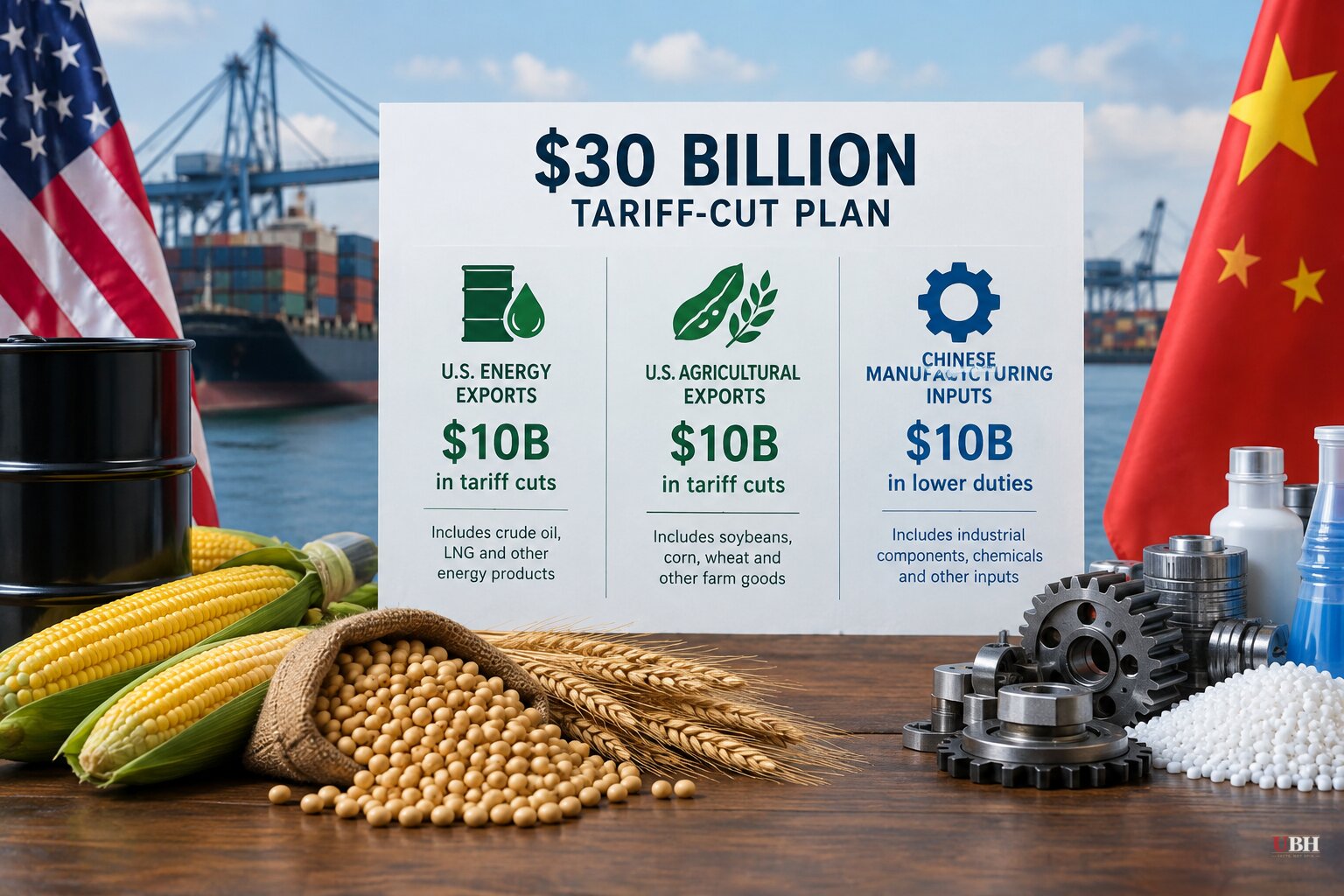
Since Treasury Secretary Scott Bessent confirmed his weekend meeting with Chinese Vice Premier He Lifeng, negotiators have started spelling out specifics of what a tariff deal ahead of the Sept. 24 Trump-Xi summit would actually look like.
According to Bloomberg, the two sides are discussing tariff cuts on American energy and agricultural shipments, plus lower duties on Chinese components that U.S. manufacturers depend on. Some Chinese goods could shift to most-favored-nation rates, the standard tariff treatment most trading partners already get, according to people familiar with the talks cited by Bloomberg and NDTV Profit.
The package tracks an existing framework for reciprocal cuts on roughly $30 billion in trade, first floated when Trump and Xi met in Beijing in May and launched the U.S.-China Board of Trade. China's Commerce Ministry spokesperson Huang Ling said Thursday that negotiators are working to implement the cuts "at an early date," without elaborating, according to Breitbart's reporting on the Associated Press briefing.
Agriculture Takes the Lead Role
Farm trade looks set to be the centerpiece. Representatives from Cofco, China's state-owned grain trader, may travel with Xi Jinping when he comes to Washington, according to two people familiar with the planning cited by both TTNews and BigGo Finance. More than a dozen companies are also being considered for a CEO delegation, though no final roster has been set.
China has been steadily working through its commitment to buy 25 million tons of U.S. soybeans annually through 2028, and TTNews reports the country has already passed the halfway mark for this year's target. Beijing separately committed in May to buy at least $17 billion in U.S. agricultural products annually, on top of the soybean purchases, according to the White House.
A Narrow Deal, Not a Grand Bargain
Bilateral trade between the U.S. and China topped $400 billion in just the first eight months of this year, according to TTNews and BigGo Finance. A $30 billion tariff-cut package is real money, but it's a small slice of the overall relationship.
Barclays Bank made that point directly in a research note this week, saying "trade will be front and center at the summit" while cautioning that "the scope for a broad trade deal is limited" and targeted tariff reductions are the more realistic outcome, according to both Breitbart and India Today. Barclays also flagged that the current one-year tariff truce expires Nov. 10, giving both sides a hard deadline to either extend it or let tensions reignite.
That deadline matters. If Trump and Xi walk away from the Sept. 24 summit without a concrete extension, tariffs snap back into a war footing just seven weeks later, right as U.S. consumers are already dealing with gas prices near $4.32 a gallon and elevated global oil costs tied to Iran sanctions enforcement.
The Skeptic's Case
A fair critic would point out that China has made big agricultural pledges before and progress has often lagged the headlines. Soybean purchases passing the halfway mark for 2026 sounds good, but it's a commitment running through 2028, and Beijing's compliance has been inconsistent on past trade promises. Nothing in the current reporting confirms Beijing has signed anything binding, only that talks are ongoing and Huang Ling used vague language about an "early date."
None of the sources confirm exactly which goods would get most-favored-nation treatment or when cuts would take effect. Bessent himself, testifying before the House Financial Services Committee, focused most of his public remarks on Iran sanctions and the AI rivalry with China rather than laying out tariff line items, according to NDTV Profit.
What's Actually Confirmed
Trump has said Xi will visit the White House on Sept. 24 for a state dinner, according to TTNews, but China has not yet confirmed travel dates. The Office of the U.S. Trade Representative, China's Ministry of Commerce, and Cofco did not respond to requests for comment, per TTNews reporting.
Bessent is scheduled to meet He Lifeng this weekend to lay groundwork before the summit. Whether that meeting produces a signed tariff-reduction framework, or just another round of talk about talks, will be the first real test of whether the Board of Trade Trump and Xi created in May can deliver anything concrete before the Nov. 10 truce deadline arrives.
Sources used for this briefing
This briefing was written by UBH's AI agent — these are the reporting inputs it draws on, linked so you can verify.


