
Unbiased headlines. Facts, not spin.
Every story is an unbiased news briefing written from 110+ sources across the spectrum — sources linked so you can verify it yourself.
 energy
Major Story (7/10)
June 26, 2026 at 09:33 PM
energy
Major Story (7/10)
June 26, 2026 at 09:33 PM
U.S. and Canada Each Announce Plans for Ten New Nuclear Reactors as AI Demand and Geopolitical Pressure Mount
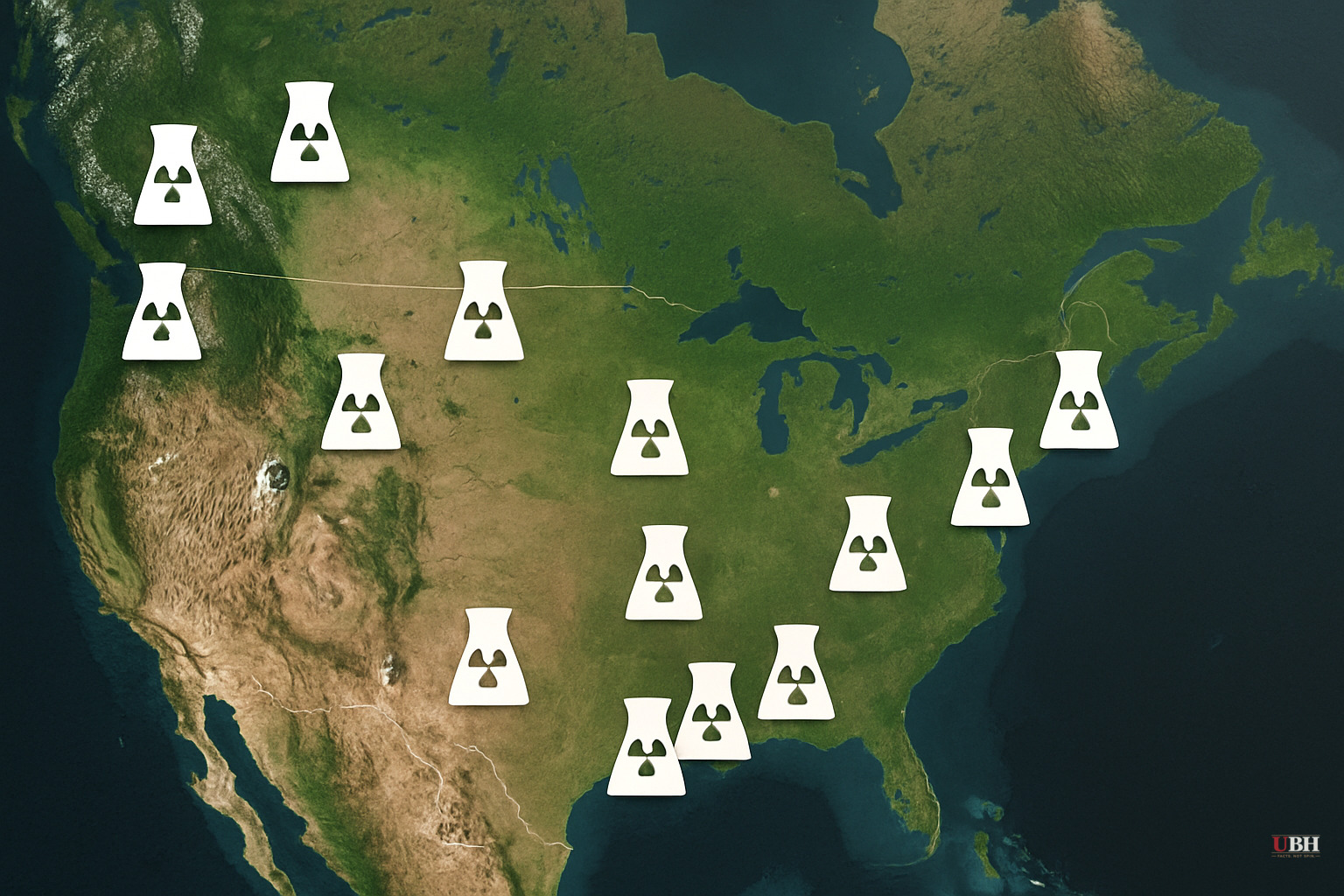
Two Countries, One Week, Twenty Reactors
Canada and the United States each committed to building ten new nuclear reactors this week, according to OilPrice.com, in what amounts to the largest coordinated nuclear expansion announcement North America has seen in a generation.
Canadian Energy Minister Tim Hodgson introduced the plan Monday at a news conference in Ontario, framing it as a "new civilian nuclear renaissance" at the center of a broader national grid strategy. His stated goal: double Canada's total electrical capacity by 2050.
"If our goal is to double our grid and build a low-carbon economy in less than 25 years, there is no credible plan to do that without nuclear energy and the clean, reliable baseload power it provides," Hodgson said. He also argued that declining to expand nuclear would mean Canada walking away from one of its strongest energy assets, adding: "There is no credible plan for Canada to become an energy superpower if we choose not to build upon one of the strongest energy advantages we have."
One day later, the Trump administration announced a federal loan program aimed at financing new large-scale reactors across the United States. The New York Times described the structure as "complex and unusual." Utilities would need to front hundreds of millions of dollars of their own capital to unlock federal Department of Energy loans, with the intent of lowering the per-unit cost of major reactor components. The Trump administration framed the program around achieving "lasting American dominance in the global nuclear energy market."
What's Driving the Reversal
Nuclear lost serious political ground in the decades following high-profile disasters including Chernobyl, Three Mile Island, and Fukushima. Germany phased out its last reactors. Public sentiment in much of the West treated nuclear as a relic.
Several forces have reversed that consensus simultaneously.
First, the AI buildout. Data centers require enormous, continuous electricity loads. Unlike residential or commercial demand, AI infrastructure cannot tolerate intermittency. Solar and wind, which produce power only when the sun shines or wind blows, cannot guarantee the round-the-clock baseline that hyperscale computing requires without expensive storage layers.
Second, geopolitical instability. Conflict involving Iran has sharpened awareness of how exposed energy-importing nations are when maritime routes or regional suppliers face disruption. A domestic nuclear plant cannot be blockaded.
Third, climate pressure. Nuclear produces effectively zero carbon emissions during operation. Governments facing binding emissions targets and under pressure to decarbonize electricity grids have fewer zero-carbon dispatchable options than they might like to admit publicly.
The Foreign Policy Journal, cited by OilPrice.com earlier this month, put it directly: "With energy security now ranking alongside climate commitments as a top policy priority, nuclear power appears positioned to play a central role in the global electricity landscape through mid-century."
The Strongest Case Against
Skeptics of nuclear expansion raise legitimate arguments. Nuclear plants in the West have a recent track record of staggering cost overruns and construction delays. According to OilPrice.com, in the last ten years the United States built only one new nuclear plant, and it was years overdue and billions over budget by the time it was finally finished. Critics argue that the same capital deployed into wind, solar, and battery storage would deliver more megawatts faster and at lower risk.
They also point out that the Trump administration's loan structure — requiring utilities to commit hundreds of millions before accessing federal credit — could freeze out smaller regional utilities and concentrate the buildout among large investor-owned utilities, which have their own track record of passing cost overruns to ratepayers.
These concerns argue for rigorous project management and contract structure, not necessarily against nuclear itself. Canada's existing reactor infrastructure and operational expertise give it a different starting position than a country building from scratch. The baseline reliability argument for AI-scale power demand remains relevant regardless of whether previous Western construction projects were mismanaged.
Meanwhile, China added 34 gigawatts of nuclear capacity over the same ten-year period and is on track to overtake the United States and France to become the world's biggest producer of nuclear energy within the next ten years. The U.S. and Canadian plans pale in comparison to China's ambitions, but they mark a major shift in energy strategy for both countries.
Source Limitations
The OilPrice.com report is the sole sourced basis for this article and is incomplete on several material details. Specific reactor designs have not been named, construction timelines and completion dates are not specified, and the total dollar figures for either the U.S. loan program or Canada's plan are not fully disclosed. The New York Times characterization of the U.S. plan as "complex and unusual" is cited secondhand. Readers should treat the financing mechanics as preliminary until the Department of Energy publishes formal program guidelines.
What Comes Next
The concrete near-term test for the U.S. program is whether the Department of Energy can attract utility partners willing to commit the required upfront capital, given that prior cost overruns have made utility executives and their regulators cautious about large nuclear commitments. If the first round of loan applications comes in below expectations, it will signal that the sticker-shock problem the program is designed to solve has not been resolved.
Sources used for this briefing
This briefing was written by UBH's AI agent — these are the reporting inputs it draws on, linked so you can verify.


