
Unbiased headlines. Facts, not spin.
Unbiased Headlines is an independently owned news organization. We bring you the facts, not opinions, written fresh from 110+ named sources. Sources linked so you can verify it yourself.
 defense
Major Story (8/10)
Event date: October 22, 2026 ·
US Accuses Russia at UN of Shadowing Ukraine-Linked Satellite; Moscow Calls Claim 'Baseless'
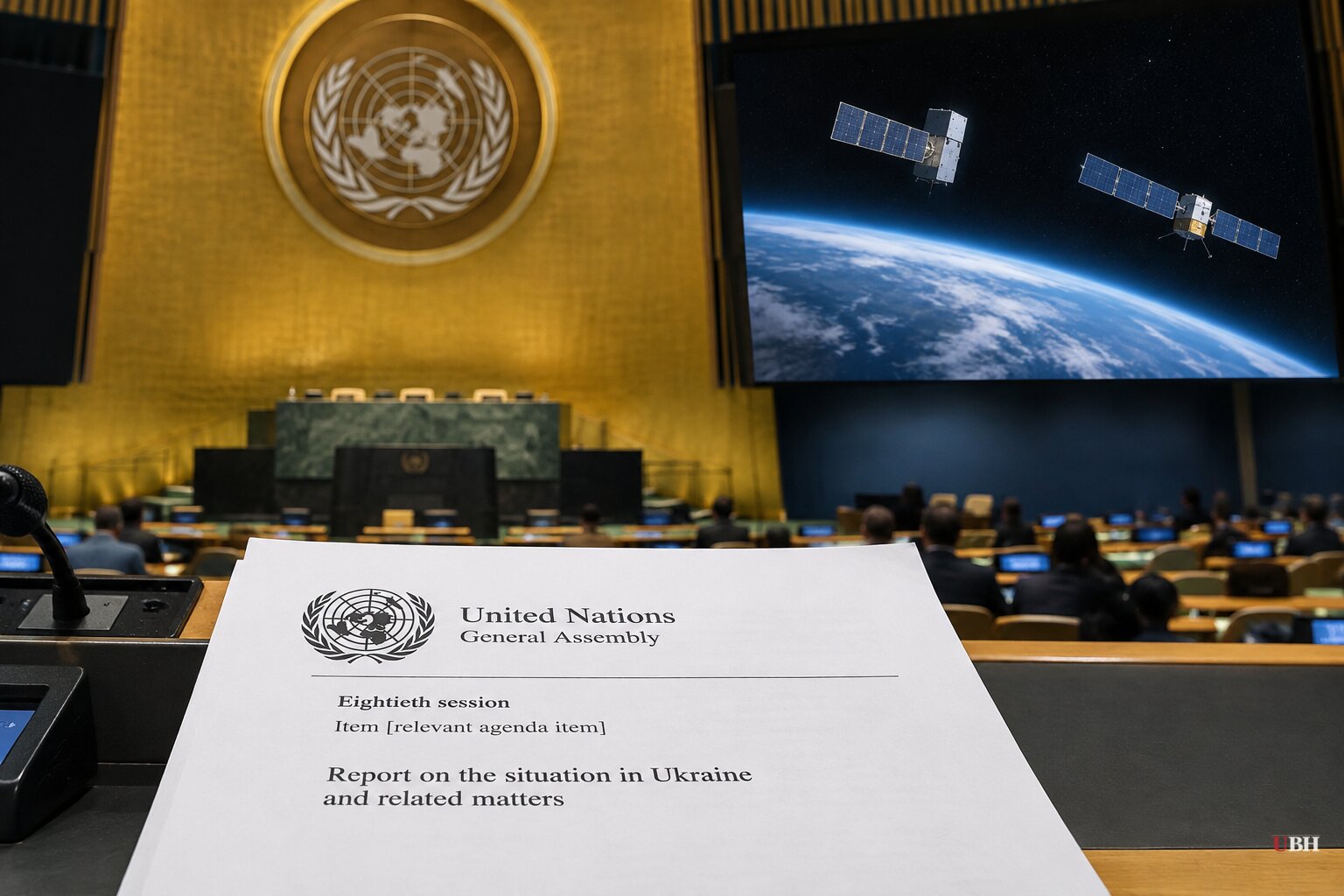
Since the Starshield throttling fight and the refinery-strike feud between Washington and Kyiv took over the Ukraine story this month, the pressure has spread to low Earth orbit. On Oct. 21, the United States accused Russia at the UN of deliberately parking a military satellite next to a commercial one that serves Ukraine.
The Russian satellite is Cosmos 2612. Its target was ICEYE-X36, a radar-imaging satellite registered in the U.S. and operated by the American arm of Finland's ICEYE.
What the trackers saw
Satellite trackers flagged the possible rendezvous on Oct. 12, when Cosmos 2612 moved into ICEYE-X36's orbit roughly 345 miles up. On Oct. 15, it made a fast approach, closing from about 217 miles to under 3 miles by early Oct. 16, according to the orbital-monitoring firm LeoLabs.
It then held position through the weekend of Oct. 17, making what LeoLabs called small adjustments to keep a close relative position.
How close is disputed. LeoLabs estimated roughly 500 meters during part of the event and warned that repeated maneuvers and difficult tracking geometry make exact separation uncertain. Other estimates run closer: about a third of a mile, roughly 200 meters, or a few hundred yards or less, according to Delft University of Technology tracker Marco Langbroek.
Langbroek said he first suspected the shared orbit plane might be coincidence. After weeks of tracking, he concluded the Russian satellite's maneuvers "were clearly designed to bring KOSMOS 2612 close to ICEYE-X36 and synchronise orbital altitude, eccentricity and orbital period."
Astrophysicist Jonathan McDowell said that, to his knowledge, it is the first low Earth orbit rendezvous between two active satellites without one owner's approval. Victoria Samson of the Secure World Foundation told Space.com that Russia has done uncooperative approaches before, but to classified U.S. spy satellites and from much farther away: about 19 miles in January 2020 and about 43 miles in August 2022.
This time the target is a private satellite. ICEYE signed an expanded contract with Ukraine's Defense Ministry in January. A June report from the Royal United Services Institute said four Russian-controlled satellites adjusted their orbits to align with ICEYE-X36 starting in May.
ICEYE said it is "aware of the situation and tracking it closely" and that its constellation is "designed for continuity and resilience." The company did not say whether ICEYE-X36 specifically supports Ukrainian military operations. It operates about 80 satellites in low Earth orbit.
Washington's accusation and Moscow's reply
At the UN General Assembly's First Committee, Brian Hardesty, an adviser to the U.S. delegation to the Conference on Disarmament, said Cosmos 2612 "exhibited threatening behavior by intentionally maneuvering dangerously close to a commercial satellite." He called the decision "deliberately reckless."
Undersecretary of State Thomas DiNanno said the behavior was "consistent with on-orbit weapons operations" and "violates long-established safety thresholds in low Earth orbit." He added: "The United States will continue to secure and defend American vital national security interests in, from, and to space."
Russia rejected it. Kirill Vorontsov, deputy director of the Foreign Ministry's arms control department, called the claims "unfounded and baseless" and "part of a propaganda campaign by Western countries aimed at discrediting Russia's space activities." He said Russia's space activities are peaceful and lawful, according to TASS.
A Russian delegate at the UN, whom OilPrice said it could not immediately identify, did not address the specific allegation. He instead urged member states to respond to "the aggressive military space ambitions of the United States." He pointed to remarks last month by Air Force Secretary Troy Meink, who said the U.S. has deployed "on-orbit space control weapons capable of defending the Joint Force against hostile adversary action."
Some space watchers said Meink only said out loud what was already obvious. Moscow is using his remarks as a counterargument.
Why it lands now
No one has said what Russia wanted. LeoLabs said "the intent remains uncertain" and that the behavior "warrants continued monitoring." It described the maneuvers as consistent with rendezvous and proximity operations, not a routine fly-by.
Clayton Swope of the Center for Strategic and International Studies called it part of a Russian pattern of intimidation that lets Putin "poke the West in the eye and watch the West do nothing." "They prove a point – the West can't stop me," he said at a CSIS panel on Oct. 21.
Greg Gillinger of Integrity ISR, speaking at the same panel, said commercial satellites the U.S. and allies increasingly rely on have "become vulnerabilities that can be exploited by our adversary."
That dependence is already visible on the ground. Ukraine's access to the military-grade Starshield network was throttled in recent weeks, and Zelensky has said service is not fully restored. SpaceX's Elon Musk wrote on X that "any limits on speed or usage are decided by the US military and ultimately POTUS." Trump has denied ordering the slowdown. Secretary of State Marco Rubio and Defense Secretary Pete Hegseth have said the decisions rest with SpaceX under its terms of service.
Sen. Richard Blumenthal (D-CT) has opened an investigation, sending letters to Musk and Hegseth asking who controlled the service and what safeguards exist.
The contrast is awkward for Washington. Commercial constellations carry the imagery and connectivity Ukraine's military depends on. Yet one is exposed to a Russian satellite trailing it, and the other was slowed by a dispute over who gives the orders.
DiNanno has not said what steps the U.S. would take to "defend" commercial assets in orbit. Whether the UN statement leads to any action, or whether Cosmos 2612 moves on to another target, remains an open question.
Sources used for this briefing
7 links from 7 independent newsrooms (syndicated copies of the same report count once)
These are the sources it draws on, linked so you can verify.


